
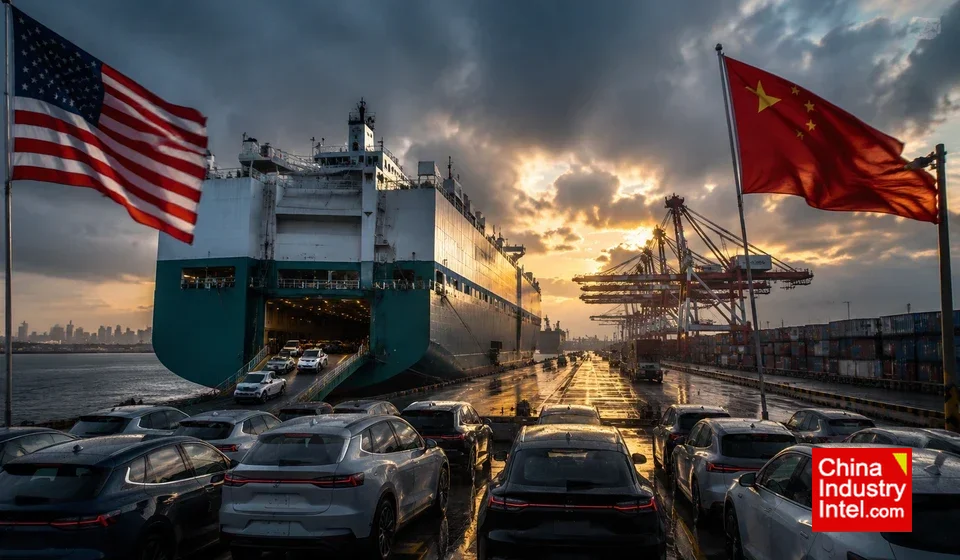
US EV Tariffs Hit 102.5% on Chinese Electric Vehicles as Trade War Escalates
By CII (China Industry Intel) – Contributing Analyst | June 25, 2026
The United States has escalated its trade offensive against Chinese electric vehicles by raising combined tariff rates to a staggering 102.5%, effectively pricing Chinese-made EVs out of the American market and forcing a fundamental restructuring of global automotive supply chains. The latest tariff increase, which builds on multiple rounds of trade actions spanning the Biden and current administrations, represents the most aggressive protectionist measure ever imposed on a single automotive category. For Chinese automakers — from industry giant BYD to premium upstarts NIO and XPeng — the prohibitive tariff wall has accelerated an already urgent push to relocate production outside China and find alternative growth markets beyond North America.
The 102.5% figure represents the cumulative effect of layered trade measures. A baseline 2.5% most-favored-nation tariff on passenger vehicles has been overlaid with a 100% Section 301 tariff specifically targeting Chinese EVs, imposed by the Biden administration in May 2024 and subsequently reaffirmed and expanded. Additional safeguard duties and anti-subsidy countervailing measures have pushed the effective rate beyond the 100% headline figure to the current 102.5% level. For a Chinese EV with a factory-gate price of $25,000, the landed cost in the United States now exceeds $50,000 before distribution, dealer margins, and sales tax — eliminating the price advantage that has driven Chinese EV adoption across Asia, Europe, and Latin America.
From Biden to Trump 2.0: The Escalating Tariff Timeline
The tariff escalation on Chinese EVs has followed a trajectory of progressive tightening over multiple administrations, reflecting a bipartisan consensus in Washington that Chinese automotive imports represent both an economic competitive threat and a national security concern. The timeline underscores how trade policy on this issue has become decoupled from the usual partisan dynamics that characterize other areas of U.S.-China economic relations.
| Date | Action | Effective Tariff Rate | Administration |
|---|---|---|---|
| 2018-2019 | Section 301 tariffs on Chinese autos (25%) imposed during initial trade war | 27.5% | Trump (first term) |
| May 2024 | Biden administration raises Section 301 EV tariff to 100%, citing unfair subsidies and industrial overcapacity | 102.5% | Biden |
| September 2024 | Additional 25% Section 232 national security tariff on connected vehicles proposed; software and hardware restrictions on Chinese-connected car technology | 102.5% (plus proposed additions) | Biden |
| January 2025 | Commerce Department finalizes rule banning Chinese and Russian connected vehicle software and hardware from US roads (effective 2027-2029 model years) | 102.5% + de facto software/hardware ban | Biden |
| 2025-2026 | Current administration maintains and reinforces all existing tariff measures; signals potential escalation to address transshipment through third countries | 102.5% + enforcement expansion | Current |
Sources: USTR Federal Register notices 2018-2026; White House fact sheets on Section 301 EV tariffs (May 2024); Commerce Department ANS 2025 rulemaking on connected vehicle supply chains; Congressional Research Service reports on US-China automotive trade.
BYD, Geely, and NIO: Divergent Strategies for a Divided World
The 102.5% tariff wall has forced China’s leading EV exporters to pursue fundamentally different strategies depending on their product positioning, brand ambitions, and existing international footprint. While the United States market — once seen as an eventual target for global expansion — is now effectively closed, the strategies developed in response to the tariff shock are reshaping the global automotive landscape beyond American shores.
BYD, the world’s largest EV manufacturer by volume with over 4 million vehicle sales in 2025, has taken the most aggressive approach to tariff circumvention through overseas manufacturing. The company has accelerated construction of factories in Hungary (serving the European market), Thailand (serving Southeast Asia), Brazil (serving Latin America), and Uzbekistan (serving Central Asia). Most critically for the North American strategy, BYD has been exploring a manufacturing facility in Mexico, with site selection reportedly narrowed to locations in Nuevo Leon and Sonora states. A Mexican factory would allow BYD to export to the United States under USMCA rules of origin provisions — provided the vehicle meets the agreement’s regional value content thresholds — though U.S. trade officials have signaled they will scrutinize any such arrangement for transshipment or circumvention of the EV tariffs. BYD’s Mexico plant, if it proceeds, would represent a direct challenge to the tariff wall and potentially open a new front in U.S.-China trade conflict.
Geely, whose portfolio spans Volvo Cars, Polestar, Zeekr, and Lynk & Co alongside its namesake brand, has leveraged its existing European manufacturing footprint to partially insulate itself from U.S. tariffs. Volvo and Polestar vehicles assembled in Sweden, Belgium, and the United States (Volvo’s South Carolina plant) face only the baseline 2.5% tariff rather than the 100% Section 301 surcharge. However, Geely’s Chinese-manufactured brands — particularly Zeekr, which had targeted a U.S. launch by 2027 — are fully exposed to the punitive tariff regime. Geely has responded by accelerating Zeekr’s European expansion and exploring contract manufacturing arrangements in South Korea and India rather than pursuing a direct U.S. retail presence. The company’s strategic calculus appears to be that the U.S. market, while highly profitable for premium brands, is not worth the investment required to achieve tariff-exempt local production given the company’s strong growth trajectory in Europe, Southeast Asia, and the Middle East.
NIO, which has positioned itself as a premium EV brand with battery-swapping technology as a key differentiator, faces perhaps the most difficult strategic adjustment. NIO’s brand premium and technology story — including its NIO Power battery-swap network with over 2,500 stations globally — are difficult to replicate in a tariff-circumvention manufacturing arrangement. The company had previously signaled interest in the U.S. market as part of its long-term global brand ambitions but has now officially shelved any U.S. entry plans through 2028. NIO has instead doubled down on Europe, where it already operates in Norway, Germany, the Netherlands, Sweden, and Denmark, and has expanded aggressively into the Middle East through a strategic partnership with Abu Dhabi’s CYVN Holdings. The company is also exploring right-hand-drive variants for potential entry into the UK, Australia, and Southeast Asian markets.
XPeng and Li Auto have similarly pivoted away from North America. XPeng, which derives a significant portion of its revenue from advanced driver-assistance technology licensing, has focused on European and Middle Eastern markets for vehicle sales while developing its technology licensing model as a parallel revenue stream that is not affected by vehicle tariffs. Li Auto, whose extended-range electric vehicles (EREVs) target the family SUV segment that is the most popular category in the U.S. market, has determined that the investment required for tariff-exempt U.S. manufacturing is not justified by the prospective returns given the company’s dominant position in China’s domestic premium SUV market.
The EU Follows Suit: Anti-Subsidy Duties and the Fragmentation of Global EV Markets
The European Union, which has taken a more measured approach than the United States but has been steadily tightening its own trade defenses, represents a potentially more consequential battleground for Chinese automakers. While the EU has not imposed the kind of prohibitive tariffs seen in the United States, its anti-subsidy investigation into Chinese EVs has resulted in provisional duties that, while lower than the U.S. rates, nonetheless reshape the competitive dynamics of what was Chinese automakers’ most important export market.
The European Commission’s anti-subsidy investigation, launched in October 2023, concluded that Chinese EV manufacturers benefit from subsidies that distort competition and harm European industry. The investigation resulted in countervailing duties calibrated to each manufacturer’s estimated subsidy benefit: BYD faces an additional 17.0% duty, Geely 18.8%, and SAIC — which was deemed to have cooperated less fully with the investigation — the highest rate at 35.3%. Other cooperating manufacturers face a 20.7% weighted average duty, while non-cooperating companies face the full 35.3% rate. These duties are applied on top of the EU’s existing 10% MFN tariff on passenger vehicles, bringing total tariffs on Chinese EVs in Europe to between 27% and 45.3% depending on the manufacturer.
The impact has been immediate and significant. Chinese EV exports to the EU, which surged from virtually zero in 2019 to over 500,000 units in 2024, have declined by approximately 35% in the first half of 2026 as the duties bite. Chinese manufacturers’ share of the European EV market, which peaked at approximately 11% in late 2024, has fallen to roughly 7%. The decline has been partially offset by increased sales of Chinese-brand EVs manufactured in European factories — BYD’s Hungary plant is ramping production, and Geely’s Volvo and Polestar operations are expanding — but these volumes remain small relative to the size of the European market.
The EU’s actions have created a three-tier global EV market structure. The first tier — the United States and Canada — is effectively closed to Chinese EV imports through prohibitive tariffs and software/hardware bans. The second tier — the European Union and United Kingdom — imposes significant but not prohibitive duties that make Chinese EVs competitive only in mid-to-premium segments where their price advantage is less decisive. The third tier — much of Asia, Latin America, the Middle East, and Africa — remains largely open, and it is in these markets that Chinese EV exports continue to grow rapidly, with BYD alone on track to export over 800,000 vehicles to these regions in 2026.
SEA and Mexico: The Tariff Circumvention Playbook
The most significant structural response to the tariff escalation has been the rapid build-out of Chinese EV manufacturing capacity in Southeast Asia and Mexico — two regions that offer the combination of competitive production costs, established automotive supply chains, and preferential access to key markets that Chinese automakers require.
Southeast Asia has emerged as the primary production hub for Chinese EVs destined for right-hand-drive markets and the broader Asia-Pacific region. Thailand, with its well-developed automotive supply chain (the country is known as the “Detroit of Asia” for its concentration of Japanese-brand vehicle manufacturing), has been the biggest beneficiary. BYD, Great Wall Motor, SAIC, and Changan have all established or announced manufacturing facilities in Thailand’s Eastern Economic Corridor, attracted by government incentives including zero import duties on battery EVs through 2025, reduced excise taxes, and corporate income tax holidays. BYD’s Rayong plant, which began operations in 2024, now produces over 150,000 vehicles annually for the Thai domestic market and export to ASEAN countries, Australia, and New Zealand.
Indonesia, leveraging its nickel reserves (the country is the world’s largest nickel producer and a critical link in the EV battery supply chain), has attracted major Chinese investments across the full EV value chain. CATL has partnered with Indonesia Battery Corporation on a $6 billion integrated nickel mining-to-battery manufacturing project, while BYD and Wuling (SAIC-GM-Wuling) have established vehicle assembly operations. Indonesia’s strategy of leveraging its raw material endowment to attract downstream manufacturing investment mirrors China’s own development playbook and has made the country the second-largest EV production base in Southeast Asia after Thailand.
Mexico represents both the most promising and most strategically fraught avenue for Chinese automakers seeking access to the North American market. Under the USMCA trade agreement, vehicles manufactured in Mexico with sufficient regional value content can enter the United States and Canada duty-free. The prospect of Chinese automakers using Mexico as a production platform to circumvent U.S. tariffs has triggered intense debate in Washington, with lawmakers from both parties proposing legislation to close what they describe as a “tariff loophole.” The Biden administration’s May 2024 tariff announcement specifically flagged transshipment through third countries as an area of concern, and the U.S. Trade Representative has initiated consultations with Mexico on rules of origin enforcement for vehicles containing Chinese components.
Despite these headwinds, Chinese investment in Mexican automotive manufacturing continues. MG Motor (SAIC) has announced plans for a $1.5 billion EV factory in Mexico, while BYD’s previously mentioned site search in northern Mexico continues. Chinese auto parts manufacturers, including battery makers CATL and Gotion High-Tech, are also establishing Mexican operations to supply the broader North American automotive supply chain. Whether these investments ultimately translate into meaningful Chinese-brand vehicle sales in the United States depends on the evolving trade policy environment, but they have already transformed Mexico into a significant node in the global Chinese automotive production network.
Implications for the Global Automotive Industry
The 102.5% U.S. tariff on Chinese EVs is accelerating the fragmentation of a global automotive industry that had spent the previous three decades integrating across borders. The bifurcation of the industry into Chinese-supplied and Western-supplied spheres — with some overlap in neutral markets — has implications that extend far beyond the EV segment to encompass the entire automotive value chain.
For Western legacy automakers — Ford, General Motors, Stellantis, Volkswagen, Toyota, and others — the tariff wall provides a temporary competitive shield in the U.S. market but does nothing to address the fundamental challenge of Chinese EVs, which is competition in the global markets that account for the majority of automotive sales. Chinese EVs continue to gain share in Europe (despite EU duties), Southeast Asia, Latin America, and the Middle East, and Western automakers’ retreat from the Chinese domestic market — where their market share has fallen from over 60% in 2018 to below 35% in 2025 — means they are losing ground in the world’s largest automotive market even as they are protected in North America.
For consumers, particularly American consumers, the tariff wall means higher prices and fewer choices. The cheapest EVs available in the United States — models like the Chevrolet Bolt and Nissan Leaf — start at approximately $28,000-$30,000, while Chinese EVs with comparable or better specifications sell for the equivalent of $12,000-$20,000 in markets without punitive tariffs. The absence of this competitive pressure means American EV adoption may proceed more slowly than it otherwise would, with implications for the pace of transportation decarbonization in the world’s second-largest automotive market.
For the global climate transition, the tariff escalation creates a tension between industrial policy objectives and environmental goals. Chinese EVs’ affordability and availability have been key drivers of EV adoption in developing economies across Southeast Asia, Africa, and Latin America, where Western automakers have shown limited interest in offering affordable electric options. Restricting the flow of affordable Chinese EVs — whether through U.S. tariffs, EU anti-subsidy duties, or other trade barriers — risks slowing the global transition to electric transportation at precisely the moment when acceleration is needed to meet Paris Agreement targets.
Sources
- Caixin — US Raises Tariffs on Chinese Electric Vehicles to 102.5% Final Rate (2026)
- Office of the U.S. Trade Representative — Section 301 Investigation of China’s Acts, Policies, and Practices Related to EVs (May 2024)
- European Commission — Anti-Subsidy Investigation into Battery Electric Vehicles from China: Definitive Findings and Countervailing Duties (2024-2025)
- U.S. Department of Commerce Bureau of Industry and Security — Connected Vehicle Supply Chain Rule (January 2025)
- Reuters — BYD Narrows Mexico Plant Site Search as U.S. Tariff Pressure Mounts (2026)
- Nikkei Asia — Thailand Becomes Chinese EV Export Hub as Automakers Build ASEAN Production Base (2026)
- Rhodium Group — Chinese EV Exports in the Age of Trade Barriers: 2026 Assessment
- International Energy Agency — Global EV Outlook 2026: Trade Tensions and the Electric Vehicle Transition