Zhipu AI Stock Surges Nearly 3x After IPO as Half of Employees Become Multi-Millionaires
By CII (China Industry Intel) – Contributing Analyst | June 24, 2026
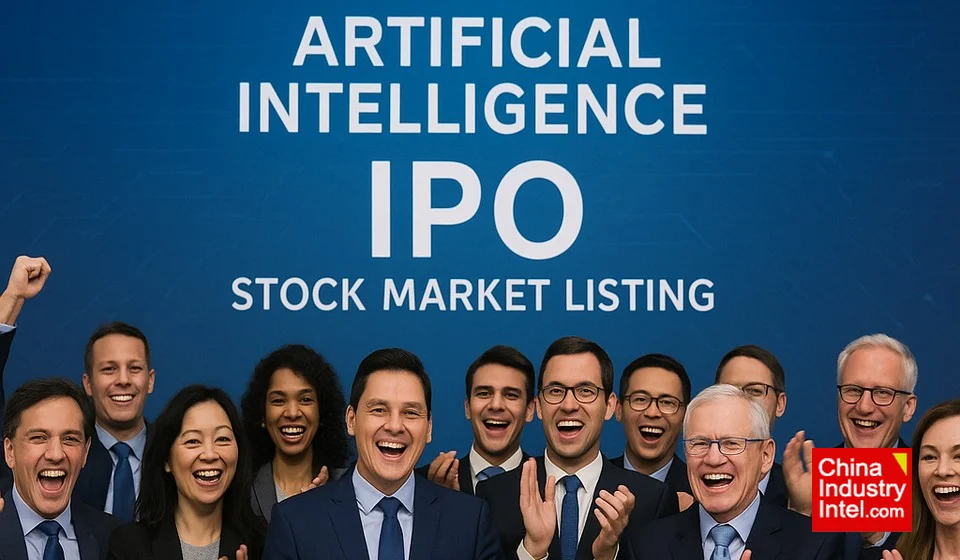
Zhipu AI, the Beijing-based artificial intelligence company that has positioned itself as China’s answer to OpenAI, has delivered one of the most spectacular IPO performances in recent technology history. Since listing on the Hong Kong Stock Exchange on January 8, 2026, Zhipu’s stock price has surged nearly 300% — from its IPO price of approximately HK$51 to over HK$150 per share as of mid-June 2026. The company’s market capitalization has swelled to HK$57.9 billion (approximately $7.4 billion), making it one of the most valuable AI pure-play stocks in the world and the first major large language model (LLM) company to go public globally. The extraordinary stock performance has created staggering wealth for employees: according to multiple reports, roughly half of Zhipu’s approximately 3,000 employees — around 1,500 people — have become multi-millionaires (in Hong Kong dollar terms) through their equity holdings, a wealth creation event that rivals the early days of Alibaba and Tencent.
The Zhipu IPO and subsequent stock surge represent a landmark moment for China’s artificial intelligence industry. Dubbed the “world’s first big model IPO” (全球大模型第一股) by Chinese state media, Zhipu’s public listing has validated the commercial potential of foundational AI models while also demonstrating the intense investor appetite for exposure to China’s AI ecosystem. The company, founded in 2019 by a team of researchers from Tsinghua University led by CEO Zhang Peng, has rapidly emerged as one of China’s “AI Tigers” — alongside Baichuan, MiniMax, Moonshot AI, and Stepfun — developing large language models that compete with OpenAI’s GPT series and Google’s Gemini. Zhipu’s flagship ChatGLM product, now in its fourth generation, is widely considered one of the most capable Chinese-language AI models and has been deployed across enterprise, government, and consumer applications.
IPO Structure and Shareholder Windfall: Lei Jun, Xu Xin, and the Early Backers
The Zhipu IPO has generated extraordinary returns for a constellation of prominent early investors who backed the company when it was still an academic research project at Tsinghua University. The most notable individual investor is Lei Jun, the billionaire founder and CEO of Xiaomi, who invested in Zhipu through his personal investment vehicle and Xiaomi Ventures during the company’s Series A and B rounds in 2020-2021. Lei Jun’s investment, reportedly totaling approximately $50 million across multiple rounds, is now valued at over $300 million based on current market prices — a roughly six-fold return in five years. Lei Jun’s involvement with Zhipu reflects Xiaomi’s broader AI ambitions, as the smartphone and IoT giant integrates large language models into its products, including the XiaoAI voice assistant and Xiaomi EVs.
Xu Xin, the legendary venture capitalist known as China’s “Queen of VC” and the founder of Capital Today, was another early backer whose prescient bet on Zhipu has delivered outsized returns. Capital Today led Zhipu’s Series B round in 2021 at a valuation of approximately $1.2 billion, and Xu Xin personally championed the company as one of the most important technology investments of her career. At current market prices, Capital Today’s Zhipu stake is worth an estimated $500-600 million, representing a return of approximately 5-6x on the firm’s investment. Xu Xin, known for early bets on JD.com, Meituan, and Yum China, has described AI foundational models as “the single most important technological shift” she has witnessed in her three-decade investment career.
| Investor | Investment Vehicle | Round / Year | Est. Investment (USD) | Est. Current Value (USD) | Est. Return |
|---|---|---|---|---|---|
| Lei Jun | Personal / Xiaomi Ventures | Series A-B (2020-2021) | ~$50 million | ~$300 million | ~6x |
| Xu Xin / Capital Today | Capital Today Fund | Series B (2021) | ~$100 million | ~$550 million | ~5.5x |
| Sequoia China (HongShan) | HongShan Capital | Series B-C (2021-2022) | ~$150 million | ~$700 million | ~4.7x |
| Qiming Venture Partners | Qiming Fund VII | Series C (2022) | ~$80 million | ~$320 million | ~4x |
| Alibaba Group | Alibaba / Ant Group | Series C-D (2022-2024) | ~$200 million | ~$550 million | ~2.75x |
| Tencent Holdings | Tencent Investment | Series D (2024) | ~$100 million | ~$200 million | ~2x |
| Silicon Valley Bank JV (SSVB) | SSVB Capital | Series B-C (2021-2022) | ~$30 million | ~$120 million | ~4x |
Sources: CNBC, The Paper, STCN, HKEX filings, CB Insights, PitchBook. Investment amounts and current values are estimates based on publicly reported funding rounds, regulatory filings, and current market capitalization. Actual returns may differ based on share class conversion terms, dilution, and lock-up periods.
Employee Wealth Creation: An Estimated 1,500 Multi-Millionaires
Perhaps the most striking aspect of the Zhipu IPO story is the wealth created for the company’s rank-and-file employees. Zhipu, like many Chinese technology companies, issued equity (in the form of restricted stock units and stock options) broadly across its workforce as a retention and incentive mechanism during its rapid growth phase. The company’s headcount expanded from approximately 500 in early 2023 to over 3,000 by the time of its IPO in January 2026, with employees across engineering, research, product, and business functions receiving equity grants.
Based on the current share price of approximately HK$150, reports from STCN and The Paper estimate that roughly half of Zhipu’s 3,000 employees — or approximately 1,500 individuals — hold equity stakes worth at least HK$7.8 million (approximately $1 million). This includes not only senior executives and research scientists but also mid-level engineers, product managers, and operations staff who joined the company between 2021 and 2024. The wealth effect has been particularly dramatic for the company’s earliest employees, some of whom hold stakes worth HK$50-100 million or more. The concentration of AI talent wealth in Beijing’s Haidian district, where Zhipu is headquartered, has reportedly driven up local real estate prices and sparked a wave of startup formation as newly wealthy AI engineers seed their own ventures.
The employee wealth creation at Zhipu mirrors the legendary IPO windfalls of China’s earlier tech generations — Alibaba’s 2014 NYSE listing created thousands of millionaires among its employees, as did Tencent’s rise, Meituan’s 2018 IPO, and Kuaishou’s 2021 Hong Kong listing. However, Zhipu’s wealth creation is notable for occurring entirely within the AI sector, underscoring the premium that public markets are placing on artificial intelligence talent and technology. It also reinforces the fierce competition for AI talent in China, where companies like Zhipu, MiniMax, Baichuan, and ByteDance’s Doubao division are offering increasingly generous equity packages to attract and retain the country’s limited pool of experienced machine learning researchers and engineers.
Wall Street Raises Its Bets on China AI
The Zhipu stock surge is not occurring in isolation. According to a June 15, 2026 CNBC report, Wall Street is broadly raising its bets on China’s artificial intelligence sector, with analysts at major investment banks issuing bullish research notes on the investability of Chinese AI companies. The CNBC report highlighted that Zhipu’s shares surged 33% in a single week as institutions increased their positions, alongside positive analyst coverage of rival Chinese AI firms including MiniMax and Moonshot AI, both of which are reportedly preparing their own IPOs in Hong Kong or New York.
Several factors are driving Wall Street’s growing enthusiasm for China AI. First, the technology gap between Chinese and American AI models has narrowed substantially over the past 18 months, with models like Zhipu’s ChatGLM-4, MiniMax’s MiniMax-2, and DeepSeek’s V3 demonstrating capabilities that rival or match GPT-4 in many benchmarks, particularly in Chinese-language tasks. Second, China’s AI market is enormous and growing rapidly — McKinsey estimates that generative AI could add $2-3 trillion in annual economic value to China’s economy by 2035. Third, Chinese AI companies have demonstrated faster commercialization paths than their US counterparts, with enterprise AI adoption in China’s manufacturing, finance, and healthcare sectors proceeding at a rapid pace. Fourth, US export controls on advanced AI chips, while constraining Chinese AI development at the cutting edge, have inadvertently strengthened the domestic Chinese AI chip ecosystem and forced Chinese AI companies to develop more computationally efficient models that are cheaper to deploy.
The Competitive Landscape: China’s AI Tigers
Zhipu operates in an intensely competitive Chinese AI market that has produced a cohort of well-funded, technically ambitious companies collectively known as the “AI Tigers.” Each of these firms has raised hundreds of millions or billions of dollars and is racing to commercialize foundational AI models across enterprise, consumer, and government markets.
| Company | Founded | Headquarters | Flagship Model | Funding Raised (Est.) | 2026 Status |
|---|---|---|---|---|---|
| Zhipu AI | 2019 | Beijing | ChatGLM-4 | $2 billion+ | Public (HKEX), HK$57.9B market cap |
| MiniMax | 2021 | Shanghai | MiniMax-2 | $850 million+ | Pre-IPO, reportedly filing for HKEX |
| Moonshot AI | 2023 | Beijing | Kimi | $1 billion+ | Private, $3B valuation (2025) |
| Baichuan AI | 2023 | Beijing | Baichuan 4 | $700 million+ | Private, $2B valuation (2025) |
| DeepSeek | 2023 | Hangzhou | DeepSeek-V3 | $500 million+ (est.) | Private, backed by High-Flyer quant fund |
| Stepfun (StepStar) | 2023 | Shanghai | Step-2 | $600 million+ | Private, expanding enterprise offerings |
Sources: CNBC, STCN, The Paper, CB Insights, PitchBook, publicly reported funding rounds. Funding estimates include disclosed rounds only; actual totals may be higher. Market capitalization and valuations reflect publicly available data as of June 2026.
The AI Tiger pack is increasingly differentiated by strategy. Zhipu, with its Tsinghua University heritage and deep research capabilities, has emphasized enterprise and government AI adoption, positioning ChatGLM as a trusted platform for sensitive applications in finance, energy, and public services. MiniMax has adopted a more consumer-focused approach, building AI companion and entertainment applications that have attracted hundreds of millions of users. Moonshot AI’s Kimi has become one of the most popular AI assistants among Chinese young people, with a distinctive product-led growth strategy. As these companies move toward public markets, Zhipu’s successful IPO provides a powerful benchmark that is likely to accelerate the listing timelines for the entire cohort.
Future Outlook: The Path to Profitability and Global Ambitions
Despite the euphoria surrounding Zhipu’s stock surge, significant questions remain about the company’s path to sustainable profitability. Like most foundational model companies globally, Zhipu is investing heavily in research and development, with R&D expenses exceeding $500 million annually. The company’s enterprise API business, which charges developers for access to its models, is growing rapidly but remains a fraction of the revenue needed to offset these costs. Zhipu’s financial disclosures show that the company generated approximately $180 million in revenue in fiscal 2025, implying a price-to-sales ratio of approximately 40x — a multiple that reflects the market’s expectation of exponential growth rather than current financial fundamentals.
The company’s management, led by CEO Zhang Peng, has articulated a three-pronged strategy for achieving profitability: first, expanding enterprise AI adoption through industry-specific model fine-tuning and deployment services; second, building a consumer AI ecosystem through the ChatGLM app and partnerships with smartphone manufacturers; and third, monetizing Zhipu’s technology through licensing arrangements with international companies seeking AI capabilities for non-Chinese markets. The international expansion angle is particularly sensitive given US-China technology tensions, but Zhipu has indicated it may pursue markets in Southeast Asia, the Middle East, and Africa where geopolitical constraints are less acute.
What is already clear is that Zhipu’s IPO has fundamentally changed the narrative around Chinese AI companies. From being viewed primarily as technology followers constrained by US chip sanctions, Chinese AI firms are increasingly seen as globally competitive, commercially viable, and investable at scale. The 1,500 new multi-millionaires created by Zhipu’s stock surge are not just a wealth statistic — they represent the emergence of a new generation of AI-native entrepreneurs and investors who will likely seed the next wave of Chinese technology innovation. As Wall Street continues to raise its bets on China AI, the Zhipu IPO may ultimately be remembered as the moment when China’s artificial intelligence industry arrived as a force in global capital markets.
Sources
- CNBC — Zhipu surges 33% as Wall Street raises bets on China AI amid Washington tensions (June 15, 2026)
- STCN (Securities Times) — Market Cap Reaches HK$57.9 Billion: Zhipu, World’s First Big Model IPO, Lists in Hong Kong (市值579亿港元!全球大模型第一股智谱上市) (2026)
- The Paper — Zhipu Stock Surges Nearly 3x After IPO (智谱暴涨) (2026)
- LinkedIn / Industry Analysis — Zhipu AI IPO: January 8, 2026
- Hong Kong Stock Exchange (HKEX) — Zhipu AI Listing Information and Filings
- Reuters — China AI startup Zhipu shares surge in Hong Kong trading debut (2026)
- Bloomberg — China AI Stocks Rally as Wall Street Raises Bets on Zhipu and MiniMax (June 2026)
- China Money Network — Zhipu AI’s Hong Kong IPO Creates 1,500 Employee Multi-Millionaires (2026)
- McKinsey & Company — The Economic Potential of Generative AI in China
- CB Insights — China’s AI Tigers: Zhipu, MiniMax, Moonshot, and the Future of Chinese Foundational Models