US Tells ASML It’s Concerned China May Have Top Chip Tool
The US has raised concerns with Dutch lithography giant ASML that China may have obtained a high-end EUV lithography machine, in what would be a serious breach of export controls.
By CII (China Industry Intel) — Contributing Analyst | June 24, 2026
The US government has told ASML Holding NV that it’s concerned China may have obtained one of the company’s most advanced chipmaking tools, according to people familiar with the matter — a development that, if confirmed, would represent the most serious breach of export controls since the US-led campaign to restrict China’s semiconductor ambitions began.
Washington conveyed its concerns to the Dutch company in recent weeks, the people said, asking not to be identified discussing confidential diplomatic exchanges. The tool in question is an extreme ultraviolet (EUV) lithography machine — the only equipment capable of etching circuitry for the most advanced chips used in AI accelerators and cutting-edge processors. ASML has never legally sold an EUV machine to a Chinese buyer under Dutch export license rules tightened beginning in 2019.
The Machine That Matters
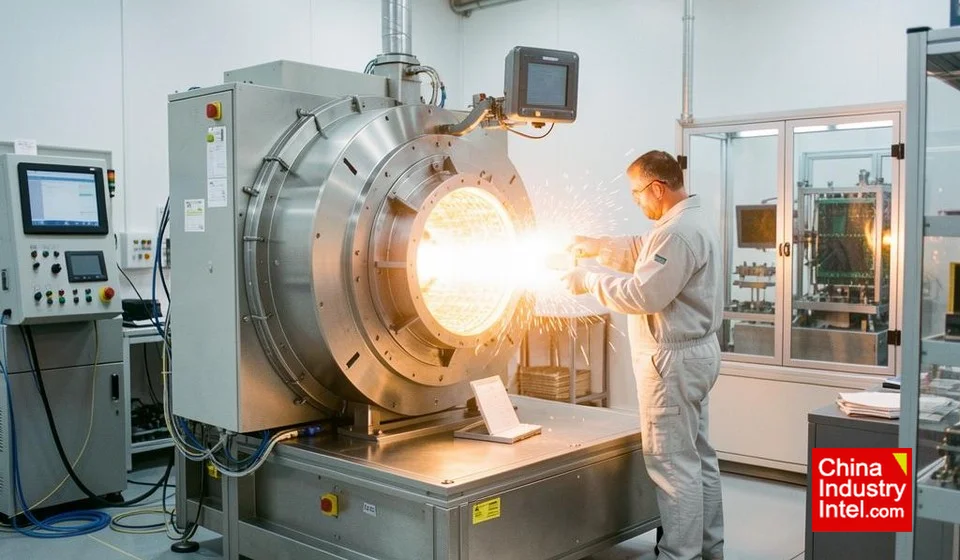
ASML’s EUV lithography systems cost upwards of $200 million each and are the result of decades of R&D by a global supply chain no single company — let alone country — has replicated. The machines, roughly the size of a city bus, use extreme ultraviolet light with a 13.5 nanometer wavelength to print circuitry down to 3nm and below. Every advanced chip from NVIDIA, Apple, AMD, Qualcomm, and Huawei’s latest Kirin processors depends on EUV lithography.
China currently operates ASML’s older deep ultraviolet (DUV) systems for production at 28nm and above, and in some cases down to 7nm through multi-patterning techniques used by SMIC. But the EUV gap has been the single most effective choke point in the US export control regime. If China has obtained an EUV machine — through diversion, transshipment, or a sanctioned intermediary — that gap effectively closes.
| Machine Type | Node Range | China Access | Unit Cost |
|---|---|---|---|
| EUV (NXE:3800E) | 3nm–7nm | Restricted | ~$220M |
| DUV (TWINSCAN NXT:2050i) | 7nm–38nm | Restricted since 2023 | ~$65M |
| DUV (Older models) | 28nm+ | Licensed | ~$35M |
How China Could Have Gotten One
If true, the breach would likely involve a diverted machine originally sold to a non-Chinese customer that was then transferred into Chinese territory. ASML machines contain trackable components and remote diagnostics, making unauthorized movement theoretically detectable — but not impossible for a determined buyer with help from intermediaries.
A second possibility: China obtained an EUV machine through a defunct or sanctioned foundry in another country that was acquired by a Chinese entity. Taiwan, South Korea, and the United States all have active EUV installations. Any security lapse at a contract fab with Chinese investment ties could serve as a vector.
A third theory — the one most discussed in semiconductor analyst circles — is that China didn’t obtain a complete ASML EUV machine at all, but reverse-engineered enough from publicly available information and smuggled components to build a functional prototype. Huawei and SMIC have both demonstrated surprising progress in domestic lithography, with Huawei’s 2025-2026 patent filings showing increasing sophistication in EUV-related mirror and light-source technologies.
What a Confirmed Breach Means
The US response would set the tone for the next phase of the technology conflict. Washington has already tightened restrictions on ASML’s older DUV systems, broadened foreign direct product rules, and pressured the Netherlands, Japan, and South Korea to align export controls. A confirmed EUV breach would likely trigger:
- Tighter Dutch export licenses — ASML may face new monitoring requirements with severe penalties for diversions.
- Expanded entity lists — New Chinese companies and intermediaries added to the US Entity List, potentially including logistics and shell firms.
- Unilateral US action — Washington could apply extraterritorial controls on ASML machines containing US-origin components, which many do.
- Retaliatory Chinese export restrictions — Beijing could tighten gallium, germanium, and antimony export controls in response.
For ASML, the stakes are existential. The company generates roughly 49% of its revenue from China in recent quarters — mostly DUV systems for mature-node production — and any escalation could cut off that market. ASML shares fell 3.2% on the report, according to Bloomberg data.
The Numbers Behind the Controls
China’s semiconductor self-sufficiency rate stands at roughly 23% in 2026, up from 16% in 2020, according to data from the Semiconductor Industry Association. But that figure masks a wide gap: China produces 90%+ of its mature-node chips (28nm and above) internally, while advanced-node chips (7nm and below) remain overwhelmingly imported.
| Metric | 2020 | 2024 | 2026 Est. |
|---|---|---|---|
| China chip self-sufficiency | 16% | 21% | 23% |
| EUV machines in China (official) | 0 | 0 | 0 |
| Domestic DUV installs | ~80 | ~200 | ~350 |
| China IC import bill | $350B | $380B | $395B |
Paul Triolo, partner at DGA-Albright Stonebridge Group, wrote in a June analysis that “2026 is a pivotal year for China’s semiconductor industry, not because it will achieve EUV parity, but because the cumulative effect of years of investment in domestic alternatives will begin to show.” An EUV breach would accelerate that timeline significantly.
CII Analysis
An EUV breach — if confirmed — would be the semiconductor equivalent of a nuclear non-proliferation failure. The US-led export control regime’s entire architecture assumes China cannot access EUV lithography. That assumption, if wrong, invalidates the single most effective constraint on China’s advanced chip production.
But here’s what gives us pause: ASML machines send telemetry data. They require regular service visits. They need consumable parts that only ASML supplies. Operating a diverted EUV machine without detection would require extraordinary operational security that no Chinese entity has demonstrated to date. It’s possible the US concern is based on intelligence about an attempted — not successful — transfer.
That said, China’s progress on domestic EUV alternatives should not be underestimated. Huawei’s patent filings from 2025-2026 show accelerating activity in laser-produced plasma sources, multilayer mirrors, and vacuum stages — all core EUV subsystems. China may not need to smuggle an ASML machine. It just needs more time.
Follow CII’s semiconductor coverage on LinkedIn for daily chip war updates.
Sources
- Bloomberg — US Tells ASML It’s Concerned China May Have Top Chip Tool
- Semiconductor Industry Association — State of the Industry Report
- DW — China’s Chip Ambitions Shake Up Global Tech Industry
- New York Times — How China Built a Chip Industry
- Oplexa — US-China Chip War 2026