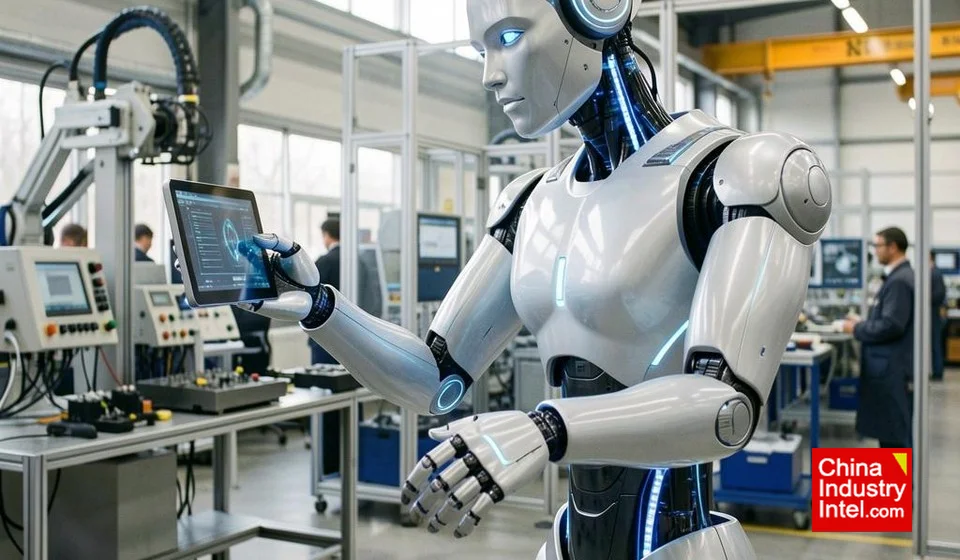
Countries Grapple With China’s Expanding Robotics Dominance
By CII (China Industry Intel) — Contributing Analyst | June 24, 2026
Countries from the United States to Germany to Japan are grappling with an uncomfortable reality: China has not only caught up in robotics — it is pulling ahead, and the gap is widening. Chinese companies installed more industrial robots in 2025 than the rest of the world combined, and the country’s push into humanoid robotics is drawing comparisons to the early days of the smartphone race.
At ICRA 2026 — the IEEE International Conference on Robotics and Automation held in Philadelphia in May — Chinese research institutions and companies presented more papers and demonstrations than any other country. Six of the top 10 humanoid robot prototypes shown at the conference were developed by Chinese teams, according to conference records.
The Scale of China’s Robotics Lead
China has been the world’s largest industrial robot market since 2013, but the lead has accelerated sharply since 2023. The International Federation of Robotics (IFR) reported that China installed 328,000 industrial robots in 2025, up from 290,000 in 2024. Japan, the second-largest market, installed just 58,000.
| Country | 2023 Installations | 2024 Installations | 2025 Installations | Global Share |
|---|---|---|---|---|
| China | 276,000 | 290,000 | 328,000 | 54% |
| Japan | 52,000 | 55,000 | 58,000 | 9.5% |
| United States | 41,000 | 44,000 | 48,000 | 7.9% |
| South Korea | 33,000 | 35,000 | 36,000 | 5.9% |
| Germany | 28,000 | 30,000 | 31,000 | 5.1% |
The Humanoid Frontier
The more significant shift is in humanoid robotics — machines designed to work alongside humans in factories, warehouses, and eventually homes. China has made this a national priority, with the Ministry of Industry and Information Technology (MIIT) issuing a target in 2024: mass-produce humanoid robots by 2027 and achieve “a globally competitive humanoid robotics industry” by 2030.
Beijing announced a ¥100 billion ($13.8 billion) fund for strategic technologies including robotics in early 2026, as reported by The Guardian in March. Local governments in Shanghai, Shenzhen, and Beijing have added matching funds, creating what analysts estimate is a ¥150-200 billion state-backed robotics ecosystem.
Leading Chinese humanoid robot companies include:
- Unitree Robotics — The Hangzhou-based company debuted its H1 humanoid in 2024, capable of walking, running, and jumping at 3.3 m/s. The H2 model, launched in early 2026, adds bimanual manipulation and is priced at ¥90,000 ($12,400) — roughly one-tenth the cost of comparable US humanoids.
- Robot Era — Its L7 humanoid, shown at CES 2026, can navigate uneven terrain, climb stairs, and carry 20kg payloads. The company has partnered with multiple EV factories for pilot testing.
- UBTECH Robotics — The Shenzhen listed company’s Walker S humanoid has been deployed in manufacturing lines at NIO and BYD factories for material handling.
- Xiaomi’s CyberOne — The electronics giant’s humanoid platform is being integrated into smart manufacturing systems within Xiaomi’s smartphone and EV factories.

Why China Has an Advantage
China’s robotics lead stems from three structural factors that competitors cannot easily replicate:
Supply chain completeness. China produces 70%+ of the world’s servo motors, 60% of reducers, and 80% of the lithium batteries used in robots. A Chinese humanoid robot company can source every component domestically. A US or European competitor must import key components from multiple countries.
Scale of deployment. With 328,000 industrial robots installed annually, Chinese manufacturers accumulate operating data 6-10x faster than their US or Japanese counterparts. That data feeds iterative improvement cycles in AI training, motion control, and reliability engineering — creating a compounding advantage.
Government coordination. The MIIT’s humanoid robotics roadmap coordinates development across research institutes, component suppliers, and integrators through standards-setting bodies and shared platform technologies. This avoids the fragmented R&D approach common in Western markets.
Policy Responses
The US, EU, and Japan are all developing responses. The US CHIPS and Science Act II — currently in early congressional discussions — includes provisions for robotics R&D funding. The European Commission’s AI Act includes robotics-specific provisions for safety certification, though critics argue it creates regulatory burden without investment. Japan’s METI launched a “Next-Generation Robotics Strategy” in April 2026 with ¥500 billion in proposed funding.
But none of these responses match the scale or coordination of China’s approach. Bloomberg reported in May that humanoid robots are expected to drive the next leg of China’s export dominance, as the combination of advanced manufacturing and low-cost humanoid automation enables Chinese factories to reshore production that had moved to Southeast Asia.
CII Analysis
China’s robotics dominance is not a future projection — it’s the current reality. The country installs more industrial robots annually than the next four countries combined, and its humanoid robotics sector is advancing faster than most Western analysts expected.
The cost gap is the most underappreciated factor. Unitree’s H2 costs $12,400. Tesla’s Optimus, the closest US equivalent, is projected to cost $20,000-30,000 at mass production. A Chinese humanoid at half the US price — backed by coordinated government procurement and a complete domestic supply chain — could achieve market dominance in factory automation within 3-5 years, similar to how Chinese EV companies disrupted the automotive market.
For Western policymakers, the window to act is closing. Supply chains for robotics components are already concentrated in China, and the data flywheel effect means every year of delay widens the gap. The question is whether the US and Europe can match China’s combined domestic market scale, government coordination, and supply chain integration — an extremely difficult combination to replicate.
Follow CII’s robotics coverage on LinkedIn for daily updates.
Sources
- International Federation of Robotics — World Robotics 2025 Statistics
- The Guardian — Inside China’s Robotics Revolution
- Humanoid Robotics Technology — Top 10 Chinese Humanoid Robots of 2026
- NBC News — Inside China’s Race to Dominate Humanoid Robotics
- Bloomberg — Humanoid Robots to Drive Next Leg of China Export Dominance