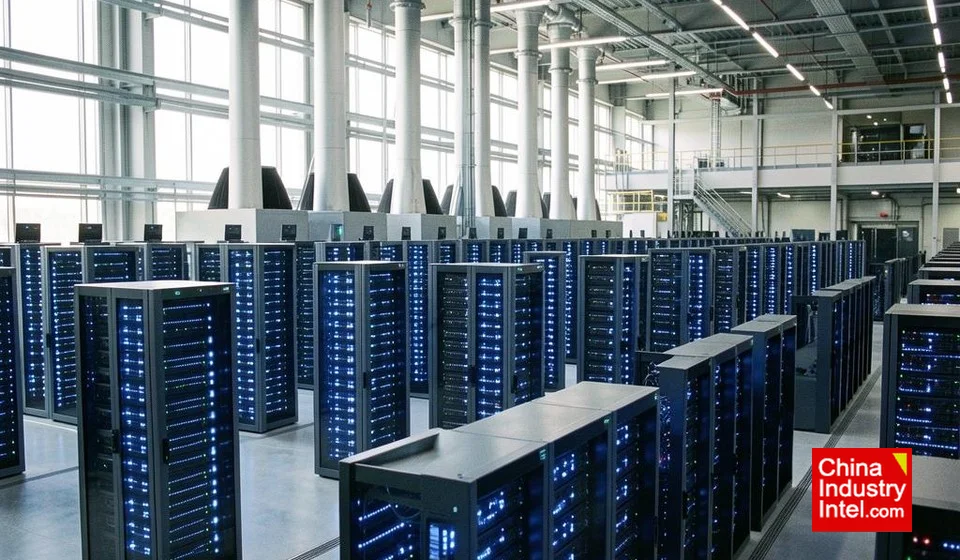
China Plans $295 Billion Fund for Nationwide AI Data Center Buildout
China is preparing to spend around 2 trillion yuan (95 billion) over the next five years on building AI data centers across the country, in one of the largest state-directed technology investments in history.
By CII (China Industry Intel) — Contributing Analyst | June 24, 2026
China is preparing to spend around 2 trillion yuan ($295 billion) over the next five years on building data centers across the country to power artificial intelligence, in what would be one of the largest state-directed technology infrastructure investments in history, Bloomberg reported on June 9.
The plan, still being finalized by the National Development and Reform Commission (NDRC), would fund construction of dozens of large-scale AI computing centers in inland provinces, upgrading existing facilities, and building out the high-speed fiber and power infrastructure needed to support them. It dwarfs comparable efforts — the US CHIPS and Science Act committed $52 billion to semiconductor manufacturing, while the European Chips Act allocated €43 billion.
What $295 Billion Buys
The scale of the proposed investment reflects a simple reality: AI compute is insatiable, and whoever builds the most infrastructure fastest may win the next phase of the technology race.
| Category | Allocation | Details |
|---|---|---|
| New AI computing centers | ~¥800B ($118B) | 50+ centers in inland provinces, each 100-500MW |
| Existing facility upgrades | ~¥500B ($74B) | Retrofit 200+ data centers for AI workloads |
| Fiber and power infrastructure | ~¥400B ($59B) | High-speed connections, substation upgrades |
| R&D and domestic chips | ~¥300B ($44B) | Domestic AI accelerator development, cooling tech |
The investment is structured as a mix of central government bonds,政策性银行 (policy bank) loans, and matching funds from provincial governments and state-owned enterprises. Local governments in less-developed western provinces — Gansu, Ningxia, Inner Mongolia — are expected to compete for center placement by offering subsidized land and power rates.

The Power Problem
The biggest constraint on China’s AI data center buildout isn’t chips or land — it’s electricity. Each large AI training cluster can consume 100-500 MW of power, equivalent to a small city. Cumulatively, the planned data centers would require an estimated 45-60 GW of additional power capacity by 2030.
China’s grid is already under strain. Reuters reported on June 22 that Beijing’s push for green power use in AI projects is facing significant hurdles, as renewable energy sources are too intermittent for 24/7 AI training workloads that demand stable power delivery. Battery storage at the scale required would add billions in costs.
The proposed solution: build AI data centers near coal and hydro power stations in western China, with long-haul fiber connections to coastal demand centers. This mirrors the “Eastern Data, Western Computing” strategy already underway but scales it up massively.
Domestic Chip Dependency
The plan also allocates significant funding for domestic AI accelerator development. Currently, Chinese AI companies rely heavily on NVIDIA’s H100 and B200 GPUs, which are restricted under US export controls and available only through gray market channels at 2-3x global prices.
Huawei’s Ascend 910C and Cambricon’s MLU590 have emerged as the leading domestic alternatives, but total shipments remain small — roughly 350,000 units combined in 2025, compared to an estimated 2+ million NVIDIA GPUs entering China through various channels in the same period.
| Chip | FP16 TFLOPS | 2025 Shipments | Process Node |
|---|---|---|---|
| NVIDIA H100 | 1,979 | ~1.5M (gray market) | 4nm TSMC |
| Huawei Ascend 910C | ~320 | ~250,000 | 7nm SMIC (DUV multi-patterning) |
| Cambricon MLU590 | ~256 | ~100,000 | 7nm SMIC |
What It Means for the Global AI Race
The $295 billion plan signals that Beijing views AI infrastructure as a strategic asset on par with high-speed rail or 5G networks — areas where state-directed investment gave China a dominant position. If implemented as planned, China’s total AI computing capacity could surpass the United States in raw petaflops by 2029, though per-capita and per-GPU efficiency gaps would remain.
The plan also puts pressure on the US and Europe to respond with their own AI infrastructure investments. The Biden administration’s 2025 Executive Order on AI directed federal agencies to accelerate data center permitting on federal lands, and the European Commission’s AI Factories initiative aims to build 15+ AI-optimized supercomputing centers. Neither comes close to the scale of China’s proposed spending.
CII Analysis
Two trillion yuan over five years is an enormous number — roughly 1.5% of China’s annual GDP directed at a single technology vertical. For comparison, China’s entire 2025 defense budget was about ¥1.8 trillion. The AI buildout would outspend the military.
Whether the money can be spent effectively is a different question. China has a track record of large infrastructure investments that build impressive capacity but struggle with utilization rates. Some of the “East Data West Compute” centers built in 2022-2025 are running at under 40% capacity because the promised enterprise demand didn’t materialize as quickly as expected.
The power constraint is real and underappreciated. Even with aggressive renewable buildout, China’s coal-heavy grid will struggle to power 45-60GW of new AI data centers without significant carbon emission increases — creating tension between Beijing’s AI ambitions and its 2030 carbon peak commitment.
That said, the strategic intent is unmistakable. China is betting that AI infrastructure, like 5G infrastructure before it, creates first-mover advantages that compound over time. Whether that bet pays off depends on solving the power, chip, and demand problems in parallel — a tall order even with $295 billion.
Follow CII’s AI coverage on LinkedIn for daily updates.
Sources
- Bloomberg — China Preps $295 Billion Plan to Fund Nationwide AI Buildout
- Reuters — China’s Push for Green Power Use in AI Projects Faces Hurdles
- National Development and Reform Commission — Policy Statements
- China Daily — East Data West Computing Initiative Progress