AI-Driven Breakthrough: World’s First Generative AI-Developed Lung Fibrosis Drug Enters Phase III Clinical Trials
AI-Driven Breakthrough: World’s First Generative AI-Developed Lung Fibrosis Drug Enters Phase III Clinical Trials
The pharmaceutical industry is witnessing a historic pivot. For decades, drug discovery has been characterized by serendipity and grueling trial-and-error—a process often described as searching for a needle in a haystack of billions of molecules. However, the ascent of Insilico Medicine and its pioneering generative AI platform is rewriting this narrative. Their lead candidate, INS018-055, a small-molecule inhibitor targeting Idiopathic Pulmonary Fibrosis (IPF), has reached a critical milestone: advancing toward Phase III clinical trials.
The Architecture of Discovery: Insilico Medicine’s Generative AI
Unlike traditional methods that rely on high-throughput screening of existing libraries, Insilico Medicine utilizes an end-to-end AI platform. This ecosystem integrates three core capabilities: target identification, molecule design, and clinical trial prediction. By leveraging deep learning and reinforcement learning, the platform doesn’t just screen molecules—it invents them. It analyzes vast biological datasets to identify novel disease targets and then “dreams up” chemical structures specifically tailored to bind to those targets with high affinity and selectivity.
The Science: TNIK Inhibition and the Fight Against IPF
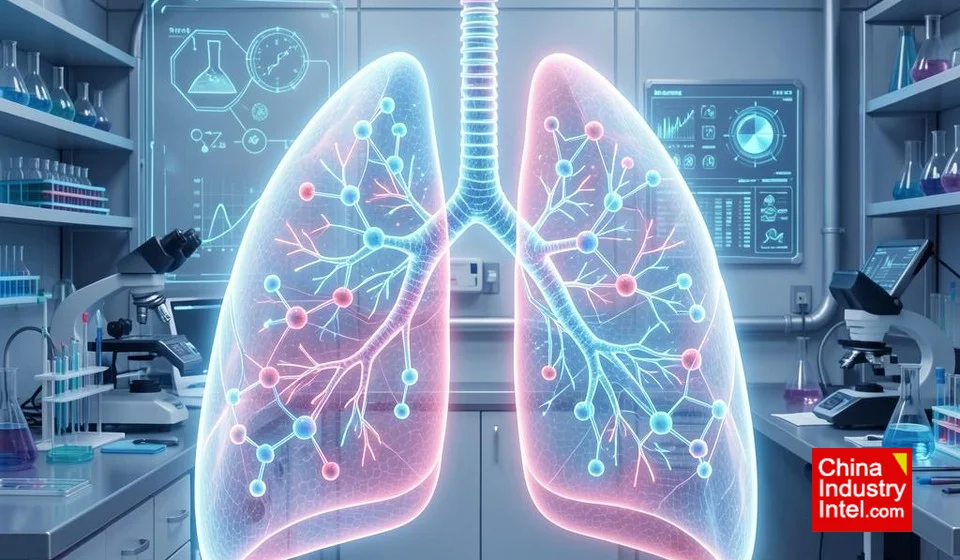
Idiopathic Pulmonary Fibrosis (IPF) is a devastating chronic lung disease characterized by the progressive scarring of lung tissue, which eventually prevents oxygen from entering the bloodstream. The biological driver of this scarring is complex, but Insilico Medicine’s AI identified TNIK (TRIB3-interacting kinase) as a pivotal target.
TNIK plays a critical role in the signaling pathways that trigger fibroblast activation and collagen deposition. By developing a potent and selective TNIK inhibitor, INS018-055 aims to arrest the fibrotic process. Rather than merely treating the symptoms, the AI-designed drug targets the molecular root of the pathology, offering the potential to slow or even halt the progression of lung scarring—a feat that has eluded traditional pharmacology for years.
Quantifying the Leap: 40x Speed-Up in R&D
The most staggering aspect of this achievement is the efficiency gain. Traditional lead optimization—the phase where a “hit” molecule is refined into a “lead” drug candidate—typically takes several years and costs millions of dollars. Insilico Medicine reported a 40x acceleration in the discovery and lead optimization phase.
What previously took 5-10 years was condensed into a fraction of that time. This compression is not merely about speed; it is about the precision of generative models that can predict pharmacokinetics and toxicity before a single molecule is synthesized in a wet lab, drastically reducing the “failure rate” common in early-stage R&D.
Paradigm Shift: From Trial-and-Error to Predictive Design
The success of INS018-055 signals a fundamental shift in the pharmaceutical industry. We are moving from an era of empirical discovery (testing everything to see what works) to predictive design (knowing what will work and designing it). This shift reduces the “Eroom’s Law” effect—the observation that drug discovery is becoming slower and more expensive over time despite improvements in technology.
By integrating AI, biotech firms can now explore a much larger chemical space, identify targets that human researchers might overlook, and optimize drug properties with mathematical precision. This democratizes the ability to treat rare diseases, as the cost barrier for early discovery is significantly lowered.
Comparison: Traditional vs. AI-Driven Drug Discovery
| Metric | Traditional Discovery | AI-Driven Discovery (Insilico) |
|---|---|---|
| Target Identification | Years of academic research / Serendipity | Weeks to Months via Big Data/ML |
| Lead Optimization | 3-5 Years (Iterative synthesis) | ~18 Months (Generative design) |
| Discovery Cost | High (Billions per approved drug) | Significantly Lower (Reduced wet-lab cycles) |
| Success Rate | Low (High attrition in Phase I/II) | Potentially Higher (Better predictive toxicity) |
| Approach | Trial-and-Error / Screening | Predictive / De Novo Design |
Conclusion
As INS018-055 enters the final stages of clinical validation, the medical world watches with anticipation. This is more than just a new drug for a lethal disease; it is a proof-of-concept for the future of medicine. The marriage of generative AI and biotechnology is transforming the pharmacy of tomorrow into a place of precision, speed, and unprecedented hope for patients worldwide.
Sources:
- Insilico Medicine Corporate Research Reports on INS018-055.
- ClinicalTrials.gov – Phase II/III status for IPF candidates.
- Nature Biotechnology – “Generative AI in drug discovery and target identification.”
- Industry Analysis: The impact of AI on pharmaceutical R&D timelines (2023-2026).