Skip to content
China Industry Intel China Industry Intel China Industry Intel

Intelligence on China’s Industries, Markets, Technology, and Manufacturing

China Industry Intel China Industry Intel China Industry Intel

Intelligence on China’s Industries, Markets, Technology, and Manufacturing

  • Home
  • INDUSTRIES
    • AI
    • Healthcare & Biotech
    • Robotics
    • Energy & Renewable
    • Semiconductor
    • EV & Battery
    • Manufacturing
  • BUSINESS
    • Logistics
    • Suppliers
    • Supply Chain
    • Stock Market
    • Economic Trends
    • Trade & Tariffs
  • TECH & CONSUMER
    • Global Industry Insights
    • Tech & Internet
    • Consumer Trends & New Product Releases
  • About
  • Contact
  • Home
  • INDUSTRIES
    • AI
    • Healthcare & Biotech
    • Robotics
    • Energy & Renewable
    • Semiconductor
    • EV & Battery
    • Manufacturing
  • BUSINESS
    • Logistics
    • Suppliers
    • Supply Chain
    • Stock Market
    • Economic Trends
    • Trade & Tariffs
  • TECH & CONSUMER
    • Global Industry Insights
    • Tech & Internet
    • Consumer Trends & New Product Releases
  • About
  • Contact
  • https://www.facebook.com/
  • https://twitter.com/
  • https://t.me/
  • https://www.instagram.com/
  • https://youtube.com/
Subscribe
China Industry Intel China Industry Intel China Industry Intel

Intelligence on China’s Industries, Markets, Technology, and Manufacturing

China Industry Intel China Industry Intel China Industry Intel

Intelligence on China’s Industries, Markets, Technology, and Manufacturing

  • Home
  • INDUSTRIES
    • AI
    • Healthcare & Biotech
    • Robotics
    • Energy & Renewable
    • Semiconductor
    • EV & Battery
    • Manufacturing
  • BUSINESS
    • Logistics
    • Suppliers
    • Supply Chain
    • Stock Market
    • Economic Trends
    • Trade & Tariffs
  • TECH & CONSUMER
    • Global Industry Insights
    • Tech & Internet
    • Consumer Trends & New Product Releases
  • About
  • Contact
  • Home
  • INDUSTRIES
    • AI
    • Healthcare & Biotech
    • Robotics
    • Energy & Renewable
    • Semiconductor
    • EV & Battery
    • Manufacturing
  • BUSINESS
    • Logistics
    • Suppliers
    • Supply Chain
    • Stock Market
    • Economic Trends
    • Trade & Tariffs
  • TECH & CONSUMER
    • Global Industry Insights
    • Tech & Internet
    • Consumer Trends & New Product Releases
  • About
  • Contact
  • https://www.facebook.com/
  • https://twitter.com/
  • https://t.me/
  • https://www.instagram.com/
  • https://youtube.com/
Subscribe
Home/INDUSTRIES/AI/DeepSeek’s Quiet Conquest: How a Chinese AI Startup Became US Enterprises’ Fastest-Growing Vendor
AI

DeepSeek’s Quiet Conquest: How a Chinese AI Startup Became US Enterprises’ Fastest-Growing Vendor

By ChinaIndustryIntel.com
10.06.2026 5 Min Read

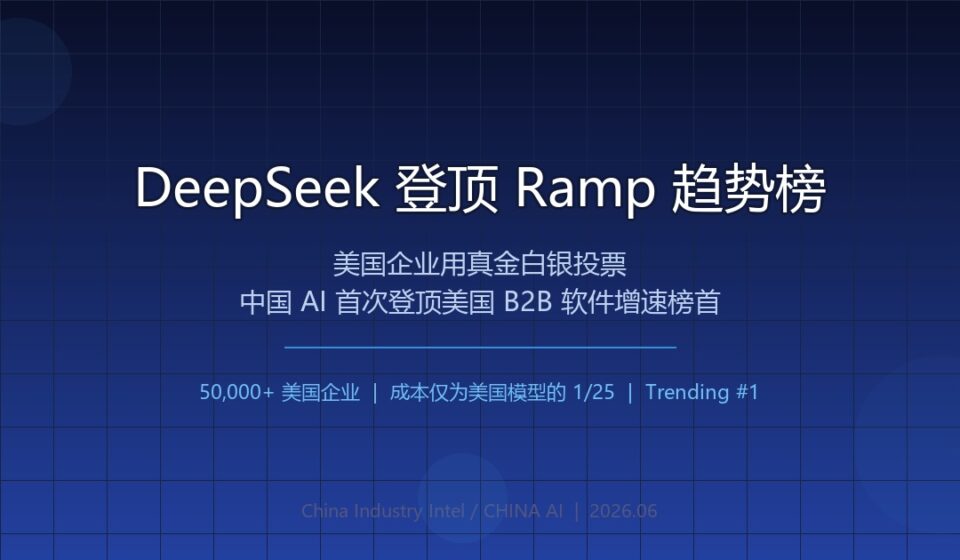
The narrative around China’s technology sector is often dominated by geopolitical tensions and restrictions. Yet, inside the expense reports and software procurement dashboards of 70,000 American companies, a different story is unfolding. According to a recent software trend report from Ramp, the corporate card and expense management platform, the fastest-growing vendor among its vast US enterprise client base isn’t a household Silicon Valley name—it’s DeepSeek, a Chinese artificial intelligence startup.

This data point marks a significant inflection point in the global AI race. It signals a tangible, financially-driven shift in corporate behavior, moving beyond theoretical benchmark debates to direct, bottom-line decisions. DeepSeek’s ascent isn’t the result of a marketing blitz or government mandate, but a cold, calculated response to a market-wide pressure: the urgent need to make AI economically viable.

## From Research Project to Corporate Workhorse

DeepSeek emerged from High-Flyer, a quantitative hedge fund that used AI for trading strategies. Founded by Liang Wenfeng, the company’s philosophy diverges sharply from the high-margin, premium pricing models of many Western AI labs. As Liang has stated, the principle is “no subsidies, no profiteering”—pricing at cost and letting architectural innovation drive down expenses. The goal, in his words, is for “APIs and AI to be universal and accessible to everyone.”

This ethos materialized in its model releases. The V4 series, particularly the high-performance V4 Pro and the cost-optimized V4 Flash, combined strong capabilities with aggressive pricing. Ramp’s June 2026 report, which tracks software spending across its platform, is a testament to this strategy’s efficacy. The finding that US companies are “directly paying DeepSeek rather than self-hosting” is particularly telling. It indicates that enterprises are now confident enough in DeepSeek’s reliability and security to send their data to servers operated by a Chinese company, a major step in commercial adoption.

## The Cost Calculus Driving Adoption

The primary driver behind this shift is brutally simple: economics. While Ramp’s report does not provide a direct price comparison, the market context is clear. DeepSeek’s V4 Pro API prices were cut by 75%, a move that landed in an environment where enterprises were starting to scrutinize their AI budgets.

OpenRouter, a platform that aggregates access to various AI models, provides a clear measure of usage. For four consecutive weeks, the collective token volume processed by Chinese models (led overwhelmingly by DeepSeek) stood at 9.22 trillion tokens per week, nearly double the 4.93 trillion tokens for US models. DeepSeek’s V4 Flash model alone led the rankings at 3.43 trillion tokens weekly. This volume isn’t just a technical metric; it’s a direct financial transaction stream. Every token represents a cost, and businesses are voting with their budgets.

The cost pressure is now systemic. A recent Bain & Company survey of 951 enterprises found that while aggregate AI spending exceeded $1 trillion, actual cost savings were “far below expectations.” This “trillion-dollar disillusionment” is forcing a tactical reset. Companies that once encouraged internal innovation with generous token allowances are now tightening controls. Amazon, for instance, has stopped internal AI usage leaderboards to prevent token-wasting. Microsoft has begun cancelling Claude Code subscriptions across key product divisions. Uber, Salesforce, and other tech giants are openly discussing significant AI cost-cutting measures.

In this climate, DeepSeek’s value proposition is irresistible. For Lindy, an AI agent startup, switching 100% of its user traffic from Anthropic’s Claude to DeepSeek V4 resulted in “saving millions”—a lifeline for a growth-stage company.

## Industry Implications: The Democratization of AI

DeepSeek’s rise reshapes the competitive landscape. It forces a fundamental reevaluation of the AI value chain. For large US AI model providers, the threat is clear: they can no longer rely solely on superior benchmarks to justify premium pricing. Performance parity or near-parity, combined with a drastic cost difference, will erode market share. The era of limitless AI spending is over, and procurement officers are now equipped with powerful, cost-efficient alternatives.

This dynamic also benefits a wide swath of businesses previously priced out of advanced AI applications. Smaller enterprises and developers can now access near-frontier capabilities at a fraction of the cost, accelerating experimentation and integration across industries.

However, it also raises complex questions. The direct financial integration of US corporate data with servers operated by a Chinese firm will inevitably attract regulatory scrutiny in Washington, D.C. While current data shows strong commercial adoption, the geopolitical environment remains a significant variable. DeepSeek’s model proves that technical excellence and pricing discipline can create a compelling product, but long-term success in the US market may depend on navigating an increasingly fraught political landscape.

## A Broader Significance: The New Rules of the AI Economy

DeepSeek’s trajectory signifies more than the success of one company. It heralds the maturation of the AI industry from its “gold rush” phase to a more competitive, efficiency-focused era. The initial winners were those with the most capital and the best research talent to train the largest models. The next winners will be those who can deliver the best performance-per-dollar.

This shift favors engineering optimization and novel architectures. DeepSeek’s focus on cost efficiency has led it to innovate in model structure and training methodology, rather than simply scaling parameters. This approach is proving to be commercially disruptive.

Furthermore, Ramp’s data provides a unique, verifiable window into actual enterprise behavior, cutting through the hype cycle. When 70,000 businesses, through millions of individual transactions, consistently increase their spending with a single provider, it speaks louder than any benchmark score or product launch announcement. It reveals the raw nerve of the market: sustainability.

## Conclusion: The Price-Performance Paradigm

The story of DeepSeek’s ascent in the US market is a story about the triumph of economics. In the end, enterprise technology decisions circle back to a timeless question: does the value delivered justify the cost? For a growing number of American companies, DeepSeek’s answer—a powerful AI service delivered at cost, following a philosophy of “no profiteering”—is a resounding yes.

The company has effectively hacked the growth trajectory not with sales teams, but with a product that aligns perfectly with a market in correction. As the AI industry transitions from limitless budgets to fiscal responsibility, DeepSeek stands as a potent symbol of this new paradigm. Its challenge to the incumbents is not just technological, but philosophical. It demonstrates that in the next chapter of the AI revolution, accessibility and affordability may prove to be the most formidable competitive advantages of all. The quiet conquest has begun, and it’s being logged one transaction at a time on the expense reports of corporate America.


Tags:

AIAnthropicDeepSeekEnterprise AILLM PricingOpenAIUS Market
Author

ChinaIndustryIntel.com

Follow Me
Other Articles
Previous

How the End of De Minimis Exemption and Surging Jet Fuel Costs Threaten Shein, Temu, and China’s Cross-Border E-Comme…

Next

First-in-Class Epigenetic Silencer TUNE-401 Shows Positive Phase 1b/2a Proof-of-Concept Data for Hepatitis B at EASL 2026

No Comment! Be the first one.

Leave a Reply Cancel reply

You must be logged in to post a comment.

Recent Posts

  • First-in-Class Epigenetic Silencer TUNE-401 Shows Positive Phase 1b/2a Proof-of-Concept Data for Hepatitis B at EASL 2026
  • DeepSeek’s Quiet Conquest: How a Chinese AI Startup Became US Enterprises’ Fastest-Growing Vendor
  • How the End of De Minimis Exemption and Surging Jet Fuel Costs Threaten Shein, Temu, and China’s Cross-Border E-Comme…
  • China’s Palantir Xunce Technology Stock Price Doubles After Hong Kong IPO as AI Data Solutions Market Surges
  • The Double Squeeze: How De Minimis Policy Changes and Jet Fuel Costs Challenge Shein and Temu’s Global Dominance

Archives

  • June 2026

Categories

  • BUSINESS
    • Economic Trends
    • Stock Market
    • Suppliers
    • Supply Chain
      • Logistics
    • Trade & Tariffs
  • INDUSTRIES
    • AI
    • Energy & Renewable
    • EV & Battery
    • Healthcare & Biotech
    • Manufacturing
    • Robotics
    • Semiconductor
  • TECH & CONSUMER
    • Consumer Trends & New Product Releases
    • Global Industry Insights
    • Tech & Internet
Independent coverage of China’s industries, technology, manufacturing, supply chains, and market trends.

Focused on AI, semiconductors, EVs, robotics, logistics, trade, and global industrial intelligence.

  • X
  • Instagram
  • Facebook
  • YouTube
Short Version
We welcome industry news tips, research contributions, press releases, and collaboration inquiries related to China’s industrial and technology sectors.
Contact: editor@chinaindustryintel.com

Available for Hire
Get In Touch

Recent Posts

  • First-in-Class Epigenetic Silencer TUNE-401 Shows Positive Phase 1b/2a Proof-of-Concept Data for Hepatitis B at EASL 2026
    by CII-Contributing Analyst
    14.06.2026
  • 10th Huawei ICT Competition Global Final Concludes with Record 220,000 Participants from 49 Countries in Shenzhen10.06.2026
  • 42 Rules for Sourcing and Manufacturing in China: Navigating Quality, Culture, and Operational Realities for Global B…09.06.2026
  • A Comprehensive Guide: The 12-Step Framework for Successfully Opening a Factory in China in 202609.06.2026

Search...

Tag

5G AI Autonomous Driving Belt and Road Biotech China Supplier Cloud Computing Cybersecurity E-commerce Economy Electronics EV Export Global Sourcing Guangdong Innovation Investment Lighting LLM Manufacturing New Energy OpenAI Pharmaceutical Policy Product Innovation Quality Control Robot Semiconductor Stock Market Supply Chain Trade War

You May Have Missed

Healthcare & Biotech

First-in-Class Epigenetic Silencer TUNE-401 Shows Positive Phase 1b/2a Proof-of-Concept Data for Hepatitis B at EASL 2026

By CII-Contributing Analyst
14.06.2026
AI

DeepSeek’s Quiet Conquest: How a Chinese AI Startup Became US Enterprises’ Fastest-Growing Vendor

By ChinaIndustryIntel.com
10.06.2026
Trade & Tariffs

How the End of De Minimis Exemption and Surging Jet Fuel Costs Threaten Shein, Temu, and China’s Cross-Border E-Comme…

By ChinaIndustryIntel.com
10.06.2026
Stock Market

China’s Palantir Xunce Technology Stock Price Doubles After Hong Kong IPO as AI Data Solutions Market Surges

By ChinaIndustryIntel.com
10.06.2026
Trade & Tariffs

The Double Squeeze: How De Minimis Policy Changes and Jet Fuel Costs Challenge Shein and Temu’s Global Dominance

By ChinaIndustryIntel.com
10.06.2026
Manufacturing

Advanced Automotive Supply Chain Analysis: How BAIC Foton and Qingling Motors Showcase China’s Hardcore Manufacturing…

By ChinaIndustryIntel.com
10.06.2026
Suppliers

China’s Advanced Peptide Manufacturers: Supplying Global Research and Wellness Markets with Precision Synthesis

By ChinaIndustryIntel.com
10.06.2026
Manufacturing

Evolution of the Chinese Auto Industry: How Beijing Automotive Group Powers Global Supply Chains

By ChinaIndustryIntel.com
10.06.2026
Healthcare & Biotech

Leading China-Based Peptide Manufacturer for FDA-Approved and Custom API Production

By ChinaIndustryIntel.com
10.06.2026

China Industry Intel is an independent media and intelligence platform covering China’s industrial economy, emerging technologies, manufacturing ecosystems, and global supply chains.

We provide curated analysis on AI, semiconductors, robotics, EVs, healthcare, logistics, trade policy, and consumer technology — helping readers understand how China’s industries are shaping global markets.

  • Facebook
  • X
  • Instagram
  • LinkedIn

Latest Posts

  • Zhejiang Momali Valve Co., Ltd. Expands Global Footprint as a Leading Brass Sanitary Ware Manufacturer from China’s Valve Capital
    In the fiercely competitive world of plumbing and sanitary ware manufacturing, few regions on earth carry the industrial weight and concentrated expertise of Yuhuan, Taizhou — widely known as **China
  • Xunce Technology Stock Price Doubles on Hong Kong IPO: Why China’s “Palantir” Large Model Data Leader Is Attracting G…
    The Hong Kong Stock Exchange has long served as a barometer for China's most innovative technology companies, and late 2025 delivered one of its most striking debuts in recent memory. On December 30,
  • Xunce Technology Hong Kong IPO: Why ‘China’s Palantir’ is a Data Analytics Stock to Watch in 2026
    The global tech investment community is perpetually scanning the horizon for the next paradigm-shifting company, a "next Palantir" that can harness the exponential value of data. While Silicon Valley

Contact

alibaba.com

Contact

Phone

+77 822411

Email

editor@chinaindustryintel.com

Location

New York, USA

Copyright 2026 — China Industry Intel. All rights reserved. Blogsy WordPress Theme