Skip to content
China Industry Intel China Industry Intel China Industry Intel

Intelligence on China’s Industries, Markets, Technology, and Manufacturing

China Industry Intel China Industry Intel China Industry Intel

Intelligence on China’s Industries, Markets, Technology, and Manufacturing

  • Home
  • INDUSTRIES
    • AI
    • Healthcare & Biotech
    • Robotics
    • Energy & Renewable
    • Semiconductor
    • EV & Battery
    • Manufacturing
  • BUSINESS
    • Logistics
    • Suppliers
    • Supply Chain
    • Stock Market
    • Economic Trends
    • Trade & Tariffs
  • TECH & CONSUMER
    • Global Industry Insights
    • Tech & Internet
    • Consumer Trends & New Product Releases
  • About
  • Contact
  • Home
  • INDUSTRIES
    • AI
    • Healthcare & Biotech
    • Robotics
    • Energy & Renewable
    • Semiconductor
    • EV & Battery
    • Manufacturing
  • BUSINESS
    • Logistics
    • Suppliers
    • Supply Chain
    • Stock Market
    • Economic Trends
    • Trade & Tariffs
  • TECH & CONSUMER
    • Global Industry Insights
    • Tech & Internet
    • Consumer Trends & New Product Releases
  • About
  • Contact
  • https://www.facebook.com/
  • https://twitter.com/
  • https://t.me/
  • https://www.instagram.com/
  • https://youtube.com/
Subscribe
China Industry Intel China Industry Intel China Industry Intel

Intelligence on China’s Industries, Markets, Technology, and Manufacturing

China Industry Intel China Industry Intel China Industry Intel

Intelligence on China’s Industries, Markets, Technology, and Manufacturing

  • Home
  • INDUSTRIES
    • AI
    • Healthcare & Biotech
    • Robotics
    • Energy & Renewable
    • Semiconductor
    • EV & Battery
    • Manufacturing
  • BUSINESS
    • Logistics
    • Suppliers
    • Supply Chain
    • Stock Market
    • Economic Trends
    • Trade & Tariffs
  • TECH & CONSUMER
    • Global Industry Insights
    • Tech & Internet
    • Consumer Trends & New Product Releases
  • About
  • Contact
  • Home
  • INDUSTRIES
    • AI
    • Healthcare & Biotech
    • Robotics
    • Energy & Renewable
    • Semiconductor
    • EV & Battery
    • Manufacturing
  • BUSINESS
    • Logistics
    • Suppliers
    • Supply Chain
    • Stock Market
    • Economic Trends
    • Trade & Tariffs
  • TECH & CONSUMER
    • Global Industry Insights
    • Tech & Internet
    • Consumer Trends & New Product Releases
  • About
  • Contact
  • https://www.facebook.com/
  • https://twitter.com/
  • https://t.me/
  • https://www.instagram.com/
  • https://youtube.com/
Subscribe
Home/BUSINESS/Suppliers/Mastering the Dragon’s Factory Floor: A Practical Guide to Sourcing and Manufacturing in China for Western Businesses
Suppliers

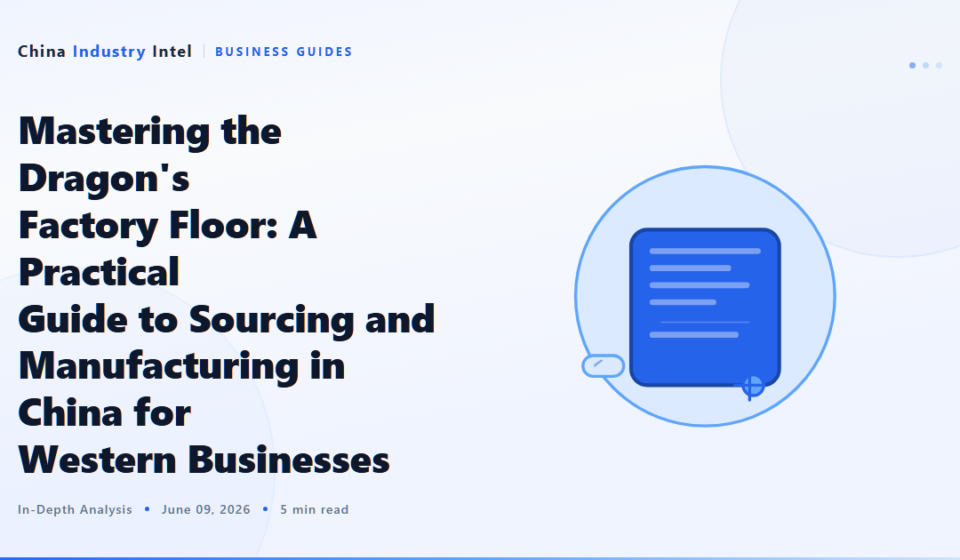
Mastering the Dragon’s Factory Floor: A Practical Guide to Sourcing and Manufacturing in China for Western Businesses

By ChinaIndustryIntel.com
09.06.2026 5 Min Read

In the global pursuit of competitive advantage, China’s manufacturing prowess remains an undeniable draw for businesses worldwide. Yet, the path to successful sourcing and production is frequently misunderstood, littered with cultural blind spots and operational pitfalls that can turn opportunity into costly failure. As the seminal guide “42 Rules for Sourcing and Manufacturing in China” underscores through over twenty executive interviews, success is not a matter of luck, but of disciplined learning and adaptation. For Western executives, navigating this complex landscape requires moving beyond transactional thinking to embrace a nuanced, experience-based approach that accounts for evolving standards, deep-seated cultural frameworks, and the imperative for vigilant oversight.

Navigating the Cultural and Operational Chasm in Sourcing from China

The most profound initial challenge for Western businesses is recognizing that doing business in China is fundamentally different from dealing with American or European suppliers. This gap is not merely linguistic but rooted in centuries of history, distinct social protocols, and a developing industrial ecosystem. As highlighted in the source material, the book emphasizes understanding “the importance of China’s history, culture, and business etiquette.” This goes far beyond simple dos and don’ts; it involves grasping concepts like *guanxi* (relationships) and *mianzi* (face), which are the currency of trust and negotiation. Pushing for rapid decisions, as one might in the West, often backfires, as the Chinese system values careful consensus among multiple stakeholders, frequently requiring managers to consult other groups after a meeting.

The Pitfalls of Assumed Equivalence

A core mistake, often repeated by newcomers, is assuming Western business norms apply directly. Supplementary data confirms that “cultural issues in global sourcing are manageable, but still they should be recognized as concerns.” This manifests in critical areas like communication and contract enforcement. Direct criticism can cause a loss of face, irrevocably damaging a relationship. Similarly, viewing a signed contract as the final word is a misstep. In the Chinese context, a contract is often seen as the beginning of a relationship, subject to ongoing discussion. Successful executives, as profiled in Coates’ interviews, learn to foster “open and transparent” communication channels and understand that negotiations may continue even after the ink is dry.

Bridging the Manufacturing Maturity Gap

Another crucial insight is that China’s manufacturing sector, while massive, exhibits a wide spectrum of capability and quality standards. The source directly states that “China’s experience in manufacturing is still developing. It will be a few years before the majority of manufacturers are up to world standards.” This reality necessitates a hands-on approach. Western businesses cannot simply issue a purchase order and expect identical output to a factory in Germany. The variation in equipment, worker training, and quality management systems requires that buyers “closely monitor” quality, schedules, and logistics. Assuming a uniform level of sophistication across the supplier landscape is a direct route to receiving subpar goods and encountering production delays.

Mitigating Risk Through Diligence and Quality Control in China Manufacturing

Given the operational challenges, risk mitigation must be built into the core sourcing strategy. Learning from the costly mistakes of others, as detailed in “42 Rules,” provides a blueprint for avoiding common errors in quality, intellectual property, and supply chain management. The supplementary data from quality control advisors reinforces that “the complexity of the manufacturing process means you must integrate clear procedures and supplier audits into your sourcing strategies.”

The Non-Negotiable Role of On-the-Ground Oversight

Trust but verify is the paramount rule. Relying solely on a supplier’s assurances or digital reports is insufficient. Effective quality control in China demands a multi-layered approach:

  • Supplier Vetting and Audits: Before any contract is signed, conducting thorough due diligence and physical audits of potential manufacturing partners is essential to assess capabilities and ethical standards.
  • Clear Specifications and Prototypes: Vague product descriptions are a primary source of defects. Successful sourcing requires “precise guidelines that detail product characteristics as well as packaging details together with production deadlines.”
  • Third-Party Inspections: Engaging independent quality control firms for pre-shipment inspections is a standard best practice. These inspections catch defects before products are shipped, protecting against expensive rework or recalls.
  • Ongoing Production Monitoring: For long-term partnerships, implementing regular production line checks ensures that agreed-upon processes are consistently followed, preventing “quality fade” over time.

Protecting Assets: Contracts and Intellectual Property

Robust legal frameworks are a critical safety net. As advised in best practices for contract manufacturing, it is vital to ensure clear ownership of all assets, stating “You own the product IP, tooling, etc., because you paid for it.” This must be explicitly detailed in contracts, alongside comprehensive non-disclosure and non-compete clauses. The legal system for enforcing IP rights in China has strengthened, but proactive protection through patents, trademarks, and guarded documentation remains the first line of defense. Navigating this requires specialized legal counsel familiar with both international and Chinese law.

From Theory to Practice: Actionable Strategies from the Front Lines

The true value of the “42 Rules” approach lies in its translation of hard-won experience into actionable strategy. Moving from understanding challenges to implementing solutions is what separates successful long-term partnerships from failed experiments.

Leveraging Local Expertise and Relationships

One of the most consistent recommendations is to not go it alone. Engaging a reputable sourcing agent in China can be invaluable, particularly for businesses new to the market. These agents “prevent communication barriers that lead to errors” and possess the local network (*guanxi*) to identify and vet reliable manufacturers. They act as cultural interpreters and operational advocates, ensuring that buyer specifications are clearly understood and that factory commitments are met. This local presence is crucial for “making things happen” and solving problems in real-time.

Building for the Long Term, Not Just for the Order

Successful executives highlighted in the book treat their Chinese suppliers as partners, not just vendors. This involves investing time in relationship building, visiting factories regularly (“factory tours” are a key part of the 42 rules), and providing consistent, clear feedback. It also means understanding the business pressures your supplier faces, which can lead to more resilient collaborations. As noted in the source, the guide helps readers discover “how you can make things happen in China”—often through patience, respect, and a collaborative spirit that aligns mutual interests toward quality and timely delivery.

Conclusion: The Enduring Need for Pragmatism and Adaptation

The landscape of sourcing and manufacturing in China continues to evolve, with rising costs, advancing automation, and increasing domestic competition reshaping opportunities. Yet, the foundational principles outlined in guides like Coates’ remain timeless. The key takeaway is that success in China is not found in shortcuts, but in diligent preparation, cultural empathy, and relentless oversight. For the Western businessperson, the journey begins with acknowledging the complexity and committing to a learning mindset. As the global supply chain becomes more dynamic, the ability to effectively and respectfully navigate the world’s manufacturing powerhouse will remain a definitive competitive skill. The future belongs to those who, armed with the pragmatic wisdom of those who came before them, approach the Dragon’s factory floor not with trepidation, but with a well-crafted, informed strategy.
Tags:

Belt and RoadInnovationInvestmentManufacturingPolicyStock MarketSupply Chain
Author

ChinaIndustryIntel.com

Follow Me
Other Articles
Previous

Balancing AI Safety and Market Momentum: Why Anthropic’s Responsible Scaling Policy Matters for the Future of Global …

Next

How to Source from China: Navigating Sourcing Agents, Trading Companies, and Manufacturing Risks in 2024

No Comment! Be the first one.

Leave a Reply Cancel reply

You must be logged in to post a comment.

Recent Posts

  • First-in-Class Epigenetic Silencer TUNE-401 Shows Positive Phase 1b/2a Proof-of-Concept Data for Hepatitis B at EASL 2026
  • DeepSeek’s Quiet Conquest: How a Chinese AI Startup Became US Enterprises’ Fastest-Growing Vendor
  • How the End of De Minimis Exemption and Surging Jet Fuel Costs Threaten Shein, Temu, and China’s Cross-Border E-Comme…
  • China’s Palantir Xunce Technology Stock Price Doubles After Hong Kong IPO as AI Data Solutions Market Surges
  • The Double Squeeze: How De Minimis Policy Changes and Jet Fuel Costs Challenge Shein and Temu’s Global Dominance

Archives

  • June 2026

Categories

  • BUSINESS
    • Economic Trends
    • Stock Market
    • Suppliers
    • Supply Chain
      • Logistics
    • Trade & Tariffs
  • INDUSTRIES
    • AI
    • Energy & Renewable
    • EV & Battery
    • Healthcare & Biotech
    • Manufacturing
    • Robotics
    • Semiconductor
  • TECH & CONSUMER
    • Consumer Trends & New Product Releases
    • Global Industry Insights
    • Tech & Internet
Independent coverage of China’s industries, technology, manufacturing, supply chains, and market trends.

Focused on AI, semiconductors, EVs, robotics, logistics, trade, and global industrial intelligence.

  • X
  • Instagram
  • Facebook
  • YouTube
Short Version
We welcome industry news tips, research contributions, press releases, and collaboration inquiries related to China’s industrial and technology sectors.
Contact: editor@chinaindustryintel.com

Available for Hire
Get In Touch

Recent Posts

  • First-in-Class Epigenetic Silencer TUNE-401 Shows Positive Phase 1b/2a Proof-of-Concept Data for Hepatitis B at EASL 2026
    by CII-Contributing Analyst
    14.06.2026
  • 10th Huawei ICT Competition Global Final Concludes with Record 220,000 Participants from 49 Countries in Shenzhen10.06.2026
  • 42 Rules for Sourcing and Manufacturing in China: Navigating Quality, Culture, and Operational Realities for Global B…09.06.2026
  • A Comprehensive Guide: The 12-Step Framework for Successfully Opening a Factory in China in 202609.06.2026

Search...

Tag

5G AI Autonomous Driving Belt and Road Biotech China Supplier Cloud Computing Cybersecurity E-commerce Economy Electronics EV Export Global Sourcing Guangdong Innovation Investment Lighting LLM Manufacturing New Energy OpenAI Pharmaceutical Policy Product Innovation Quality Control Robot Semiconductor Stock Market Supply Chain Trade War

You May Have Missed

Healthcare & Biotech

First-in-Class Epigenetic Silencer TUNE-401 Shows Positive Phase 1b/2a Proof-of-Concept Data for Hepatitis B at EASL 2026

By CII-Contributing Analyst
14.06.2026
AI

DeepSeek’s Quiet Conquest: How a Chinese AI Startup Became US Enterprises’ Fastest-Growing Vendor

By ChinaIndustryIntel.com
10.06.2026
Trade & Tariffs

How the End of De Minimis Exemption and Surging Jet Fuel Costs Threaten Shein, Temu, and China’s Cross-Border E-Comme…

By ChinaIndustryIntel.com
10.06.2026
Stock Market

China’s Palantir Xunce Technology Stock Price Doubles After Hong Kong IPO as AI Data Solutions Market Surges

By ChinaIndustryIntel.com
10.06.2026
Trade & Tariffs

The Double Squeeze: How De Minimis Policy Changes and Jet Fuel Costs Challenge Shein and Temu’s Global Dominance

By ChinaIndustryIntel.com
10.06.2026
Manufacturing

Advanced Automotive Supply Chain Analysis: How BAIC Foton and Qingling Motors Showcase China’s Hardcore Manufacturing…

By ChinaIndustryIntel.com
10.06.2026
Suppliers

China’s Advanced Peptide Manufacturers: Supplying Global Research and Wellness Markets with Precision Synthesis

By ChinaIndustryIntel.com
10.06.2026
Manufacturing

Evolution of the Chinese Auto Industry: How Beijing Automotive Group Powers Global Supply Chains

By ChinaIndustryIntel.com
10.06.2026
Healthcare & Biotech

Leading China-Based Peptide Manufacturer for FDA-Approved and Custom API Production

By ChinaIndustryIntel.com
10.06.2026

China Industry Intel is an independent media and intelligence platform covering China’s industrial economy, emerging technologies, manufacturing ecosystems, and global supply chains.

We provide curated analysis on AI, semiconductors, robotics, EVs, healthcare, logistics, trade policy, and consumer technology — helping readers understand how China’s industries are shaping global markets.

  • Facebook
  • X
  • Instagram
  • LinkedIn

Latest Posts

  • Zhejiang Momali Valve Co., Ltd. Expands Global Footprint as a Leading Brass Sanitary Ware Manufacturer from China’s Valve Capital
    In the fiercely competitive world of plumbing and sanitary ware manufacturing, few regions on earth carry the industrial weight and concentrated expertise of Yuhuan, Taizhou — widely known as **China
  • Xunce Technology Stock Price Doubles on Hong Kong IPO: Why China’s “Palantir” Large Model Data Leader Is Attracting G…
    The Hong Kong Stock Exchange has long served as a barometer for China's most innovative technology companies, and late 2025 delivered one of its most striking debuts in recent memory. On December 30,
  • Xunce Technology Hong Kong IPO: Why ‘China’s Palantir’ is a Data Analytics Stock to Watch in 2026
    The global tech investment community is perpetually scanning the horizon for the next paradigm-shifting company, a "next Palantir" that can harness the exponential value of data. While Silicon Valley

Link

alibaba.com

Contact

Phone

+77 822411

Email

editor@chinaindustryintel.com

Location

New York, USA

Copyright 2026 — China Industry Intel. All rights reserved.