Scaling Production and Solving the Buyer Puzzle: China’s Humanoid Robot Commercialization Challenge
Chinese-made humanoid robots are capturing global imagination, executing flawless backflips, managing traffic flow in bustling cities, and even brewing coffee with precise movements. These remarkable demonstrations of advanced motion control and artificial intelligence integration signal a significant technical leap for manufacturers in the world’s largest robotics market. However, beneath the spectacle of these agile machines lies a formidable commercial dilemma. As companies like UBTech and others race to scale production to hundreds of thousands of units, they confront a stark reality: a mismatch between manufacturing ambition and genuine market demand. The path to dominating the humanoid robot sector is not just about engineering prowess in building at scale, but about solving the far more complex puzzle of finding enough willing buyers to sustain that scale.
The Engineering Triumph: Achieving Advanced Capabilities at Scale
The technical achievements of Chinese humanoid robot developers are undeniable and serve as the foundation of their global appeal. Recent demonstrations have moved far beyond simple walking prototypes to showcase robots performing complex, dynamic tasks that were once the domain of science fiction. These capabilities, highlighted by actions like directing traffic or making coffee, are not merely for show; they represent crucial milestones in real-world AI integration and precise biomechanical motion control. The ability to execute a backflip requires an extraordinary synthesis of balance, power, and millisecond-level computational adjustments—a feat that validates years of R&D in actuators and control algorithms.
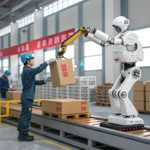
More importantly, these demonstrations are precursors to practical deployment. Companies report thousands of orders from government entities and pilot programs, indicating a foundational layer of institutional demand. For instance, UBTech has announced plans to deploy between 500 to 1,000 of its Walker S Series industrial humanoids this year. This initial adoption in controlled environments—factories, research labs, and public service roles—proves the technology’s viability and provides a critical testing ground for refinement. The focus here is on building a track record of reliability and performance in semi-structured settings, which is essential before wider commercial rollout.
The use cases of these robots are still so limited,” noted Chibo Tang of venture capital firm Gobi Partners. This insight underscores the core challenge: impressive demos do not automatically translate to universal utility.
Beyond the Backflip: The Quest for Practical Use Cases
The current wave of orders, while promising, is largely concentrated in the public sector and corporate pilot programs. The “wow factor” of a backflipping robot attracts attention and investment, but sustainable growth requires identifying and monetizing applications that deliver clear value to a mass market. This is where the industry must pivot from showcasing capability to solving specific problems. Potential high-value domains include eldercare assistance, hazardous environment operations, logistics in structured warehouses, and hospitality services. However, each of these arenas presents unique integration challenges with existing workflows and infrastructure, requiring not just a capable robot but a holistic solution.
Scaling Ambition: The Race to Mass Production and Cost Reduction
In response to the perceived opportunity, Chinese manufacturers are setting audacious production targets aimed at leveraging economies of scale. The ambition is to produce at volumes exceeding 100,000 units annually, a scale that could dramatically alter the cost structure of humanoid robotics. This strategy is directly informed by the playbook of other Chinese hardware industries, where massive production runs have consistently driven down unit costs and captured global market share. The goal is to make humanoids not just technically possible, but economically accessible.
- Current Production Cost Estimate: Approximately $100,000 USD per unit for pilot-stage models, as cited by Bank of America analysts.
- Target Cost Reduction: Industry forecasts project unit costs could fall to the $20,000-$30,000 range by 2035 through standardization and increased production volume.
- Primary Cost Driver: The actuator system—the components responsible for movement—accounts for a significant portion of the total hardware expense.
- Scale Target: Leading companies aim to achieve production capacity of over 100,000 units annually to realize necessary cost efficiencies.
The push for scale is critical, but it creates a classic chicken-and-egg problem. Achieving the target cost of $20,000-$30,000 requires massive volume, yet that volume is difficult to justify without proven, widespread demand. Bank of America’s analysis suggests Chinese manufacturers have a cost structure advantage, but this advantage is only fully realized if the market can absorb the output. The current estimated production cost of around $100,000 places these robots firmly out of reach for individual consumers and many small businesses, limiting the buyer pool to large corporations and government agencies.
The Battery Bottleneck: A Critical Technical Limitation
Beyond cost, another practical barrier to widespread adoption is the robots’ operational endurance. Verified data highlights that these humanoids typically operate for only two to three hours at near-full capacity before requiring a recharge cycle. For any continuous, real-world application—whether as a factory assistant, a caregiver, or a retail server—this limited battery life is a significant impediment. The recharge time adds further downtime, reducing the robot’s overall utility and return on investment. Solving this energy storage challenge is as vital as advancing motion control, as it directly impacts the total cost of ownership and operational viability for potential buyers.
The Commercialization Conundrum: Bridging Production and Demand
Herein lies the heart of the challenge for China’s humanoid robot industry: a widening gap between production capacity and identifiable commercial demand. As experts like Gobi Partners’ Chibo Tang emphasize, limited use cases mean limited buyers. While government programs and large corporate pilots provide an initial off-take agreement, they cannot sustain the industry’s ambitious scale targets in the long term. The market must generate genuine, widespread demand from a diverse base of buyers to absorb the projected output of hundreds of thousands of units per year.
This demand deficit is a global issue, not unique to China, but the Chinese approach of scaling production first makes it particularly acute. The industry risks building an immense manufacturing capacity for a product without a proven, scalable market. This contrasts with more iterative, demand-pull models of development. To succeed, Chinese firms must concurrently invest in market creation—educating potential customers, developing customizable software platforms for various industries, and perhaps even exploring new business models like Robot-as-a-Service (RaaS) to lower the barrier to entry.
Furthermore, the focus on humanoid form factor, while compelling, may not be the most efficient solution for all tasks. The industry may need to critically assess where a humanoid provides a decisive advantage over simpler, more specialized, and cheaper robotic arms or autonomous vehicles. The hard truth is that a robot’s ability to make coffee is less important than its ability to do so more cost-effectively and reliably than a human worker or a dedicated, non-humanoid coffee machine.
Conclusion: From Spectacle to Sustainable Market Creation
China has unequivocally proven its capability to engineer and mass-produce sophisticated humanoid robots at a pace that outstrips most global competitors. The technical foundation for a new era of automation is being laid with remarkable speed. However, the final, most critical piece of the puzzle is market development. The journey forward requires a strategic pivot from a focus on production-scale milestones to a relentless focus on solving real-world problems for a broad array of customers. Success will not be measured by the number of units rolling off assembly lines, but by the number of units deployed in productive, revenue-generating roles across the economy.
For Chinese humanoid robot makers, the next frontier is not in the laboratory or on the factory floor, but in the boardrooms of potential clients and in the daily routines of future users. They must convincingly demonstrate return on investment, overcome practical limitations like battery life, and develop flexible solutions tailored to specific industry needs. The race to dominate the humanoid market will ultimately be won not by the companies that can build the most robots, but by those that can most effectively answer the simple, profound question: “Why do you need one?” Answering that question at scale is the hard part, and it is where the true competition for the future of robotics will be decided.