
Skip to content
China Industry Intel China Industry Intel China Industry Intel

Intelligence on China’s Industries, Markets, Technology, and Manufacturing

China Industry Intel China Industry Intel China Industry Intel

Intelligence on China’s Industries, Markets, Technology, and Manufacturing

  • Home
  • INDUSTRIES
    • AI
    • Healthcare & Biotech
    • Robotics
    • Energy & Renewable
    • Semiconductor
    • EV & Battery
    • Manufacturing
  • BUSINESS
    • Logistics
    • Suppliers
    • Supply Chain
    • Stock Market
    • Economic Trends
    • Trade & Tariffs
  • TECH & CONSUMER
    • Global Industry Insights
    • Tech & Internet
    • Consumer Trends & New Product Releases
  • About
  • Contact
  • Home
  • INDUSTRIES
    • AI
    • Healthcare & Biotech
    • Robotics
    • Energy & Renewable
    • Semiconductor
    • EV & Battery
    • Manufacturing
  • BUSINESS
    • Logistics
    • Suppliers
    • Supply Chain
    • Stock Market
    • Economic Trends
    • Trade & Tariffs
  • TECH & CONSUMER
    • Global Industry Insights
    • Tech & Internet
    • Consumer Trends & New Product Releases
  • About
  • Contact
  • https://www.facebook.com/
  • https://twitter.com/
  • https://t.me/
  • https://www.instagram.com/
  • https://youtube.com/
Subscribe
China Industry Intel China Industry Intel China Industry Intel

Intelligence on China’s Industries, Markets, Technology, and Manufacturing

China Industry Intel China Industry Intel China Industry Intel

Intelligence on China’s Industries, Markets, Technology, and Manufacturing

  • Home
  • INDUSTRIES
    • AI
    • Healthcare & Biotech
    • Robotics
    • Energy & Renewable
    • Semiconductor
    • EV & Battery
    • Manufacturing
  • BUSINESS
    • Logistics
    • Suppliers
    • Supply Chain
    • Stock Market
    • Economic Trends
    • Trade & Tariffs
  • TECH & CONSUMER
    • Global Industry Insights
    • Tech & Internet
    • Consumer Trends & New Product Releases
  • About
  • Contact
  • Home
  • INDUSTRIES
    • AI
    • Healthcare & Biotech
    • Robotics
    • Energy & Renewable
    • Semiconductor
    • EV & Battery
    • Manufacturing
  • BUSINESS
    • Logistics
    • Suppliers
    • Supply Chain
    • Stock Market
    • Economic Trends
    • Trade & Tariffs
  • TECH & CONSUMER
    • Global Industry Insights
    • Tech & Internet
    • Consumer Trends & New Product Releases
  • About
  • Contact
  • https://www.facebook.com/
  • https://twitter.com/
  • https://t.me/
  • https://www.instagram.com/
  • https://youtube.com/
Subscribe
Home/INDUSTRIES/Robotics/China Humanoid Robot Mass Production Advances Despite Commercial Demand Challenges and High Costs
Robotics

China Humanoid Robot Mass Production Advances Despite Commercial Demand Challenges and High Costs

By ChinaIndustryIntel.com
08.06.2026 4 Min Read

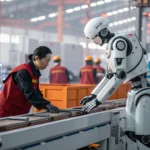
China is rapidly establishing itself as a global powerhouse in the manufacturing of humanoid robots, showcasing machines capable of athletic backflips, complex traffic management, and service tasks like making coffee. This impressive display of engineering and production scale is a testament to the country’s strategic industrial ambitions. However, the industry is now grappling with a fundamental paradox: the ability to build these sophisticated machines at volume has outpaced the development of a clear, scalable market for them. Companies and policymakers are now focused on the critical next step—transitioning from spectacular demonstrations to sustainable commercial deployment by finding enough consistent buyers.

Supply-Side Dominance: China’s Industrial Scale in Humanoid Robotics

Chinese firms have achieved significant milestones in the mass production and technical capabilities of humanoid robots. A landmark moment arrived in late 2025 when UBTECH Robotics began mass production and delivery of its industrial humanoid, the Walker S2. The initial orders exceeded 800 million yuan (approximately $110 million), with a target of 500 units within the year and a scalable goal of 10,000 units by 2027. This represents one of the first large-scale commercial deployments globally, moving the technology from prototype to factory floor. The progress is underpinned by a robust and rapidly expanding market projection. According to the China Humanoid Robot Market Size, Share & Industry Report, 2030, the domestic market is forecast to reach USD 2.80 billion by 2030, growing from USD 0.40 billion in 2025 at a compound annual growth rate (CAGR) of 47.6%.

Driving Forces: Aging Demographics and Labor Economics

A primary driver for this industrial push is China’s demographic reality. With over 320 million people aged 60 and above, the country faces a shrinking labor force and acute shortages in both manufacturing and service sectors, particularly in eldercare. This societal pressure has accelerated the policy and corporate focus on automation. The eldercare robot market, a key application area, is rapidly expanding and is expected to exceed $1.5 billion in 2026. Industry analysis from institutions like Stanford University highlights that human resources both drive and limit China’s automation push—the urgent need for replacement labor is propelling investment, while the complexity of replicating human dexterity and judgment remains a technical bottleneck. As noted in the source article, China’s companies are leveraging their manufacturing prowess to produce robots that can “direct traffic, and even make coffee,” exploring a wide range of potential use cases.

Demand-Side Dilemma: The Quest for Commercial Viability and Clear Use Cases

Despite the impressive supply-side advancements, the core challenge remains igniting sufficient and sustained commercial demand. The supplementary data verifies that insufficient commercial demand and a lack of clear, high-utility use cases are the primary headwinds facing mass adoption. For many potential buyers, the value proposition of a general-purpose humanoid robot is not yet compelling enough to justify the investment. This is often referred to as the search for the industry’s “ChatGPT moment.” As cited in the verification materials, an industry expert noted that the critical breakthrough will arrive when “robots, placed in unfamiliar real-world settings, can complete about 80 percent of tasks simply by following voice or text instructions.” Until that level of versatile, intuitive utility is achieved, many potential applications remain in the realm of pilot projects rather than essential, scaled deployments.

The Cost Barrier: A Major Hurdle to Adoption

A significant factor inhibiting demand is cost. The price of Chinese-made humanoids remains prohibitively high for widespread commercial use. According to analysis cited in the supplementary data, the average cost per unit ranges from CNY 300,000 to 500,000 (approximately EUR 36,000 to EUR 62,500). For comparison, Guotai Securities calculates the commercial viability threshold—based on annual labor costs that the robot could offset—to be around CNY 160,000. This stark gap between current pricing and the break-even point for buyers underscores the challenge. Key takeaways on this barrier include:

  • High Initial Investment: Substantial capital outlay is required for acquisition and deployment.
  • System Complexity: Integration into existing workflows demands technical expertise and may involve significant ancillary costs.
  • Limited ROI Validation: Few large-scale deployments have provided robust, public data on return on investment.
  • Technical Limitations: Constraints in battery endurance and AI autonomy further limit continuous, productive use.

Looking Ahead: Navigating the Path from Production to Practical Integration

The future of China’s humanoid robot industry hinges on bridging the gap between production scale and market pull. Government support remains a powerful catalyst, but the trajectory will ultimately be defined by solving the commercial equation. The projected CAGR of 47.6% indicates strong anticipated growth, but realizing this potential requires addressing the dual challenges of cost reduction and application refinement. Companies must move beyond spectacle to demonstrate clear operational and financial benefits in targeted sectors like eldercare, logistics, and specialized manufacturing.

The road ahead involves not only continued technical innovation to lower costs and enhance battery life and AI responsiveness but also deep collaboration with potential end-users to co-develop practical solutions. As the industry matures, a fragmented supply chain must also be consolidated to ensure quality, reliability, and economies of scale. If Chinese manufacturers can successfully navigate these complexities, they are poised to not only dominate production but also define the global commercial landscape for humanoid robotics. The next phase will be less about what the robots can do in a lab or exhibition hall, and more about what they can do for a paying customer on a daily basis.

Tags:

AIInnovationInvestmentManufacturingNew EnergyPolicyRobotSupply Chain
Author

ChinaIndustryIntel.com

Follow Me
Other Articles
Previous

How China Global Logistics Co., Ltd is Redefining the China-Latin America Trade Lane with Comprehensive NVOCC Services

Next

Chinese Humanoid Robots Dominate Global Shipments But Still Struggle to Move Beyond Performative Spectacles to Real-W…

No Comment! Be the first one.

Leave a Reply Cancel reply

You must be logged in to post a comment.

Recent Posts

  • First-in-Class Epigenetic Silencer TUNE-401 Shows Positive Phase 1b/2a Proof-of-Concept Data for Hepatitis B at EASL 2026
  • DeepSeek’s Quiet Conquest: How a Chinese AI Startup Became US Enterprises’ Fastest-Growing Vendor
  • How the End of De Minimis Exemption and Surging Jet Fuel Costs Threaten Shein, Temu, and China’s Cross-Border E-Comme…
  • China’s Palantir Xunce Technology Stock Price Doubles After Hong Kong IPO as AI Data Solutions Market Surges
  • The Double Squeeze: How De Minimis Policy Changes and Jet Fuel Costs Challenge Shein and Temu’s Global Dominance

Archives

  • June 2026

Categories

  • BUSINESS
    • Economic Trends
    • Stock Market
    • Suppliers
    • Supply Chain
      • Logistics
    • Trade & Tariffs
  • INDUSTRIES
    • AI
    • Energy & Renewable
    • EV & Battery
    • Healthcare & Biotech
    • Manufacturing
    • Robotics
    • Semiconductor
  • TECH & CONSUMER
    • Consumer Trends & New Product Releases
    • Global Industry Insights
    • Tech & Internet
Independent coverage of China’s industries, technology, manufacturing, supply chains, and market trends.

Focused on AI, semiconductors, EVs, robotics, logistics, trade, and global industrial intelligence.

  • X
  • Instagram
  • Facebook
  • YouTube
Short Version
We welcome industry news tips, research contributions, press releases, and collaboration inquiries related to China’s industrial and technology sectors.
Contact: editor@chinaindustryintel.com

Available for Hire
Get In Touch

Recent Posts

  • First-in-Class Epigenetic Silencer TUNE-401 Shows Positive Phase 1b/2a Proof-of-Concept Data for Hepatitis B at EASL 2026
    by CII-Contributing Analyst
    14.06.2026
  • 10th Huawei ICT Competition Global Final Concludes with Record 220,000 Participants from 49 Countries in Shenzhen10.06.2026
  • 42 Rules for Sourcing and Manufacturing in China: Navigating Quality, Culture, and Operational Realities for Global B…09.06.2026
  • A Comprehensive Guide: The 12-Step Framework for Successfully Opening a Factory in China in 202609.06.2026

Search...

Tag

5G AI Autonomous Driving Belt and Road Biotech China Supplier Cloud Computing Cybersecurity E-commerce Economy Electronics EV Export Global Sourcing Guangdong Innovation Investment Lighting LLM Manufacturing New Energy OpenAI Pharmaceutical Policy Product Innovation Quality Control Robot Semiconductor Stock Market Supply Chain Trade War

You May Have Missed

Healthcare & Biotech

First-in-Class Epigenetic Silencer TUNE-401 Shows Positive Phase 1b/2a Proof-of-Concept Data for Hepatitis B at EASL 2026

By CII-Contributing Analyst
14.06.2026
AI

DeepSeek’s Quiet Conquest: How a Chinese AI Startup Became US Enterprises’ Fastest-Growing Vendor

By ChinaIndustryIntel.com
10.06.2026
Trade & Tariffs

How the End of De Minimis Exemption and Surging Jet Fuel Costs Threaten Shein, Temu, and China’s Cross-Border E-Comme…

By ChinaIndustryIntel.com
10.06.2026
Stock Market

China’s Palantir Xunce Technology Stock Price Doubles After Hong Kong IPO as AI Data Solutions Market Surges

By ChinaIndustryIntel.com
10.06.2026
Trade & Tariffs

The Double Squeeze: How De Minimis Policy Changes and Jet Fuel Costs Challenge Shein and Temu’s Global Dominance

By ChinaIndustryIntel.com
10.06.2026
Manufacturing

Advanced Automotive Supply Chain Analysis: How BAIC Foton and Qingling Motors Showcase China’s Hardcore Manufacturing…

By ChinaIndustryIntel.com
10.06.2026
Suppliers

China’s Advanced Peptide Manufacturers: Supplying Global Research and Wellness Markets with Precision Synthesis

By ChinaIndustryIntel.com
10.06.2026
Manufacturing

Evolution of the Chinese Auto Industry: How Beijing Automotive Group Powers Global Supply Chains

By ChinaIndustryIntel.com
10.06.2026
Healthcare & Biotech

Leading China-Based Peptide Manufacturer for FDA-Approved and Custom API Production

By ChinaIndustryIntel.com
10.06.2026

China Industry Intel is an independent media and intelligence platform covering China’s industrial economy, emerging technologies, manufacturing ecosystems, and global supply chains.

We provide curated analysis on AI, semiconductors, robotics, EVs, healthcare, logistics, trade policy, and consumer technology — helping readers understand how China’s industries are shaping global markets.

  • Facebook
  • X
  • Instagram
  • LinkedIn

Latest Posts

  • Zhejiang Momali Valve Co., Ltd. Expands Global Footprint as a Leading Brass Sanitary Ware Manufacturer from China’s Valve Capital
    In the fiercely competitive world of plumbing and sanitary ware manufacturing, few regions on earth carry the industrial weight and concentrated expertise of Yuhuan, Taizhou — widely known as **China
  • Xunce Technology Stock Price Doubles on Hong Kong IPO: Why China’s “Palantir” Large Model Data Leader Is Attracting G…
    The Hong Kong Stock Exchange has long served as a barometer for China's most innovative technology companies, and late 2025 delivered one of its most striking debuts in recent memory. On December 30,
  • Xunce Technology Hong Kong IPO: Why ‘China’s Palantir’ is a Data Analytics Stock to Watch in 2026
    The global tech investment community is perpetually scanning the horizon for the next paradigm-shifting company, a "next Palantir" that can harness the exponential value of data. While Silicon Valley

Contact

alibaba.com

Contact

Phone

+77 822411

Email

editor@chinaindustryintel.com

Location

New York, USA

Copyright 2026 — China Industry Intel. All rights reserved. Blogsy WordPress Theme