Chinese Humanoid Robots Dominate Global Shipments But Still Struggle to Move Beyond Performative Spectacles to Real-W…
The image of a humanoid robot executing a flawless backflip or deftly pouring a cup of coffee has become a potent symbol of China’s technological ambition. A wave of Chinese-made robots, developed by companies like Unitree, Fourier Intelligence, and even consumer electronics giant Xiaomi, is making a spectacular entrance on the global stage. According to recent data, Chinese startups have seized the top positions in global humanoid robot shipments, with Unitree alone selling over 5,500 units in 2025. This surge has been so decisive that **China now controls an estimated 90% of the global humanoid robot market**. Yet, beneath the dazzling demonstrations of agility and dexterity lies a more complex reality: for all their market dominance, these machines remain largely confined to roles as high-tech entertainers or research tools, struggling to transition into the functional, industrial workhorses that could truly reshape the global economy.
China’s Strategic Playbook: State-Led Dominance in Humanoid Robotics
The rise of Chinese humanoid robots is no accident; it is the result of a deliberate, state-coordinated industrial strategy that mirrors the playbook used to conquer the global electric vehicle (EV) market. Beijing has identified embodied AI and humanoid robotics as cornerstone technologies for future economic leadership. This vision is backed by substantial policy support, including the Ministry of Industry and Information Technology’s (MIIT) goal to build humanoid robot pilot lines and double China’s manufacturing robot density by 2030. Government initiatives provide crucial **subsidies, tax breaks, and structured research collaborations** between leading AI firms like Baidu and iFlytek and hardware specialists like UBTech Robotics and Zhiyuan Robotics. This top-down support creates a fertile ecosystem for rapid scaling and iteration.
The results of this strategy are already evident in the global sales figures. While a US company like Figure AI, with a $39 billion valuation, has shipped around 150 units, Unitree’s humanoid models are priced at approximately $13,000 and have shipped in the thousands. This stark contrast highlights a core tenet of China’s approach: leveraging manufacturing scale and aggressive pricing to flood the market and establish a dominant installed base. Between 13,000 and 18,000 humanoid robots were sold globally in 2025 according to research firms Omdia and IDC, and the overwhelming majority originated from Chinese production lines. This volume-centric model prioritizes capturing market share first, betting that software improvements and functional applications will follow the hardware diffusion.
From Spectacle to Substance: The Performance vs. Functionality Divide
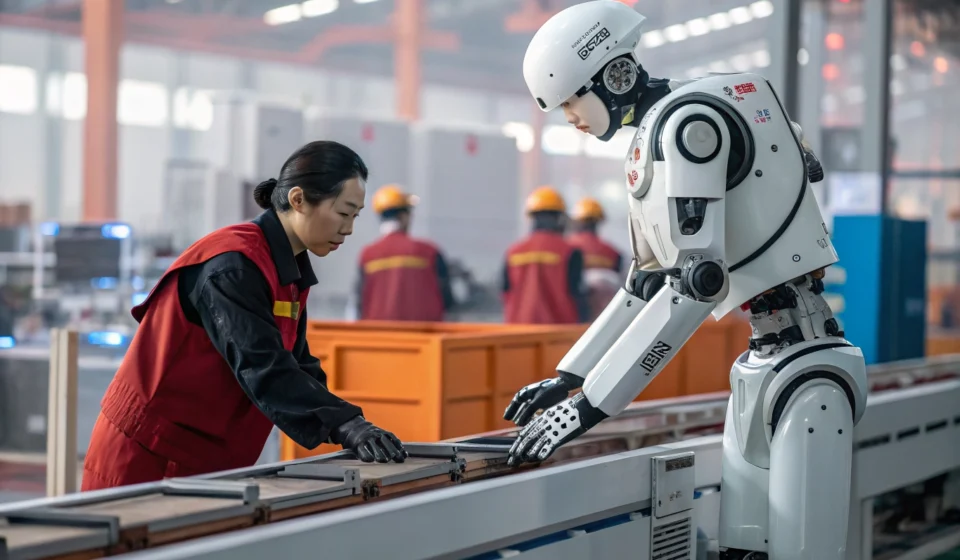
Despite the impressive shipment numbers, a significant gap persists between what these robots can showcase and what they can commercially deliver. As Fortune noted, the robots are adept at **performative tasks** like directing traffic, dancing, and making coffee—activities designed to demonstrate mobility, balance, and basic object manipulation. However, they are not yet replacing human workers on factory floors or in warehouses for core labor tasks. The current deployment is often more about marketing and proof-of-concept than about achieving measurable productivity gains in real-world industrial environments.
The Engineering Hurdles Behind the Hype
The transition from demo to daily workhorse is blocked by formidable engineering and economic challenges. A humanoid robot must integrate solutions for locomotion, manipulation, perception, force control, and task planning into a single, cohesive platform—a feat that conventional industrial automation solves with separate, specialized machines like robotic arms and autonomous mobile robots (AMRs). Key limitations cited across industry analyses include poor durability, unreliable balance over long shifts, and critically, short battery life. While an AMR can operate for 10-20 hours on a predictable duty cycle, a humanoid’s power consumption for dynamic movement severely limits its uptime, making it inefficient for high-throughput environments.
Furthermore, the **cost structure remains prohibitive for widespread adoption**. The industry considers a battery to account for about 10% of a robot’s total cost, but solid-state batteries—which offer the necessary safety and energy density—remain expensive. When combined with advanced actuators, sensors, and AI processors, the total price of a capable humanoid robot puts it out of reach for many potential commercial buyers outside of R&D labs and wealthy automotive plants. This economic reality means that for most industrial applications, the return on investment is not yet justified.
Engineering and Economic Frontiers: Scaling Beyond the Demo
The path forward for Chinese—and indeed all global humanoid robot makers—requires navigating a series of technical and commercial milestones. The industry is actively transitioning from early-stage prototyping toward structured commercial deployment, driven by persistent labor shortages and advances in embodied AI. Early adopters are emerging in specific sectors where the human form factor offers a tangible advantage, albeit with limitations.
Targeted Industrial Pilots and Future Applications
Automotive manufacturing is leading the charge. Companies like BMW have partnered with firms such as Apptronik to test humanoids for tasks like carrying parts along assembly lines. These environments are controlled and structured, providing a “bridge” application that plays to the robot’s strengths in mobility and flexibility while mitigating weaknesses like endurance. The vision is for humanoids to eventually handle more complex assembly, maintenance, or logistics tasks that require navigating spaces designed for humans. Another promising, though socially complex, avenue is **elder care**, where the need for assistance is high and environments are less rigidly standardized than a factory. However, both paths demand significant leaps in reliability, safety, and intuitive operation.
The roadmap forward is clear: the first wave of Chinese humanoid robots successfully proved manufacturing scale and market capture. The second, more critical wave must focus on **solving the core engineering puzzles of durability, power management, and cost-effective production**. Success will depend on moving beyond viral videos to secure long-term contracts in pilot facilities, gathering data to improve AI decision-making, and demonstrating tangible productivity benefits. The global race is far from over; as Figure AI, Tesla’s Optimus, and others in the US continue to develop their platforms, China’s state-backed champions must prove their machines are ready not just for the stage, but for the shop floor. The transition from a performative marvel to a functional tool will determine whether the humanoid robot market becomes a transformative force in the global economy or remains a high-tech curiosity.