Skip to content
China Industry Intel China Industry Intel China Industry Intel

Intelligence on China’s Industries, Markets, Technology, and Manufacturing

China Industry Intel China Industry Intel China Industry Intel

Intelligence on China’s Industries, Markets, Technology, and Manufacturing

  • Home
  • INDUSTRIES
    • AI
    • Healthcare & Biotech
    • Robotics
    • Energy & Renewable
    • Semiconductor
    • EV & Battery
    • Manufacturing
  • BUSINESS
    • Logistics
    • Suppliers
    • Supply Chain
    • Stock Market
    • Economic Trends
    • Trade & Tariffs
  • TECH & CONSUMER
    • Global Industry Insights
    • Tech & Internet
    • Consumer Trends & New Product Releases
  • About
  • Contact
  • Home
  • INDUSTRIES
    • AI
    • Healthcare & Biotech
    • Robotics
    • Energy & Renewable
    • Semiconductor
    • EV & Battery
    • Manufacturing
  • BUSINESS
    • Logistics
    • Suppliers
    • Supply Chain
    • Stock Market
    • Economic Trends
    • Trade & Tariffs
  • TECH & CONSUMER
    • Global Industry Insights
    • Tech & Internet
    • Consumer Trends & New Product Releases
  • About
  • Contact
  • https://www.facebook.com/
  • https://twitter.com/
  • https://t.me/
  • https://www.instagram.com/
  • https://youtube.com/
Subscribe
China Industry Intel China Industry Intel China Industry Intel

Intelligence on China’s Industries, Markets, Technology, and Manufacturing

China Industry Intel China Industry Intel China Industry Intel

Intelligence on China’s Industries, Markets, Technology, and Manufacturing

  • Home
  • INDUSTRIES
    • AI
    • Healthcare & Biotech
    • Robotics
    • Energy & Renewable
    • Semiconductor
    • EV & Battery
    • Manufacturing
  • BUSINESS
    • Logistics
    • Suppliers
    • Supply Chain
    • Stock Market
    • Economic Trends
    • Trade & Tariffs
  • TECH & CONSUMER
    • Global Industry Insights
    • Tech & Internet
    • Consumer Trends & New Product Releases
  • About
  • Contact
  • Home
  • INDUSTRIES
    • AI
    • Healthcare & Biotech
    • Robotics
    • Energy & Renewable
    • Semiconductor
    • EV & Battery
    • Manufacturing
  • BUSINESS
    • Logistics
    • Suppliers
    • Supply Chain
    • Stock Market
    • Economic Trends
    • Trade & Tariffs
  • TECH & CONSUMER
    • Global Industry Insights
    • Tech & Internet
    • Consumer Trends & New Product Releases
  • About
  • Contact
  • https://www.facebook.com/
  • https://twitter.com/
  • https://t.me/
  • https://www.instagram.com/
  • https://youtube.com/
Subscribe
Home/BUSINESS/Suppliers/Navigating China’s Manufacturing Ecosystem: How to Choose Between Sourcing Companies and Trading Companies for Your S…
Suppliers

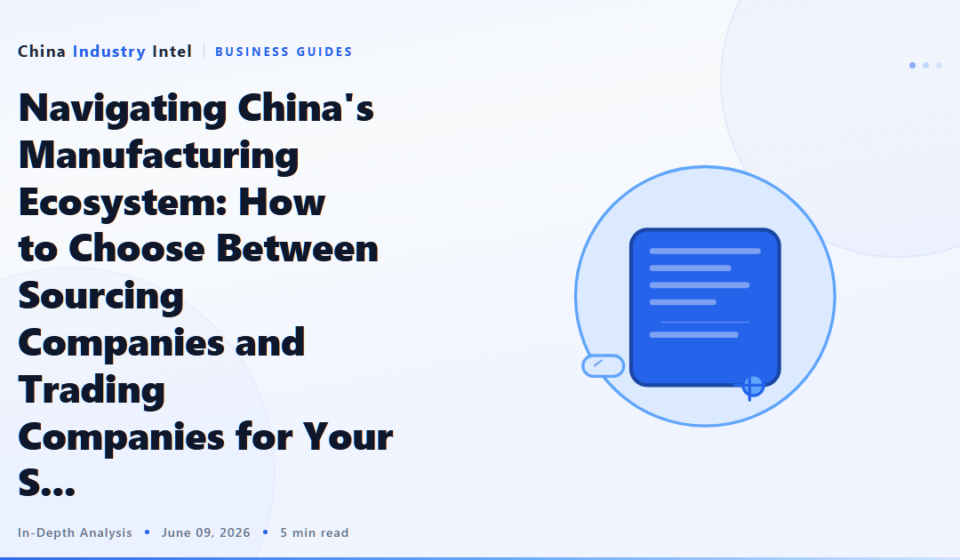
Navigating China’s Manufacturing Ecosystem: How to Choose Between Sourcing Companies and Trading Companies for Your S…

By ChinaIndustryIntel.com
09.06.2026 4 Min Read

For any international business aiming to leverage China’s formidable manufacturing capacity, the initial steps of finding and vetting partners are critical. The landscape is vast and complex, offering immense opportunity but also significant risk. Choosing the right intermediary—a sourcing company or a trading company—is a foundational decision that can determine a project’s cost, quality, and ultimate success. Understanding their fundamental differences is not just beneficial; it is essential for mitigating the very real dangers of fraud and substandard production that persist in cross-border trade.

The Strategic Value and Cost of Professional Sourcing Companies in China

When entering the Chinese market, many businesses seek a more managed approach to supplier identification and quality assurance. This is where professional **sourcing companies** come into play. These firms act as dedicated third-party partners, leveraging their on-the-ground presence to bridge the gap between international client requirements and the capabilities of local manufacturers. Their core service is not merely connecting parties but actively curating and evaluating the supply chain on a client’s behalf. A proficient sourcing company brings an invaluable blend of local language fluency, deep understanding of traditional Chinese business customs, and expertise in international trade logistics and compliance.

How Sourcing Companies Mitigate Risk and Add Value

The primary value proposition of a **sourcing company** lies in its systematic approach to risk mitigation. They typically have established protocols for conducting thorough due diligence on factories, which includes verifying business licenses, assessing production capacity, and evaluating historical quality control performance. This process is designed to protect clients from common pitfalls such as outright fraud, inconsistent product quality, and unreliable delivery timelines. Furthermore, these companies often provide critical support with factory audits, sample evaluation, and ongoing production monitoring, offering a layer of oversight that is difficult for a foreign company to achieve independently.

Understanding the Financial and Practical Trade-offs

However, this comprehensive service comes at a price. Engaging a **sourcing company** can represent a significant cost, which may include retainer fees, commissions, or markups on the product price. This expense structure means they are most cost-effective for larger, ongoing orders where their expertise can secure better pricing and ensure consistency over time. For businesses with smaller initial orders or highly constrained budgets, the cost may seem prohibitive. As the source material advises, speaking with industry peers who have firsthand experience can provide invaluable insights into which sourcing partners are reputable and offer genuine value for their fees.

Trading Companies: Convenience and the Peril of Misrepresentation

On the other side of the intermediary spectrum are **trading companies**. Unlike sourcing companies that often facilitate a direct relationship between the buyer and the manufacturer, trading companies operate as middlemen who purchase products from factories and resell them. They typically specialize in specific product categories or industries, accumulating a catalog of goods from various suppliers. The key differentiator is that a trading company is the seller of record; they add their margin to the factory price and handle the export process themselves.

The Allure of Simplicity and Lower Barriers to Entry

For many businesses, especially those new to importing from China, **trading companies** present a seemingly simpler path to market. They often provide a one-stop-shop solution, offering easier communication (frequently including translation services), access to a wider range of products within their niche, and crucially, a willingness to accommodate smaller Minimum Order Quantities (MOQs). This can be advantageous for market testing, product sampling, or businesses that do not have the volume to command direct factory attention. The initial interaction may feel more accessible and less intimidating than navigating complex manufacturer negotiations.

The Critical Risks of Opacity and Lack of Control

Despite the convenience, relying on a **trading company** introduces substantial risks that demand careful scrutiny. A major issue highlighted in industry guidance is the prevalence of trading companies misrepresenting themselves as direct factories, a practice that can deceive buyers about the true source and cost of their products. Because they are resellers, their prices are inherently higher and often fixed, leaving little room for negotiation based on raw material or production costs. More critically, buyers typically relinquish direct oversight of the manufacturing process. The trading company controls quality checks and production schedules, which can lead to inconsistencies or failures that are difficult to rectify swiftly. Effective due diligence, including requesting verifiable factory visit reports or independent quality inspections, becomes paramount to protect your investment.

In conclusion, navigating the choice between a sourcing company and a trading company is a defining strategic decision in manufacturing in China. There is no one-size-fits-all answer; the optimal path depends entirely on your business’s specific priorities regarding cost, control, order volume, and risk tolerance. A sourcing company offers a shield of expertise and oversight for a fee, ideal for businesses prioritizing quality and long-term partnership. A trading company offers a streamlined, lower-volume entry point, but with the critical need for heightened due diligence to avoid opacity and misrepresentation. The most successful international players conduct exhaustive research, seek verifiable referrals, and often start with small pilot projects to test a partnership before committing significant resources. In the world’s factory, your choice of local partner is the most important product you will source.

Tags:

AIBelt and RoadE-commerceInvestmentManufacturingPolicyStock MarketSupply Chain
Author

ChinaIndustryIntel.com

Follow Me
Other Articles
Previous

How to Source from China: A 2024 Guide to Manufacturers, Suppliers, and Sourcing Agents

Next

Guangzhou Youguang Optoelectronics: A 20-Year-Old Light Guide Panel Manufacturer Navigating the Global LED Boom

No Comment! Be the first one.

Leave a Reply Cancel reply

You must be logged in to post a comment.

Recent Posts

  • First-in-Class Epigenetic Silencer TUNE-401 Shows Positive Phase 1b/2a Proof-of-Concept Data for Hepatitis B at EASL 2026
  • DeepSeek’s Quiet Conquest: How a Chinese AI Startup Became US Enterprises’ Fastest-Growing Vendor
  • How the End of De Minimis Exemption and Surging Jet Fuel Costs Threaten Shein, Temu, and China’s Cross-Border E-Comme…
  • China’s Palantir Xunce Technology Stock Price Doubles After Hong Kong IPO as AI Data Solutions Market Surges
  • The Double Squeeze: How De Minimis Policy Changes and Jet Fuel Costs Challenge Shein and Temu’s Global Dominance

Archives

  • June 2026

Categories

  • BUSINESS
    • Economic Trends
    • Stock Market
    • Suppliers
    • Supply Chain
      • Logistics
    • Trade & Tariffs
  • INDUSTRIES
    • AI
    • Energy & Renewable
    • EV & Battery
    • Healthcare & Biotech
    • Manufacturing
    • Robotics
    • Semiconductor
  • TECH & CONSUMER
    • Consumer Trends & New Product Releases
    • Global Industry Insights
    • Tech & Internet
Independent coverage of China’s industries, technology, manufacturing, supply chains, and market trends.

Focused on AI, semiconductors, EVs, robotics, logistics, trade, and global industrial intelligence.

  • X
  • Instagram
  • Facebook
  • YouTube
Short Version
We welcome industry news tips, research contributions, press releases, and collaboration inquiries related to China’s industrial and technology sectors.
Contact: editor@chinaindustryintel.com

Available for Hire
Get In Touch

Recent Posts

  • First-in-Class Epigenetic Silencer TUNE-401 Shows Positive Phase 1b/2a Proof-of-Concept Data for Hepatitis B at EASL 2026
    by CII-Contributing Analyst
    14.06.2026
  • 10th Huawei ICT Competition Global Final Concludes with Record 220,000 Participants from 49 Countries in Shenzhen10.06.2026
  • 42 Rules for Sourcing and Manufacturing in China: Navigating Quality, Culture, and Operational Realities for Global B…09.06.2026
  • A Comprehensive Guide: The 12-Step Framework for Successfully Opening a Factory in China in 202609.06.2026

Search...

Tag

5G AI Autonomous Driving Belt and Road Biotech China Supplier Cloud Computing Cybersecurity E-commerce Economy Electronics EV Export Global Sourcing Guangdong Innovation Investment Lighting LLM Manufacturing New Energy OpenAI Pharmaceutical Policy Product Innovation Quality Control Robot Semiconductor Stock Market Supply Chain Trade War

You May Have Missed

Healthcare & Biotech

First-in-Class Epigenetic Silencer TUNE-401 Shows Positive Phase 1b/2a Proof-of-Concept Data for Hepatitis B at EASL 2026

By CII-Contributing Analyst
14.06.2026
AI

DeepSeek’s Quiet Conquest: How a Chinese AI Startup Became US Enterprises’ Fastest-Growing Vendor

By ChinaIndustryIntel.com
10.06.2026
Trade & Tariffs

How the End of De Minimis Exemption and Surging Jet Fuel Costs Threaten Shein, Temu, and China’s Cross-Border E-Comme…

By ChinaIndustryIntel.com
10.06.2026
Stock Market

China’s Palantir Xunce Technology Stock Price Doubles After Hong Kong IPO as AI Data Solutions Market Surges

By ChinaIndustryIntel.com
10.06.2026
Trade & Tariffs

The Double Squeeze: How De Minimis Policy Changes and Jet Fuel Costs Challenge Shein and Temu’s Global Dominance

By ChinaIndustryIntel.com
10.06.2026
Manufacturing

Advanced Automotive Supply Chain Analysis: How BAIC Foton and Qingling Motors Showcase China’s Hardcore Manufacturing…

By ChinaIndustryIntel.com
10.06.2026
Suppliers

China’s Advanced Peptide Manufacturers: Supplying Global Research and Wellness Markets with Precision Synthesis

By ChinaIndustryIntel.com
10.06.2026
Manufacturing

Evolution of the Chinese Auto Industry: How Beijing Automotive Group Powers Global Supply Chains

By ChinaIndustryIntel.com
10.06.2026
Healthcare & Biotech

Leading China-Based Peptide Manufacturer for FDA-Approved and Custom API Production

By ChinaIndustryIntel.com
10.06.2026

China Industry Intel is an independent media and intelligence platform covering China’s industrial economy, emerging technologies, manufacturing ecosystems, and global supply chains.

We provide curated analysis on AI, semiconductors, robotics, EVs, healthcare, logistics, trade policy, and consumer technology — helping readers understand how China’s industries are shaping global markets.

  • Facebook
  • X
  • Instagram
  • LinkedIn

Latest Posts

  • Zhejiang Momali Valve Co., Ltd. Expands Global Footprint as a Leading Brass Sanitary Ware Manufacturer from China’s Valve Capital
    In the fiercely competitive world of plumbing and sanitary ware manufacturing, few regions on earth carry the industrial weight and concentrated expertise of Yuhuan, Taizhou — widely known as **China
  • Xunce Technology Stock Price Doubles on Hong Kong IPO: Why China’s “Palantir” Large Model Data Leader Is Attracting G…
    The Hong Kong Stock Exchange has long served as a barometer for China's most innovative technology companies, and late 2025 delivered one of its most striking debuts in recent memory. On December 30,
  • Xunce Technology Hong Kong IPO: Why ‘China’s Palantir’ is a Data Analytics Stock to Watch in 2026
    The global tech investment community is perpetually scanning the horizon for the next paradigm-shifting company, a "next Palantir" that can harness the exponential value of data. While Silicon Valley

Link

alibaba.com

Contact

Phone

+77 822411

Email

editor@chinaindustryintel.com

Location

New York, USA

Copyright 2026 — China Industry Intel. All rights reserved.