The global manufacturing landscape is undergoing a significant transformation, with supply chain resilience and te…
The Core Business Models: ODM vs. OEM in the Chinese Context
At the heart of China’s contract manufacturing prowess lie two foundational business models: the Original Design Manufacturer (ODM) and the Original Equipment Manufacturer (OEM). These models define the level of involvement and intellectual property ownership, offering distinct pathways for companies seeking production partners.
ODM: The Speed and Cost-Efficiency Powerhouse
The ODM model represents the fastest and most cost-effective route to market for companies looking to launch products quickly. Under this framework, the Chinese manufacturer has already developed a product design and often holds the associated intellectual property. The client company essentially rebrands or lightly customizes this existing, proven design for its own market. This approach dramatically reduces upfront investment in research, development, and tooling. As industry analysis confirms, “hiring an ODM is the fastest and lowest cost way to get a me-too type of product to market.” It is particularly prevalent in fast-moving consumer electronics and home appliances, where speed to shelf is a critical success factor.
OEM: The Path to Custom Innovation
In contrast, the OEM model is defined by customization and client-driven innovation. Here, the brand or company supplies its own detailed product designs, specifications, and engineering to the Chinese manufacturer, who then builds the product. This method provides the client with full control over design, functionality, and intellectual property, enabling true product differentiation. While inherently more time-consuming and costly upfront due to the need for custom prototyping, tooling, and development, it is the preferred model for creating unique, branded products. Most advanced Chinese ODMs are flexible, offering OEM capabilities as well, though this requires careful management of intellectual property through robust agreements and partner selection.
End-to-End Solutions: Beyond Assembly to Strategic Partnership
The value proposition of China’s top contract manufacturers extends far beyond simple assembly. Leading firms, exemplified by giants like Midea and Haier, operate as full-service Electronics Manufacturing Services (EMS) providers, delivering a vertically integrated suite of capabilities. This comprehensive approach is a key driver of China’s market dominance, as evidenced by its colossal EMS & ODM market valued at USD 259.8 billion in 2024, with a projected growth rate of 7.80% CAGR.
- Design and Prototyping: In-house engineering teams assist with product design for manufacturability (DFM), 3D printing, and rapid prototyping to refine concepts before mass production.
- Component Sourcing and Supply Chain Management: Leveraging vast, deeply integrated local supply chains to secure components efficiently, mitigating risks of shortages and price volatility.
- Advanced Manufacturing Processes: Executing precise techniques such as PCB assembly, precision machining, injection molding, and automated surface-mount technology (SMT) lines.
- Quality Assurance and Regulatory Compliance: Implementing stringent quality control systems and ensuring products meet global standards (CE, FCC, UL), which is critical for medical and industrial applications.
- Full-Scale Production and Logistics: Managing high-volume production runs and coordinating complex global logistics for seamless delivery.
This end-to-end capability allows global OEMs to outsource production entirely while maintaining high-quality standards. As noted in sector reports, these companies “serve industries ranging from consumer electronics to industrial automation and medical devices,” showcasing their versatility. The presence of diversified industrial conglomerates like Midea—which produces lighting, water appliances, microwave ovens, and refrigerators through its 150,000-strong workforce and 60 overseas branches—illustrates the scale and breadth of this ecosystem.
The Evolving Landscape and Future Outlook
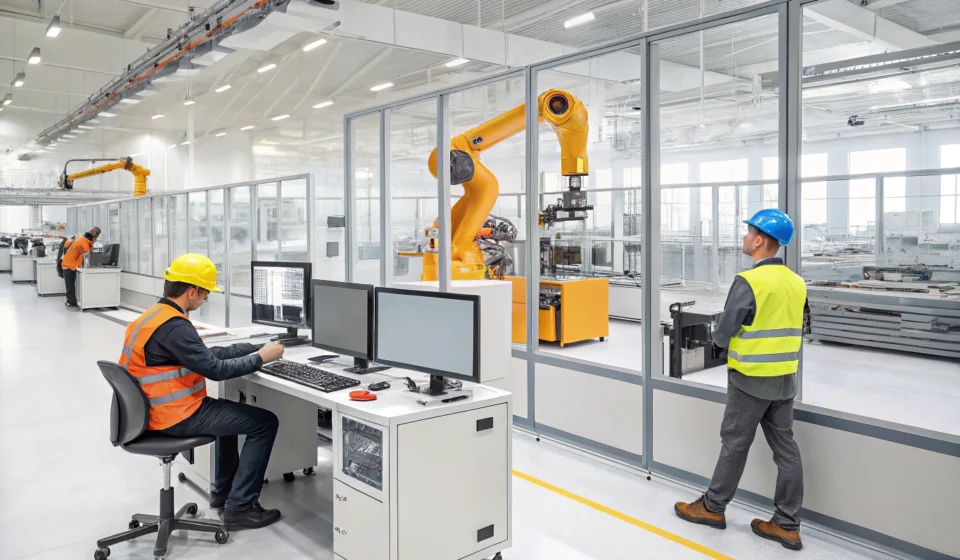
Despite geopolitical tensions and supply chain diversification trends, China’s contract manufacturing sector is adapting and evolving. The future points towards even greater integration of smart manufacturing, automation, and sustainable practices. Forward-looking Chinese manufacturers are investing heavily in Industry 4.0 technologies—robotics, AI-driven quality control, and IoT-enabled production lines—to enhance efficiency and precision further. This technological deepening helps counter rising labor costs and reinforces China’s position as a hub for complex, high-value manufacturing.
Furthermore, the global contract manufacturing market is on a strong growth trajectory, forecasted to reach USD 968.7 billion by 2030. Chinese firms are positioning themselves to capture a significant share of this expansion by moving up the value chain, offering more sophisticated ODM designs and specialized OEM production for sectors like new energy vehicles, renewable energy equipment, and advanced medical devices. For global businesses, the strategic calculus is clear: partnering with a Chinese manufacturer is no longer just about cost savings; it’s about accessing a mature, technologically advanced ecosystem that can turn innovative designs into scalable, market-ready products with unparalleled speed and comprehensive support. The narrative is shifting from “Made in China” to “Created and Engineered with China,” cementing its role as an indispensable node in the global innovation and supply chain network.