






























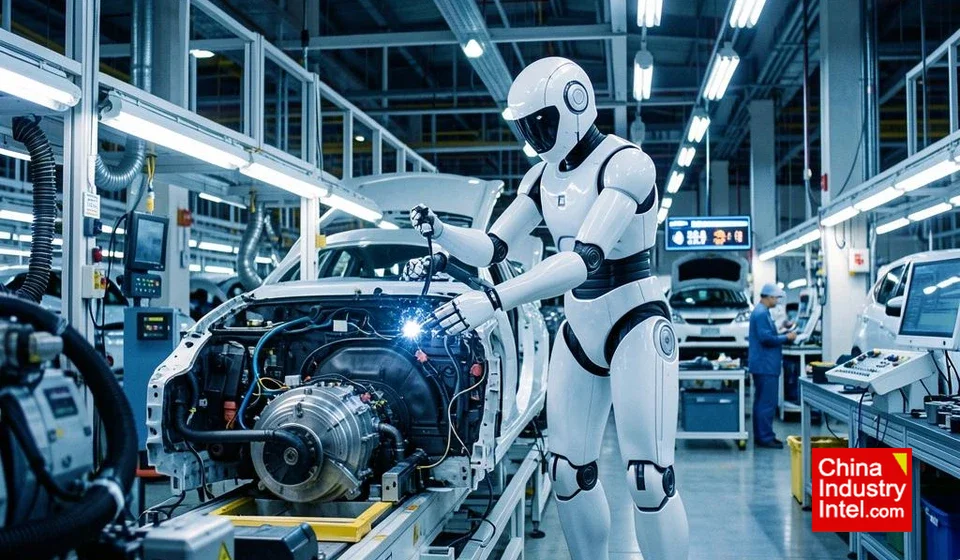
China Fast-Tracks Humanoid Robots Into Industry as Production Scales Up
By China Industry Intel | June 21, 2026
China is rapidly moving humanoid robots from research labs onto factory floors, backed by a sweeping government policy push that aims to make the country the world’s dominant producer and deployer of embodied AI systems. With subsidies, tax incentives, and dedicated industrial zones, Beijing is treating humanoid robotics as a strategic priority on par with semiconductors and electric vehicles.
The Policy Framework Driving Deployment
In January 2025, China’s Ministry of Industry and Information Technology (MIIT) issued its “Implementation Plan for the Innovation and Development of Humanoid Robots,” setting a target of mass production capability by 2027 and large-scale industrial deployment by 2030. The plan allocated over ¥10 billion ($1.4 billion) in direct subsidies and R&D grants across the sector. By mid-2026, at least 15 provincial governments have introduced their own humanoid robotics incentive programs, with Beijing, Shanghai, Shenzhen, and Hangzhou leading the charge.
The policy push extends beyond direct funding. Municipalities are offering rent-free factory space for robotics startups, fast-tracked land approvals, and subsidized procurement programs where local manufacturers receive government vouchers to purchase domestically produced humanoid robots for their production lines.
Current Deployment Numbers

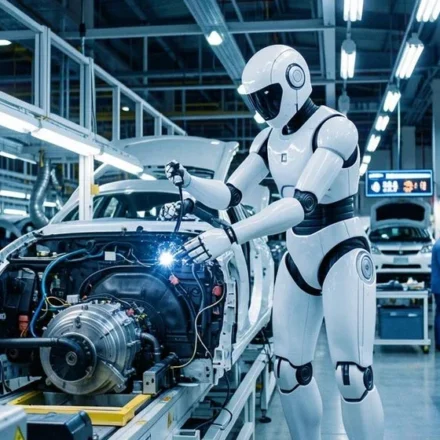
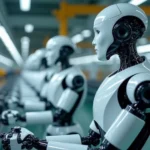
According to the China Robot Industry Alliance (CRIA), over 3,200 humanoid robots were deployed across Chinese manufacturing facilities in Q1 2026 alone, a 480% increase from the same period in 2025. The automotive, electronics assembly, and logistics sectors account for the majority of deployments. Factories operated by BYD, Foxconn, and SAIC Motor are among the largest adopters, using humanoid robots for quality inspection, component handling, and light assembly tasks.
Key Companies Leading the Charge

Unitree Robotics, based in Hangzhou, has emerged as a frontrunner with its G1 humanoid robot, priced aggressively at under ¥100,000 ($13,700) per unit. The company delivered over 1,500 units in Q1 2026 and has secured contracts with three major automotive OEMs.
UBTECH Robotics, listed in Hong Kong since December 2023, has pivoted aggressively from educational robotics into industrial humanoids. Its Walker S robot is now deployed in over 40 factory sites across China, handling logistics and inspection tasks. The company reported a 210% year-on-year increase in industrial robot revenue for Q1 2026.
Fourier Intelligence has carved out a niche in healthcare and rehabilitation robotics but is now expanding into manufacturing. Its GR-1 humanoid, standing 1.65 meters tall, can handle payloads of up to 50 kg and has been adopted by several pharmaceutical warehouse operators.
Other notable players include Agibot (backed by Shanghai’s municipal government), Galbot, and Xpeng Robotics, which leverages its parent company’s autonomous driving AI stack for robot navigation.
Government Subsidies and Industrial Policy
| Subsidy Type | Amount/Benefit | Eligibility |
|---|---|---|
| R&D Grant | Up to ¥50M per project | Companies developing humanoid core components |
| Procurement Voucher | 30% of robot purchase price | Manufacturers buying domestic humanoids |
| Tax Deduction | 200% super-deduction on R&D spending | Certified robotics enterprises |
| Factory Space | 3 years rent-free in designated zones | Robotics startups in 15 pilot cities |
| Talent Subsidy | ¥500,000 signing bonus per top researcher | AI/robotics PhDs recruited from overseas |
Comparison with the US and Japan
The United States has taken a more market-driven approach, with companies like Tesla (Optimus), Figure AI, and Agility Robotics pursuing commercial humanoid robots without comparable government subsidies. Tesla has stated it aims to begin limited Optimus deployments in its own factories in late 2026, while Figure AI has raised over $750 million in venture capital.
Japan, historically the robotics powerhouse, has seen its humanoid efforts lag behind China’s industrial scale. Honda discontinued its Asimo program in 2022, and while Toyota and SoftBank continue research, Japan lacks the coordinated national strategy and manufacturing scale that China has deployed. Japan’s robot industry remains strong in traditional industrial arms but has struggled to match China’s pace in humanoid development.
South Korea’s Samsung and Hyundai (which owns Boston Dynamics) are investing heavily but face the challenge of scaling production without the government-backed ecosystem that Chinese firms enjoy.
Challenges Ahead
Despite the momentum, significant hurdles remain. Battery life for most humanoid robots remains under 4 hours of continuous operation. The dexterity required for fine manipulation tasks — threading cables, assembling small electronics — is still below human levels. Software reliability in unstructured environments remains a concern, with most deployments requiring controlled factory settings.
However, the pace of improvement is rapid. China filed over 4,800 humanoid robotics patents in 2025, more than the US and Japan combined. With continued government backing and a massive domestic manufacturing base eager to automate, China’s humanoid robot push shows no signs of slowing.
Sources
- South China Morning Post — China fast-tracks humanoid robots into industry
- Ministry of Industry and Information Technology (MIIT)
- Reuters — China’s Unitree Robotics scales humanoid production
- CNBC — Humanoid robot race heats up between US and China