

































Humanoid Robots Hit Mass Production in China as Factories Scale Up
China humanoid robot production reaches mass manufacturing. Unitree G1 at 16000 dollars, 200 units per month.
By CII (China Industry Intel) – Contributing Analyst | June 20, 2026
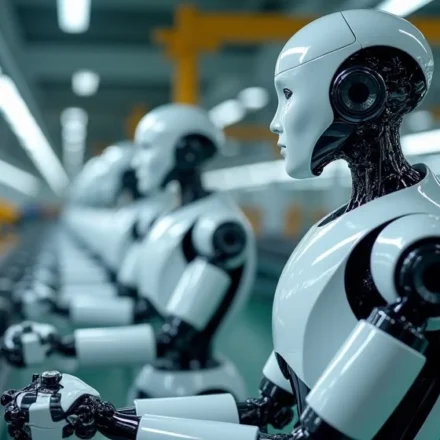
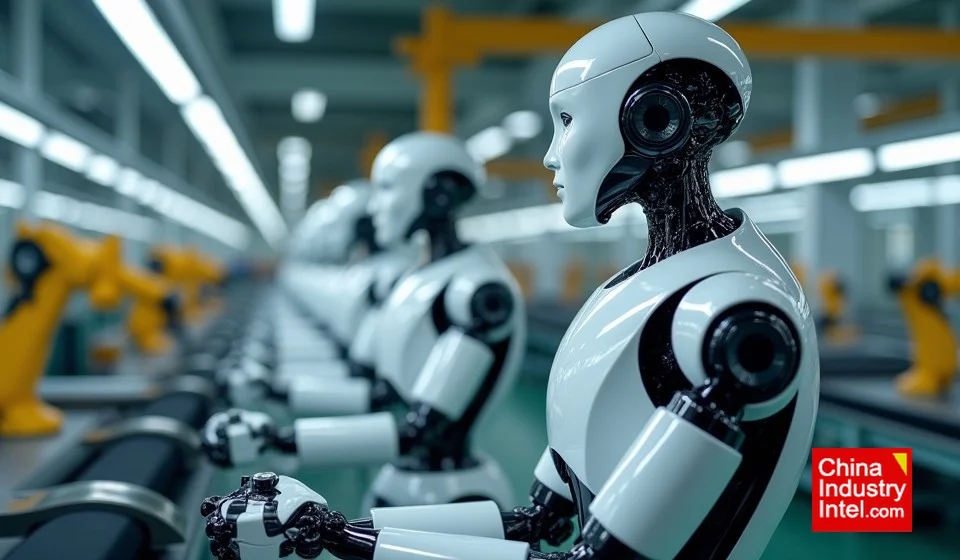
China’s humanoid robot industry has crossed the threshold from prototype to mass production. Unitree Robotics announced on June 15 that its Hangzhou factory is now producing 200 units per month of the G1 humanoid robot, with plans to scale to 500 units per month by Q4 2026. UBTECH and Agibot have made similar announcements, collectively targeting over 10,000 humanoid robot deployments in Chinese factories by year-end — a number that would have seemed fantastical 18 months ago.
The Production Numbers
The shift from handcrafted prototypes to factory production is the most significant development in China’s humanoid robot industry. For the first time, reliable production data is available:
| Company | Model | Monthly Production | 2026 Target | Price Point |
|---|---|---|---|---|
| Unitree Robotics | G1 | 200 units | 3,000 units | $16,000 |
| UBTECH Robotics | Walker S | 150 units | 2,500 units | $50,000 |
| Agibot (Zhiyuan) | A2 | 100 units | 2,000 units | $30,000 |
| Fourier Intelligence | GR-2 | 80 units | 1,500 units | $35,000 |
| Galbot | G1 | 50 units | 1,000 units | $25,000 |
Unitree’s G1 at $16,000 is the price breakthrough that has changed the market calculus. For context, a conventional industrial robot arm costs $20,000-$50,000 and can only perform fixed, repetitive tasks. The G1 can navigate human-designed spaces, climb stairs, and manipulate objects with dexterous hands — capabilities that justify a premium over conventional automation.
The Factory Floor Reality

The first wave of humanoid robot deployments is concentrated in three sectors:
1. Automotive assembly. BYD and Geely have deployed humanoid robots for quality inspection and material handling on EV assembly lines. The robots work alongside human workers, checking weld quality, transporting components between stations, and performing tasks that require navigating around obstacles. BYD’s Shenzhen factory currently has 50 Unitree G1 units in operation, with plans to expand to 200 by year-end.
2. Electronics manufacturing. Foxconn has begun testing humanoid robots at its Zhengzhou facility for iPhone assembly tasks. The current deployment is limited to 20 units performing non-critical tasks like component sorting and visual inspection, but the company has signaled plans to scale to 500 units across multiple factories in 2027.
3. Logistics and warehousing. JD.com and Cainiao (Alibaba’s logistics arm) are testing humanoid robots for last-mile delivery and warehouse picking. The economics are favorable: a humanoid robot can work 20 hours per day at an effective cost of $3-5 per hour (including depreciation and maintenance), compared to $8-12 per hour for human workers in tier-1 cities.
The Software Challenge

UPSTREAM: The hardware supply chain is maturing rapidly. Chinese component suppliers — harmonic drive maker Leaderdrive, servo motor manufacturer Inovance Technology, and sensor company Sunny Optical — are providing components at 30-50% below the cost of Japanese and German alternatives. This hardware cost advantage is the foundation of Unitree’s $16,000 price point.
DOWNSTREAM: The real bottleneck is software. Current humanoid robots can perform pre-programmed tasks reliably, but they struggle with novel situations, unstructured environments, and tasks requiring fine motor judgment. The “intelligence gap” between what the hardware can do and what the software enables is the primary constraint on adoption.
BOTTLENECKS: Embodied AI — the software that enables robots to perceive, reason, and act in the physical world — is advancing rapidly but remains immature. Baidu, Huawei, and several startups are developing foundation models specifically for robotics, but these models require massive training datasets that don’t yet exist for most industrial tasks.
What the Market Is Telling Us
BULL CASE: Humanoid robots become the default automation platform for factories by 2028. Unitree, UBTECH, and Agibot collectively produce 50,000+ units annually, and China captures 60% of global humanoid robot production. The cost per unit drops below $10,000, making humanoid robots competitive with conventional automation for most tasks.
BEAR CASE: Software limitations keep humanoid robots in pilot mode through 2028. The gap between hardware capability and software intelligence proves harder to close than expected, and factories revert to conventional automation for most tasks. The humanoid robot market remains niche, with annual sales under 10,000 units globally.
BASE CASE: Humanoid robots find their first viable niche in automotive and electronics manufacturing by 2027, with annual global sales reaching 20,000-30,000 units. China dominates hardware production but faces competition from Tesla (Optimus) and Figure AI on software capabilities.
WHAT TO WATCH: Unitree’s Q3 2026 production numbers; BYD and Foxconn deployment expansion announcements; progress on embodied AI models from Baidu and Huawei; and Tesla Optimus production milestones.
CII Analysis
China’s humanoid robot industry has reached the mass production milestone that separates hype from reality. The 200 units per month at Unitree is not a large number in absolute terms, but it represents the transition from handcrafted prototypes to factory manufacturing — the same transition that made Chinese solar panels, EVs, and batteries dominant global industries. The $16,000 price point is the game-changer: it makes humanoid robots accessible to mid-sized manufacturers, not just large corporations. If the software keeps pace with hardware improvements, China’s humanoid robot industry could follow the same trajectory as its EV industry — slow start, rapid scaling, global dominance within a decade.
Related reading:
Sources
- Fox News — Humanoid robots hit mass production in China
- SCMP — China’s humanoid robot production data
- AP News — China humanoid robot industry analysis
- Reuters — China humanoid robot mass production
- YouTube — New AI Robots 2026: China Expo and Human-Level Robots