




























China Tech Giants Face Margin Squeeze as AI Spending Surges 65 Percent
What Happened
China’s leading technology companies — including Alibaba, Tencent, Baidu, and JD.com — are reporting a significant squeeze on profit margins as they accelerate artificial intelligence investments in Q2 2026. The combined AI capital expenditure of China’s top five tech firms is projected to exceed $25 billion in the first half of 2026, a 65% increase from the same period last year, as they race to build the infrastructure needed to compete in the global AI arms race.
While revenue growth remains robust across most segments, the aggressive AI spending is compressing operating margins by 3-5 percentage points, raising questions from investors about the path to profitability for these massive infrastructure investments.
Key Developments
Alibaba Cloud AI Revenue Surges, But Costs Soar
Alibaba Group (9988.HK/BABA) reported Q1 FY2027 earnings showing cloud computing revenue growth of 28% year-over-year, driven by AI-related services. However, capital expenditure surged to $4.2 billion in the quarter, primarily for GPU procurement and data center expansion. Operating margin for the cloud segment contracted to 8.5%, down from 12.3% a year ago.
Tencent Balances Gaming Strength with AI Ambitions
Tencent (0700.HK) posted Q1 2026 revenue of $22.5 billion (+12% YoY), with gaming and advertising segments showing strong performance. However, AI infrastructure spending reached $3.8 billion in the quarter, with the company building out its Hunyuan large language model ecosystem. Operating margin fell to 29.5% from 33.2% as AI costs ramped up.
Baidu’s AI-First Strategy Shows Mixed Results
Baidu (9888.HK/BIDU) reported Q1 2026 revenue of $4.6 billion (+8% YoY), with AI cloud revenue growing 42%. However, the company’s core search advertising business continued to decline (-5% YoY) as users shift to AI-powered alternatives. Baidu’s operating margin compressed to 15.2% from 19.8% as it invested heavily in its Ernie Bot ecosystem.
| Company | Q1 2026 Revenue | YoY Growth | AI CapEx (H1 2026) | Operating Margin | Margin Change |
|---|---|---|---|---|---|
| Alibaba | $33.5B | +7% | $8.5B | 12.5% | -3.2pp |
| Tencent | $22.5B | +12% | $7.2B | 29.5% | -3.7pp |
| Baidu | $4.6B | +8% | $3.8B | 15.2% | -4.6pp |
| JD.com | $36.2B | +6% | $2.5B | 3.8% | -1.2pp |
| NetEase | $3.8B | +9% | $1.2B | 28.5% | -2.1pp |
Why It Matters
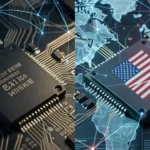
The margin compression across China’s tech sector mirrors a similar trend in the United States, where Microsoft, Google, and Meta are all investing heavily in AI infrastructure. However, China’s tech giants face unique challenges: they must build their AI stacks on domestic chips due to U.S. export controls, which increases costs by an estimated 20-30% compared to using NVIDIA’s latest GPUs.
The key question for investors is whether these AI investments will generate returns within 2-3 years or become a prolonged drag on profitability. Early evidence suggests that AI-related revenue is growing rapidly (30-50% YoY for most companies), but it still represents only 10-20% of total revenue. The transition to AI-driven business models will take time.
For the broader Chinese economy, the tech sector’s AI spending is creating a significant multiplier effect. Data center construction, GPU procurement, and AI talent hiring are driving demand across the supply chain, from semiconductor equipment to real estate to education.
China Industry Impact
GPU Shortage Drives Domestic Chip Development
The massive AI capex is creating unprecedented demand for GPUs. With NVIDIA’s latest chips restricted by U.S. export controls, Chinese tech companies are turning to domestic alternatives. Huawei’s Ascend 910C and Biren Technology’s BR100 are seeing surging orders, with delivery times extending to 6-9 months. This is accelerating China’s semiconductor self-sufficiency push.
Data Center Construction Boom
The AI infrastructure buildout is driving a construction boom across China. GDS Holdings and Chindata are expanding their data center capacity by 40-50% in 2026. The demand for liquid cooling systems, backup power, and high-speed networking equipment is creating opportunities for domestic suppliers.
AI Talent War Intensifies
The competition for AI talent is intensifying, with senior AI engineers commanding salaries of $200,000-$500,000 in China. Chinese tech companies are hiring aggressively from universities and research institutes, with Tsinghua University and Peking University being primary talent sources. The talent shortage is a key constraint on the pace of AI development.
Supply Chain Implications
Upstream: Semiconductor Equipment
The AI infrastructure buildout is driving demand for semiconductor equipment, particularly for advanced packaging and testing. Chinese equipment makers like Naura Technology and AMEC are seeing record orders. The domestic semiconductor equipment market is projected to grow 35% in 2026.
Midstream: Server and Networking
AI servers require specialized components including high-bandwidth memory (HBM), advanced interconnects, and liquid cooling systems. Chinese server makers like Inspur and H3C are ramping up production of AI-optimized servers. The market for AI servers in China is projected to reach $15 billion in 2026.
Downstream: AI Applications
The massive infrastructure investment is enabling a new generation of AI applications. Chinese tech companies are launching AI-powered products across e-commerce, gaming, healthcare, and autonomous driving. The key challenge is monetizing these applications quickly enough to justify the infrastructure costs.
CII Analysis
Our Take: The margin compression across China’s tech sector is a necessary investment phase, not a sign of weakness. Companies that fail to invest in AI infrastructure now will be left behind in 3-5 years. The key differentiator will be execution — which companies can convert AI capex into revenue growth most efficiently.
Alibaba and Tencent are best positioned due to their massive user bases and diverse revenue streams. Their AI investments are already generating returns through cloud services, advertising optimization, and new product features. Baidu faces the most risk, as its core search business is being disrupted by AI alternatives.
For investors, the current margin compression creates buying opportunities for long-term positions. The AI infrastructure buildout is a multi-year trend that will reshape China’s tech sector. Companies with strong balance sheets and clear AI strategies — particularly Alibaba, Tencent, and emerging AI chip makers — are well-positioned to benefit.
For deeper coverage of China’s tech sector, see our China AI Industry 2026 pillar page.
By CII Research Team | China Industry Intel
Sources
1. Bloomberg Intelligence, “China Tech Earnings: AI Spending Squeezes Margins,” June 14, 2026.
2. Goldman Sachs, “China Internet Sector: AI CapEx Deep Dive,” June 2026.
3. Alibaba Group, Q1 FY2027 Earnings Release, June 2026.
4. Tencent Holdings, Q1 2026 Interim Report, June 2026.
5. Baidu Inc., Q1 2026 Earnings Release, June 2026.
6. Morgan Stanley, “China AI Infrastructure: Who Wins?”, May 2026.
Disclaimer: This article is for informational purposes only and does not constitute investment advice. Data sourced from company earnings reports, analyst estimates, and industry research.