US-Iran Ceasefire Reopens Strait of Hormuz: What It Means for China
US-Iran Ceasefire Reopens Strait of Hormuz — What It Means for China
Hook: On June 15, 2026, President Trump announced that a ceasefire deal with Iran had been finalized, signaling the imminent reopening of the Strait of Hormuz — the world’s most critical oil chokepoint that has been effectively closed since late February. For China, which imports roughly 5 million barrels per day through the strait and is Iran’s largest oil buyer, the deal represents the single most significant relief event for its energy supply chain in 2026. Oil prices tumbled on the news, with Brent crude falling nearly 10 percent in intraday trading, setting the stage for lower manufacturing costs across China’s industrial base.
What Happened
On June 15, 2026, President Trump announced on Truth Social that “The Deal with the Islamic Republic of Iran is now complete,” confirming a ceasefire agreement mediated by Pakistan’s Prime Minister Shehbaz Sharif. A Memorandum of Understanding is scheduled to be signed Friday in Switzerland, with the pact calling for “immediate and permanent termination of military operations on all fronts, including Lebanon.”
The centerpiece of the deal for global markets is the reopening of the Strait of Hormuz, the narrow waterway between Iran and Oman through which approximately 20 percent of the world’s oil supply passes daily. The strait has been effectively closed since late February 2026, when US-Israeli military strikes on Iran triggered a full-scale confrontation that saw Iran deploy mines, anti-ship missiles, and drone swarms to seal the passage.
Iran has granted a two-week safe passage window coordinated with its Armed Forces to allow the 600-plus vessels stranded in the Gulf to begin transiting. The scale of the backlog is staggering: 116 million barrels of crude oil remain trapped on tankers inside the Gulf, while daily exports through Hormuz collapsed from 16.3 million barrels per day to just 1.2 million barrels per day during the crisis.

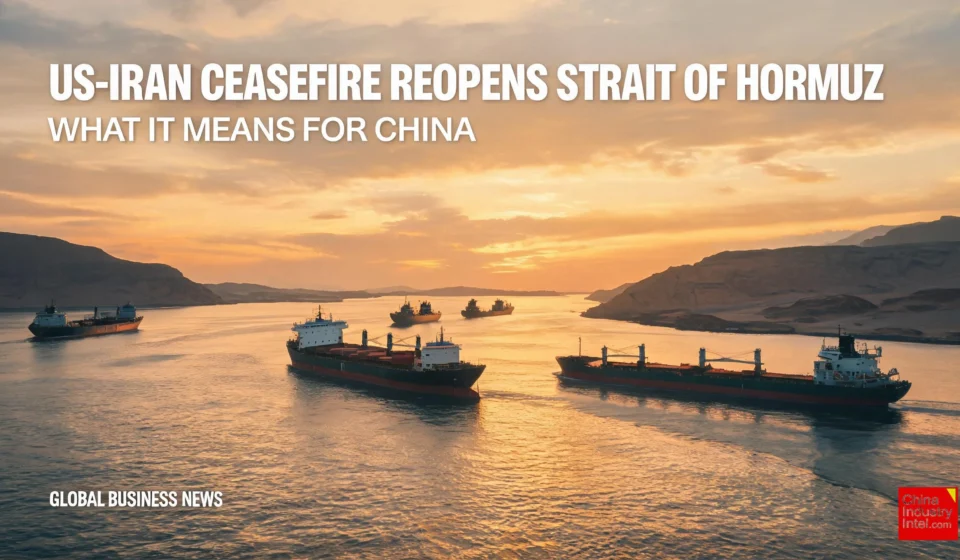
Image: Unsplash / The Strait of Hormuz handles approximately 20% of global oil transits daily
Key Developments
Oil Price Collapse: Brent crude fell approximately 10 percent on June 15 as traders priced in the reopening of Hormuz and the release of 116 million barrels of stranded crude. Prices had surged from roughly $72 per barrel in January to peaks above $95 during the crisis, with each military escalation adding a risk premium. The ceasefire removes the largest single geopolitical premium from crude markets in 2026, though analysts caution that the path back to pre-crisis levels will depend on the speed of tanker clearance and production normalization.
Saudi Redirection Unwinding: During the closure, Saudi Arabia redirected approximately 3.7 million barrels per day through the East-West Pipeline to Yanbu on the Red Sea, bypassing Hormuz entirely. This emergency rerouting — which required maximum pipeline throughput and coordination with Red Sea tanker fleets — will gradually revert to normal Hormuz routes as the passage clears. However, the logistics of repositioning hundreds of tankers will take weeks, not days.
Iran’s Safe Passage Window: Iran’s two-week safe passage window is a critical but fragile element. The coordination mechanism involves Iran’s Armed Forces providing security guarantees for vessel transits, but the window is finite and conditional on the MOU signing proceeding as planned in Switzerland. Any breakdown in talks could trigger an immediate re-closure, which would send oil prices spiking above $100 per barrel within hours.
Strait of Hormuz Crisis Timeline
| Date | Event | Oil Price Impact | China Impact |
|---|---|---|---|
| Feb 2026 | Strait closed; US-Israel strikes on Iran | Brent +15% | Import costs surge; emergency procurement begins |
| Mar 2026 | 600+ vessels stranded; exports drop to 1.2 mb/d | Brent $95+ | Shadow fleet activated; premium pricing for alternatives |
| Apr 2026 | Fragile ceasefire; 2 ships pass under escort | Brent -4% | Limited relief; cautious optimism |
| Jun 8 | US Apache helicopter downed by Iranian drone | Brent +8% | Uncertainty returns; hedging costs spike |
| Jun 9 | US strikes Iranian air defenses at Bandar Abbas | Brent +5% | Supply fears intensify; Sinopec activates reserves |
| Jun 10 | Iran strikes US bases in Bahrain, Kuwait, Jordan | Brent +12% | Peak risk; refineries ration crude allocations |
| Jun 15 | Ceasefire deal announced; Hormuz reopening | Brent -10% | Costs to fall; 116M barrels of stranded crude to clear |
Source: Reuters, US News, CSIS, CII Research. Oil price impacts are approximate intraday or daily movements. China impacts reflect CII Research assessment of immediate market and supply chain effects.
China’s Gulf Oil Exposure
| Supplier | Daily Volume to China (mb/d) | Share of China Imports | Hormuz Dependent? |
|---|---|---|---|
| Saudi Arabia | 1.8 | ~17% | Yes (Yanbu bypass limited) |
| Iraq | 1.1 | ~10% | Yes (Basra terminal via Hormuz) |
| UAE | 0.7 | ~7% | Yes |
| Kuwait | 0.4 | ~4% | Yes |
| Iran (shadow fleet) | 1.0 | ~9% | Partially (independent tankers) |
| Total Gulf-dependent | 5.0 | ~47% | Highly exposed |
Source: China Customs, Kpler tanker tracking, CII Research estimates. Volumes are approximate daily averages for Q1 2026. Shadow fleet volumes include ship-to-ship transfers and AIS-darkened tankers.
Why It Matters
The Strait of Hormuz closure was the most disruptive energy supply shock since the 1990 Iraqi invasion of Kuwait. Unlike previous oil crises — which were driven by production cuts or demand shocks — the Hormuz crisis was a physical blockade that prevented crude from reaching markets regardless of price. Global oil supply fell by approximately 15 million barrels per day at the peak of the crisis, forcing emergency drawdowns from strategic petroleum reserves worldwide and triggering a scramble for alternative supply routes.
For the global economy, the ceasefire represents a deflationary event of enormous magnitude. Every $10 per barrel decline in crude oil translates to roughly $300 billion in annual savings for global consumers and businesses. With Brent falling from $95 toward the low $80s — and potentially lower — the ceasefire alone could inject the equivalent of a significant fiscal stimulus into the global economy through lower energy costs.
The reopening also carries profound geopolitical implications. Iran’s willingness to grant safe passage and negotiate suggests that the economic toll of sanctions-plus-warfare has exceeded Tehran’s tolerance threshold. For the United States, the deal validates the Trump administration’s maximum-pressure-plus-diplomacy approach, while Pakistan’s mediating role elevates Islamabad’s status as a regional power broker.
China Industry Impact
China is the single largest beneficiary of the Hormuz reopening, and the impact reverberates across its entire industrial base. As the world’s largest crude oil importer — purchasing approximately 11 million barrels per day — China’s economy is acutely sensitive to oil price movements. Every $1 decline in Brent crude saves Chinese importers roughly $4 billion annually, and the ceasefire-driven price drop from $95 to the low $80s represents annualized savings of $50 to $60 billion.
Refining Sector: China Petroleum & Chemical Corporation (Sinopec), the nation’s largest refiner, was forced to ration crude allocations to its 30-plus refineries during the crisis, reducing throughput by an estimated 15 to 20 percent at peak disruption. The ceasefire allows Sinopec to normalize operations and rebuild crude inventories. PetroChina, China’s largest oil producer, similarly benefits from lower input costs at its downstream operations while seeing reduced pressure on its domestic production to fill the import gap.
Manufacturing Costs: Energy costs are embedded in every stage of Chinese manufacturing — from petrochemical feedstocks for plastics and chemicals to fuel for logistics and power generation. The Hormuz crisis added an estimated 8 to 12 percent to Chinese manufacturing energy costs, squeezing margins across sectors from textiles to electronics. The ceasefire-driven oil price decline will flow through to lower manufacturing costs within 4 to 8 weeks as existing high-priced crude inventories are consumed and replaced with cheaper supply.
Strategic Petroleum Reserve: China’s SPR likely sustained significant drawdowns during the four-month crisis. Beijing does not publish real-time SPR data, but satellite imagery and tanker tracking suggest that China drew down an estimated 80 to 120 million barrels from its strategic reserves between February and June 2026. The ceasefire provides a window to rebuild SPR stocks at lower prices — a strategic imperative given the demonstrated vulnerability of China’s Hormuz-dependent supply chain.
Supply Chain Implications
Upstream — Oil Production: Gulf producers, particularly Saudi Arabia, Iraq, and the UAE, will need weeks to restore full production capacity and tanker loading schedules. Saudi Arabia’s Yanbu bypass diverted 3.7 million barrels per day but strained the East-West Pipeline to maximum capacity. The gradual return to Hormuz routes will be logistically complex, requiring coordination between national oil companies, tanker operators, and port authorities across the Gulf.
Midstream — Shipping & Tankers: COSCO Shipping, China’s largest shipping company and a major crude tanker operator, faces a complex operational transition. The 600-plus vessels stranded in the Gulf must be cleared in an orderly fashion, and COSCO’s tanker fleet will need to reposition from alternative routes back to Hormuz-dependent Gulf-Asia trades. Tanker rates, which spiked to extraordinary levels during the crisis as owners charged war-risk premiums of $2 to $4 million per voyage, will normalize gradually but remain elevated until the backlog clears. COSCO’s tanker division likely earned significant premiums during the crisis but faces a rapid revenue normalization.
Downstream — Petrochemicals & Manufacturing: China’s petrochemical industry — the world’s largest by output — was among the hardest hit by the Hormuz closure. Naphtha and ethylene prices tracked crude oil higher, squeezing margins at steam crackers and downstream polymer plants. The ceasefire-driven decline in crude will restore petrochemical margins to healthier levels, benefiting producers of polyethylene, polypropylene, and other oil-derived materials that feed into China’s massive plastics and packaging industries. Airlines including China Southern, China Eastern, and Air China — which saw jet fuel costs surge 30 percent during the crisis — will see immediate relief on their largest single operating expense.

Image: Unsplash / Over 600 vessels were stranded in the Gulf during the four-month Hormuz closure
CII Analysis
Our Take: The US-Iran ceasefire is a watershed moment for China’s energy security calculus, but it would be a mistake to treat it as a simple return to normalcy. The four-month Hormuz closure has exposed a structural vulnerability in China’s energy supply chain that Beijing will not soon forget. We expect accelerated investment in three areas: strategic petroleum reserve expansion (likely adding 200 to 300 million barrels of capacity over the next 18 months), diversification of crude supply sources toward Russia, Brazil, and West Africa, and a redoubling of the electric vehicle transition to reduce long-term oil dependence.
The market signal is asymmetric. In the bull case — full Hormuz reopening with no setbacks — oil prices could retreat to $65 per barrel within 90 days, creating a manufacturing cost tailwind that boosts Chinese industrial margins by 3 to 5 percentage points and supports the broader economic recovery. In the base case, partial reopening with Iranian tolling fees keeps oil in the $75 to $80 range, which is still a significant improvement from crisis levels. The bear case — ceasefire collapse — carries a 15 percent probability but would be devastating, sending oil above $100 and forcing another round of emergency SPR drawdowns.
The Iran shadow fleet dynamic deserves close monitoring. China imported an estimated 1 million barrels per day of Iranian crude through dark-fleet tankers during the crisis, often at steep discounts to benchmark prices. The ceasefire may paradoxically reduce Iran’s willingness to offer these discounts if its oil can flow through legitimate channels. Chinese refiners that benefited from cheap Iranian crude may find themselves paying more, not less, in a normalized market.
For deeper: China EV Supply Chain
Further reading: Iran Conflict Disrupts China’s Short-Term Supply Chain
Further reading: China Clean Energy Exports Hit Record in May 2026
Further reading: China’s Factory Activity Beats Forecasts
Market Signal:
Bull Case (50%): Full Hormuz reopening proceeds on schedule. The 600-vessel backlog clears within 30 days. Oil prices retreat to $65 per barrel by September, providing a massive tailwind to Chinese manufacturing costs. Sinopec and PetroChina ramp refining throughput to full capacity. COSCO tanker rates normalize but volumes surge. China’s SPR rebuilds at attractive prices. The ceasefire holds permanently and anchors a broader US-Iran détente.
Base Case (35%): Partial reopening with complications. Iran imposes tolling or inspection fees on Hormuz passage, adding $2 to $3 per barrel to shipping costs. Oil stabilizes in the $75 to $80 range. China benefits but not as dramatically as the bull case. The MOU signing in Switzerland proceeds but implementation lags. Tanker backlog takes 60 to 90 days to fully clear.
Bear Case (15%): The ceasefire collapses before the MOU is signed. Iran re-closes the strait. Oil spikes above $100 per barrel within days. China faces a second wave of supply disruption, this time with depleted SPR stocks. Global recession fears intensify. The US escalates militarily, creating a broader Middle East conflict.
Sources
- Reuters — US-Iran ceasefire deal announced June 15, 2026; Trump Truth Social announcement
- US News & World Report — Strait of Hormuz reopening details; Pakistan mediation role
- Center for Strategic and International Studies (CSIS) — Strait of Hormuz strategic analysis and closure impact assessment
- Kpler — Tanker tracking data; Gulf crude export volumes; stranded vessel counts
- China Customs — Crude oil import data by source country
- Bloomberg — Brent crude pricing data; Saudi Yanbu pipeline throughput estimates
- Sinopec (China Petroleum & Chemical Corporation) — Refinery throughput and crude allocation data
- COSCO Shipping — Fleet operations and tanker rate data