NVIDIA Vera Rubin Platform Launched at COMPUTEX 2026
NVIDIA Vera Rubin Platform Launched at COMPUTEX 2026: 10x Lower Cost Per Token Rewrites the AI Compute Economics
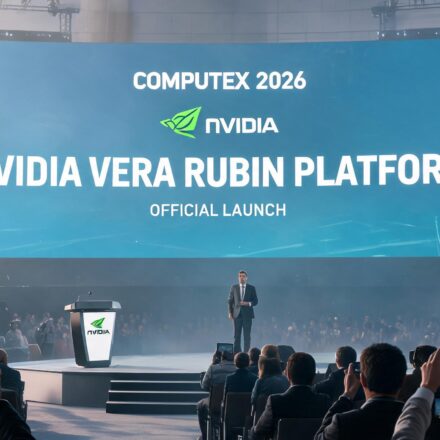
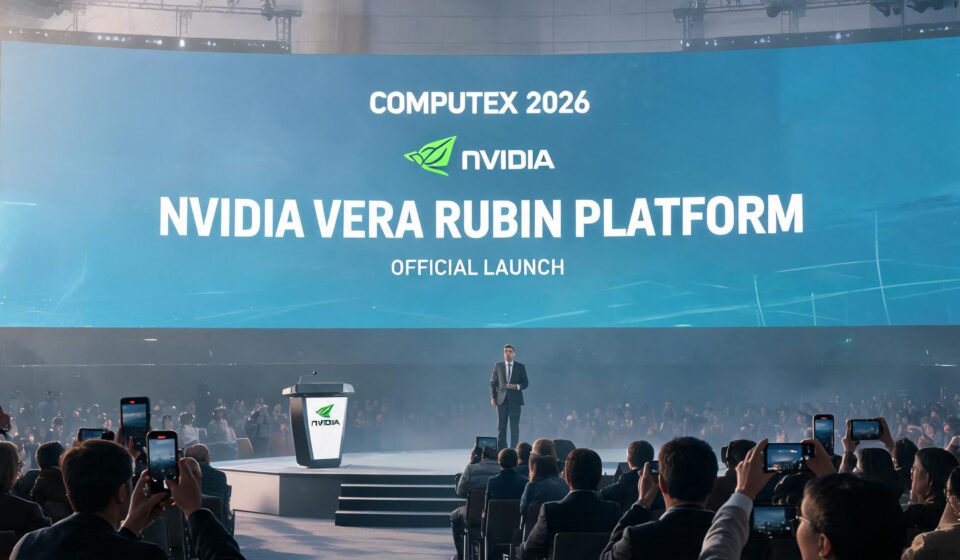
Hook: On June 1, 2026, NVIDIA CEO Jensen Huang took the stage at Taipei Music Center and declared the Vera Rubin platform “the largest product launch in Taiwan history.” The platform — six co-designed chips forming a unified rack-scale AI supercomputer — delivers 50 petaflops of FP4 inference per NVL72 rack, 10x lower cost per token than Blackwell, and 10x better inference performance per watt. With full production shipping in H2 2026 and the first rack already running at Microsoft Azure, Vera Rubin isn’t a roadmap slide — it’s a shipping product that resets the competitive calculus for every AI chip startup on the planet, including China’s fast-rising domestic players.
Photo by Brett Jordan on Unsplash
What Happened — Six Chips, One Supercomputer, 150 Taiwan Partners
Jensen Huang’s COMPUTEX 2026 keynote was less a product launch than a full-stack declaration of infrastructure dominance. Over two hours, Huang announced six new data center chips, a new PC platform (RTX Spark), a 500-billion-parameter open AI model (Nemotron 3 Ultra), next-generation robotics with Jetson Thor, and a redefinition of what constitutes a “computer” in the AI era. NVIDIA’s market capitalization, already north of $5.2 trillion, reflects investor conviction that the company intends to own every layer of the AI economy — from the power grid to the application.
The centerpiece was the Vera Rubin platform, named after astronomer Vera Rubin, whose galaxy rotation observations provided evidence for dark matter. The platform comprises six co-designed chips built as a single system — what NVIDIA calls “extreme co-design.” Each Vera Rubin NVL72 rack connects 36 Vera CPUs and 72 Rubin GPUs via sixth-generation NVLink switches, delivering 50 petaflops of NVFP4 inference compute and 260 TB/s of aggregate scale-up bandwidth. The Rubin GPU alone packs 336 billion transistors on TSMC’s 3nm node — a 1.6x increase over Blackwell’s 208 billion — with 288 GB of HBM4 memory per package and 22 TB/s bandwidth.
The first Vera Rubin rack is already operational at Microsoft Azure. Full production shipments begin H2 2026, with 150 ecosystem partners across Taiwan involved in manufacturing. Huang noted that “each one of the Vera Rubin systems consists of almost 2 million parts” — a scale of engineering integration that creates formidable barriers for competitors.
Why It Matters — The 10x Economics Reset
The headline numbers — 10x lower cost per token and 10x better inference performance per watt versus Blackwell — represent a generational leap in AI compute economics. For cloud providers and AI companies running continuous inference workloads, this translates directly into lower operating costs and higher throughput. For AI chip startups competing with NVIDIA, it raises the bar they must clear to offer a credible alternative.
The Vera Rubin platform also marks NVIDIA’s entry into the custom CPU market with the Vera processor — an ARM-based chip with 88 custom Olympus cores and 227 billion transistors. Huang projected a $200 billion total addressable market for Vera CPUs alone, including China. This move puts NVIDIA in direct competition with AMD’s EPYC and Intel’s Xeon in the data center CPU space, while simultaneously locking customers into an all-NVIDIA compute stack.
Photo by Luka Borazan on Unsplash
Key Players — NVIDIA’s Generational GPU Evolution
| Platform | Year | Process | Transistors | Memory | Key Performance |
|---|---|---|---|---|---|
| H100 | 2022 | TSMC 4N | 80B | 80 GB HBM3 | Baseline reference |
| H200 | 2024 | TSMC 4N | 80B | 141 GB HBM3e | 1.8x memory capacity vs H100 |
| B100 | 2024 | TSMC 4NP | 104B | 192 GB HBM3e | 2.5x inference vs H100 |
| B200 | 2024 | TSMC 4NP | 208B | 192 GB HBM3e | 18x training vs H100 |
| GB200 NVL72 | 2025 | TSMC 4NP | 208B (dual-die) | 192 GB HBM3e per GPU | 72-GPU rack scale; NVLink 5 |
| Vera Rubin NVL72 | 2026 | TSMC N3 (3nm) | 336B (dual-die) | 288 GB HBM4 per GPU | 50 PF FP4; 5x inference vs Blackwell; 10x lower cost/token |
Sources: NVIDIA official announcements at GTC 2025, CES 2026, GTC 2026, and GTC Taipei 2026. Performance comparisons are platform-level unless noted.
Strategic Implications — The China Angle
The Vera Rubin launch has direct implications for China’s semiconductor ecosystem. U.S. export controls already bar NVIDIA from selling its most advanced GPUs to Chinese customers, but the performance gap between NVIDIA’s latest and China’s best domestic alternatives continues to widen. China’s top AI chip startups — Enflame, Cambricon, Moore Threads, and Hygon — are collectively producing accelerators roughly comparable to NVIDIA’s H100-class performance. Vera Rubin’s 5x inference leap over Blackwell means China’s domestic chips are now two full generations behind the global frontier.
However, the export control regime creates a segmented market where absolute performance matters less than availability. Chinese cloud providers — Alibaba, Tencent, Baidu, ByteDance — cannot purchase Vera Rubin regardless of its superiority. This reality sustains demand for domestic alternatives and provides the revenue base that Chinese AI chip companies need to fund R&D. The question is whether the gap stabilizes or widens further with NVIDIA’s next-generation Feynman architecture, expected around 2028.
NVIDIA’s H200 chip has received a U.S. license to ship to China, with roughly ten Chinese firms cleared to purchase it. But as of mid-June 2026, no H200 units have been delivered to Chinese customers — a gap between regulatory approval and commercial reality that underscores the friction in even the permitted trade channels.
Market Signal — Three Scenarios for AI Compute Competition
Bull Case (for NVIDIA): Vera Rubin’s H2 2026 production ramp captures the majority of hyperscaler capex. The 10x cost-per-token improvement accelerates adoption of large-scale inference, driving NVIDIA’s data center revenue above $150 billion in FY2027. China’s domestic chipmakers remain confined to the domestic market, unable to compete on performance or software ecosystem globally. NVIDIA’s all-platform stack — GPU + CPU + networking + DPU + software — creates lock-in that no competitor can replicate.
Bear Case: Manufacturing bottlenecks at TSMC limit Vera Rubin’s H2 2026 ramp. Power consumption per rack exceeds projections, slowing data center deployment. AMD’s MI400 series and custom ASIC efforts from Google (TPU v6) and Amazon (Trainium3) capture meaningful inference market share. Chinese domestic chipmakers, subsidized by government procurement policies, achieve 70-80% of H100-class performance at 40% of the cost — enough for China’s domestic market needs.
Base Case: Vera Rubin ships on schedule and becomes the dominant AI infrastructure platform for 2026-2028. NVIDIA maintains 80%+ data center GPU market share. Chinese domestic chipmakers grow rapidly within China but remain 2-3 years behind in absolute performance. The global AI compute market bifurcates into an NVIDIA-dominated international segment and a policy-driven Chinese domestic segment, with TSMC’s advanced packaging capacity serving as the ultimate bottleneck for both.
What to watch: Three indicators will signal which scenario is materializing. First, TSMC’s CoWoS advanced packaging capacity expansion — NVIDIA has contracted approximately 60% of TSMC’s total CoWoS output, creating supply constraints for competitors. Second, the pace of Vera Rubin adoption at Chinese-excluded hyperscalers (Microsoft, Google, Amazon, Meta). Third, the performance benchmarks of China’s next-generation domestic chips from Cambricon and Hygon, expected in 2027. The outcome will determine whether NVIDIA’s dominance is structural or whether the fragmented global supply chain creates durable openings for alternative architectures in the decoupled semiconductor landscape.
CII Analysis
NVIDIA’s Vera Rubin launch represents more than a product cycle upgrade — it is a structural resetting of AI compute economics that widens the moat around NVIDIA’s ecosystem while simultaneously intensifying the urgency of China’s semiconductor self-sufficiency drive. The “extreme co-design” philosophy — where GPU, CPU, networking, DPU, and switch silicon are developed as a single integrated system — creates a level of vertical integration that no competitor, Chinese or otherwise, can currently match.
For China’s semiconductor ecosystem, the implications are paradoxical. On one hand, Vera Rubin’s performance leap makes the technology gap with domestic alternatives more visible and more painful. Chinese cloud providers running inference workloads on Cambricon SiYuan or Hygon DCU accelerators are operating at a fraction of Vera Rubin’s throughput per watt. On the other hand, export controls ensure that this gap is commercially irrelevant within China — Chinese customers cannot buy Vera Rubin regardless, which sustains the domestic market opportunity that companies like Enflame and Moore Threads depend on.
Our assessment: NVIDIA’s Vera Rubin platform cements the company’s position as the defining infrastructure provider of the AI era, but the resulting technology bifurcation between the U.S.-led and China-led semiconductor ecosystems is now irreversible. China’s domestic AI chip industry will continue to grow — supported by government procurement, sovereign compute mandates, and the sheer scale of domestic AI demand — but it will do so in an increasingly separate competitive environment where absolute performance benchmarks matter less than availability and policy alignment. The era of a single global AI compute market is ending; Vera Rubin is the clearest marker yet of that transition.
For more analysis on China’s semiconductor ecosystem, see our China Semiconductor Ecosystem pillar page and our coverage of the US-China Chip War.
Further Reading:
- Tencent-Backed Enflame IPO as China AI Chip Wave Rises
- CXMT IPO Creates Windfall for China Chip Supply Chain
- China Opens First Photonic Computing Lab to Sidestep US Chip Curbs
Sources
- NVIDIA Blog — GTC Taipei at COMPUTEX: Live Updates on What’s Next in AI (May-June 2026)
- FourWeekMBA — Inside Nvidia’s Computex 2026: Six New Chips, a PC, a Robot (June 1, 2026)
- VRLA Tech — NVIDIA Vera Rubin Architecture Explained (June 8, 2026)
- ImSeanKim — NVIDIA Vera Rubin: 50 PFLOPS Per GPU, 336B Transistors (GTC 2026)
- 2CRSi — NVIDIA Vera Rubin New-Gen Specifications
- Augustman — COMPUTEX 2026: Jensen Huang On AI And NVIDIA Vera Rubin