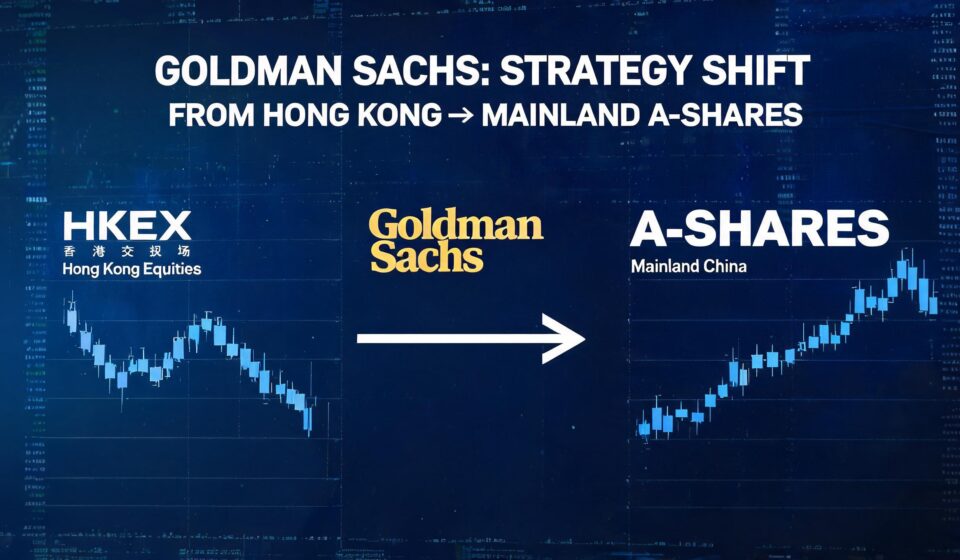
Goldman Sachs Shifts Strategy From Hong Kong to Mainland A-Shares
Goldman Sachs Shifts Strategy From Hong Kong to Mainland China A-Shares
Goldman Sachs (NYSE: GS; market capitalization approximately $155 billion as of June 2026; CEO David Solomon) is materially reducing its Hong Kong equity allocations in favor of mainland China A-shares, according to a strategy note distributed to institutional clients on June 2, 2026. The move, which represents one of the most significant tactical rotations by a major Wall Street firm this year, reflects a convergence of valuation, policy, and sector factors that increasingly favor onshore Chinese equities.
Valuation Gap Widens
The core of Goldman’s argument is straightforward: A-shares are cheaper. As of June 10, 2026, the CSI 300 Index traded at a forward price-to-earnings ratio of approximately 11.8x, compared with 14.2x for the Hang Seng Index and 16.5x for the Hang Seng TECH Index. Adjusted for sector composition — the CSI 300 is heavier in industrials, financials, and consumer staples, while the Hang Seng skews toward technology and property — the discount is even wider in comparable segments.
“The valuation differential between onshore and offshore Chinese equities has reached a level that is difficult to justify on fundamentals alone,” wrote Kinger Lau, Goldman Sachs’ chief China equity strategist, in the June 2 note. “We believe the A-share market now offers a more attractive risk-reward profile for the next 12 months.”
Goldman’s model portfolio adjustment involves reducing its overweight position in Hong Kong-listed stocks from +8 percent to +2 percent relative to benchmark, while lifting its A-share overweight from +3 percent to +9 percent. The firm did not disclose the absolute dollar amount being reallocated, but people familiar with the matter indicated the shift affects several billion dollars in client assets.
Policy Tailwinds for A-Shares
The valuation argument is reinforced by a distinct policy environment. Since late 2025, Chinese regulators have taken a series of steps designed to support the domestic stock market. The China Securities Regulatory Commission (CSRC) tightened IPO issuance in early 2026, reducing the supply of new shares. The People’s Bank of China (PBOC) expanded its stock market stabilization fund in March 2026, providing a direct backstop for large-cap A-shares. And in May 2026, the Ministry of Finance announced tax incentives for long-term individual retirement accounts invested in A-share index funds.
Hong Kong, by contrast, has faced persistent headwinds. Outflows from southbound Stock Connect have exceeded inflows for three consecutive months through May 2026, and the Hong Kong dollar’s peg to the US dollar means that Federal Reserve policy indirectly tightens financial conditions in the territory even as mainland China eases.
The divergence in retail investor behavior is also telling. Retail investors are finally coming back to China’s A-share market, with new account openings in May 2026 reaching their highest level since September 2021, according to data from the China Securities Depository and Clearing Corporation. Hong Kong’s retail participation, meanwhile, remains subdued, with average daily turnover on the Hong Kong Stock Exchange falling 12 percent year-over-year in Q1 2026.
Tech Sector Rotation
A key driver of Goldman’s rebalancing is the technology sector, which has performed differently onshore and offshore. The Hang Seng TECH Index, home to companies like Alibaba, Tencent, and Meituan, has returned approximately 8 percent year-to-date through June 10, 2026. The CSI All-Share Semiconductor Index and the CSI Artificial Intelligence Index, by contrast, have returned 22 percent and 31 percent respectively over the same period.
The gap reflects the growing importance of domestic technology themes — semiconductor self-sufficiency, AI infrastructure, and industrial automation — which are better represented in A-shares. Many of the companies benefiting from government procurement policies and “Delete A” substitution programs (whereby Chinese firms replace foreign technology suppliers with domestic alternatives) are listed exclusively on the Shanghai or Shenzhen exchanges.
Morgan Stanley echoed this view in a separate report published on May 28, 2026, flagging Chinese chip stocks as a buy and noting that domestic semiconductor names trade at a meaningful discount to global peers despite comparable or superior growth trajectories.
CSI 300 vs. Hang Seng: Diverging Fortunes
The performance divergence between the two indices has widened in 2026 after several years of rough convergence. A comparison of key metrics illustrates the gap:
| Metric | CSI 300 | Hang Seng Index |
|---|---|---|
| YTD Return (to June 10) | +14.2% | +5.8% |
| Forward P/E | 11.8x | 14.2x |
| Dividend Yield | 2.6% | 3.4% |
| Foreign Ownership (approx.) | 4.8% | 38% |
| Avg Daily Turnover (May 2026) | RMB 1.12 trillion | HK$128 billion |
The foreign ownership figure is particularly relevant. At roughly 4.8 percent of free-float market capitalization, foreign investors hold a relatively small share of A-shares. This means that any increase in global allocations — whether from active managers like Goldman or from passive index funds tracking MSCI’s China indices — has an outsized impact on prices, given the depth of the domestic investor base.
Implications for Hong Kong
Goldman’s move is not occurring in isolation. Several other global asset managers have signaled similar repositioning in recent weeks. JPMorgan Asset Management increased its A-share allocation in its Asia-Pacific fund by 4 percentage points in May 2026, according to the fund’s latest factsheet. UBS Global Wealth Management upgraded its view on A-shares from “neutral” to “most preferred” in its mid-year outlook published on June 5, 2026.
For Hong Kong, the rotation raises uncomfortable questions about the city’s role as China’s premier capital markets gateway. The Stock Connect programs, launched in 2014 and 2016, were designed to channel international capital into mainland stocks while keeping Hong Kong relevant. But the flow has become increasingly bidirectional, and mainland investors now account for a substantial portion of Hong Kong daily turnover — roughly 15 to 18 percent on average in 2026.
Hong Kong Exchanges and Clearing (HKEX) has responded by lowering listing fees and streamlining the IPO process, but these measures have yet to reverse the structural trend. The number of new listings on HKEX in the first five months of 2026 fell to 24, down from 35 in the same period of 2025, according to data compiled by the exchange.
Risk Factors
Goldman’s strategists acknowledged several risks to the A-share overweight thesis. First, the regulatory environment in China remains unpredictable; the abrupt tightening of rules governing after-school tutoring companies in 2021 is still fresh in institutional memory. Second, the yuan’s trajectory matters: a weaker renminbi reduces the dollar-denominated return for foreign investors in A-shares, partially offsetting any capital gain. Third, liquidity in certain small- and mid-cap A-shares remains thin, making it difficult to build or exit large positions without moving the market.
Nonetheless, the weight of evidence — valuation, policy support, sector composition, and retail participation trends — has convinced Goldman that the risk-reward balance has tilted in A-shares’ favor. The firm’s base case, as outlined in the June 2 note, projects that the CSI 300 will reach 4,400 by year-end 2026, representing approximately 9 percent upside from the June 10 close of 4,045.
What Investors Should Watch
For investors considering a similar rotation, Goldman recommended focusing on three A-share themes: domestic semiconductor substitution (beneficiaries of the “Delete A” policy), AI infrastructure buildout (data centers, GPU alternatives, and edge computing), and consumption recovery in lower-tier cities. Each of these themes is primarily captured through onshore listings, reinforcing the structural case for A-share exposure over Hong Kong equivalents.
The shift underscores a broader recalibration underway among global investors. After years of treating China as a monolithic market, sophisticated allocators are differentiating between onshore and offshore opportunities with increasing precision — and right now, the money is flowing toward the mainland.