China Exports Surge 19.4 Percent as AI Chips Rewrite Trade Landscape
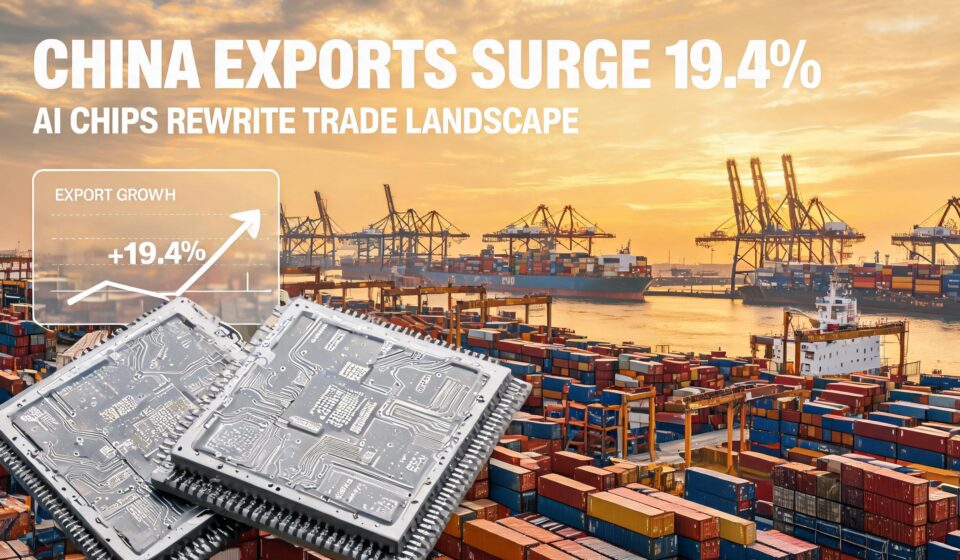
China’s export machine roared back to life in May 2026, posting a 19.4% year-over-year surge that caught even the most bullish forecasters off guard. The headline number — the strongest monthly export growth since early 2023 — was not driven by toys, textiles, or furniture. It was powered by silicon. Automated data processing equipment exports jumped 66.1%. Integrated circuits surged 111%. High-tech products broadly climbed 50.9%. The May trade data, released by China’s General Administration of Customs on June 9, is the clearest signal yet that the global AI infrastructure buildout is reshaping China’s trade composition in real time.
What Happened — May 2026 Trade Data Breakdown
China exported $363.8 billion worth of goods in May 2026, up from $304.7 billion in May 2025, according to customs data. The 19.4% growth rate exceeded the Bloomberg consensus estimate of 14.8% and marked the third consecutive month of double-digit export expansion. Total imports reached $268.4 billion, up 27.4% year-over-year — the fastest import growth in 16 months — reflecting surging demand for semiconductor manufacturing equipment, energy, and raw materials needed to sustain the export boom.
The composition of the export surge tells the real story. Conventional consumer goods — the backbone of China’s export economy for three decades — grew at low single digits. Electronics and technology categories dominated. The customs breakdown, summarized in the table below, reveals an export profile increasingly tilted toward the high-value, capital-intensive products that China’s industrial planners have spent a decade cultivating.
| Export Category | May 2026 Value (est.) | YoY Growth | Key Driver |
|---|---|---|---|
| Total Exports | $363.8B | +19.4% | AI demand, tariff front-loading |
| Integrated Circuits | — | +111% | AI accelerator chips, mature-node ICs |
| Automated Data Processing Equipment | — | +66.1% | GPU servers, AI training hardware |
| High-Tech Products (broad) | — | +50.9% | Semiconductors, telecom equipment, displays |
| Automobiles & Parts | — | +39% | EV exports to SE Asia, Middle East, Latin America |
| Total Imports | $268.4B | +27.4% | Semiconductor equipment, energy, raw materials |
The 111% surge in integrated circuit exports is the most striking figure. China’s IC exports have been climbing steadily since mid-2025, driven by two forces: the global scramble for AI-related chips and the expansion of China’s mature-node semiconductor fabrication capacity. While U.S. export controls restrict China’s access to cutting-edge sub-7nm fabrication equipment, Chinese foundries — led by SMIC, Hua Hong Semiconductor, and CXMT — have aggressively expanded production at 14nm and above. These mature-node chips, once dismissed as low-margin commodities, are now essential for AI inference workloads, edge computing, automotive electronics, and industrial automation. The AI boom has turned them into high-demand products.
Automobile exports, up 39%, continued their relentless climb. BYD, Chery, Geely, and Great Wall Motors collectively shipped more vehicles abroad than any previous May on record. The growth was concentrated in Southeast Asia, the Middle East, and Latin America — markets where Chinese EVs have established pricing dominance with minimal tariff barriers. European sales, constrained by the EU’s provisional anti-subsidy tariffs, grew more modestly at around 12%.
Why It Matters — AI Chips Are Redrawing the Trade Map
The May trade data is not an anomaly. It is the acceleration of a structural shift that has been building for two years. China’s export profile is evolving from low-cost consumer goods toward technology-intensive products, and the global AI buildout is turbocharging that transition.
Consider the arithmetic. Global spending on AI infrastructure — data centers, networking equipment, GPU clusters, cooling systems — is projected to exceed $300 billion in 2026, according to estimates from Gartner and Goldman Sachs. A significant share of that spending flows through Chinese supply chains. Chinese factories produce the server chassis, power supplies, printed circuit boards, cooling fans, optical transceivers, and increasingly the chips themselves that go into AI data centers worldwide. When Meta, Microsoft, or Google place orders for AI hardware, a substantial portion of the bill of materials originates in Guangdong, Jiangsu, and Shanghai.
The 66.1% growth in automated data processing equipment captures this demand directly. This customs category includes servers, storage systems, and computing hardware — the physical infrastructure of the AI revolution. China is not merely exporting consumer laptops; it is exporting the backbone of the global AI training and inference ecosystem.
The import surge — 27.4% — is equally revealing. China imported record volumes of semiconductor manufacturing equipment from the Netherlands (ASML), Japan (Tokyo Electron, Screen Holdings), and the United States (Applied Materials, Lam Research) in May, according to industry estimates. This equipment fills the fabs that produce the mature-node chips driving the export boom. China’s semiconductor equipment imports have risen for nine consecutive months, reflecting the massive capex cycle underway as Chinese chipmakers race to build capacity.
Key Players — Who Is Driving the Export Boom
| Company | Sector | Role in Export Surge |
|---|---|---|
| SMIC (Shanghai) | Semiconductor foundry | China’s largest contract chipmaker. Expanding 14nm and 28nm capacity to serve AI inference and automotive demand. IC export growth flows partly through SMIC’s fabs. |
| CXMT (Hefei) | DRAM memory | China’s leading DRAM producer. Mature-node memory chips for AI edge devices and industrial applications. Benefiting from substitution away from Samsung/SK Hynix in domestic and export markets. |
| Hua Hong Semiconductor (Shanghai) | Semiconductor foundry | Specializes in power management ICs and embedded NVM. Key supplier for automotive and industrial AI applications. Capacity fully booked through 2027. |
| BYD (Shenzhen) | Electric vehicles | World’s largest EV maker. Exported over 100,000 vehicles in May 2026. Primary driver of the 39% auto export growth. Expanding in Southeast Asia and Latin America. |
| Lenovo (Beijing) | Data center hardware | World’s largest PC maker and major server manufacturer. AI server exports contributed to the 66.1% data processing equipment growth. Supplies hyperscalers globally. |
| Inspur (Jinan) | Server infrastructure | China’s leading server maker for domestic AI clusters. Also exports AI-optimized hardware to Belt and Road markets. |
Supply Chain Impact — From Chips to Data Centers
The export surge radiates through multiple layers of China’s industrial supply chain, creating a reinforcing cycle of growth.
Upstream — Semiconductor Equipment and Materials: The 27.4% import growth is concentrated in capital equipment. ASML’s deep ultraviolet (DUV) lithography systems — not restricted by Dutch export controls — are flowing into Chinese fabs at record rates. Wafer fabrication chemicals, silicon wafers, and photomask materials are all seeing elevated demand. Domestic equipment makers like Naura Technology, AMEC, and Hwatsing Technology are filling gaps where imports are restricted, and their order books reflect the intensity of the capex cycle.
Midstream — Chip Fabrication and Assembly: Chinese fabs now produce more than 30% of the world’s mature-node semiconductors, up from roughly 15% three years ago, according to SEMI estimates. This capacity expansion is the engine behind the 111% IC export growth. The chips are not cutting-edge — most are 28nm and above — but the AI revolution has created enormous demand for inference chips, power management ICs, sensor arrays, and networking silicon at exactly these nodes.
Downstream — System Integration and Export: Lenovo, Inspur, H3C, and dozens of smaller server assemblers in Shenzhen and Suzhou are building AI-optimized hardware at scale. These systems — incorporating Chinese-made chips, PCBs, power supplies, and cooling modules — are shipped to data center operators across Southeast Asia, the Middle East, Africa, and Latin America. The 66.1% growth in automated data processing equipment captures this pipeline.
The Feedback Loop: Export revenue funds more R&D and capex, which builds more capacity, which generates more exports. China’s semiconductor industry invested an estimated $42 billion in capital expenditure in 2025, according to IC Insights. That investment is now producing results in the form of higher yields, greater volumes, and competitive pricing that undercuts Korean, Taiwanese, and Japanese rivals in mature-node markets.
CII Analysis — Trade Data Confirms EV and Battery Dominance
The May trade figures reinforce the structural thesis outlined in our China EV Supply Chain Deep Dive. The 39% growth in automobile exports is not a one-month anomaly — it is the continuation of a multi-year trend that has made China the world’s largest auto exporter, surpassing Japan in 2023. BYD alone now exports more vehicles than many entire national auto industries.
More critically, the IC export data validates the supply chain analysis in our EV coverage. The batteries, inverters, motor controllers, and autonomous driving systems that power China’s exported EVs run on Chinese-made chips. The 111% IC export growth is partly a downstream effect of the EV boom — every BYD Seal shipped to Thailand or Brazil carries dozens of domestically fabricated integrated circuits. The semiconductor and EV export surges are not separate phenomena; they are facets of the same industrial transformation.
For global competitors, the combined data presents a challenging picture. China is simultaneously dominating the vehicles, the batteries, and increasingly the chips that define the next generation of transportation. Tariffs on EVs address one leg of the stool. The IC export data suggests that addressing the semiconductor dimension may be the harder problem.
Market Signal — Three Scenarios for H2 2026
Bull Case: Export growth sustains above 15% through year-end. AI infrastructure spending accelerates globally, pulling more Chinese hardware and chip exports. Import growth remains strong, signaling healthy domestic investment. China’s trade surplus widens to record levels. The yuan strengthens modestly. Export-oriented Chinese equities — SMIC, Lenovo, BYD — outperform. Global companies deepen supply chain integration with Chinese component makers.
Bear Case: U.S. and EU tariff escalation targets Chinese semiconductor and AI hardware exports directly. Washington tightens the “small yard, high fence” approach, expanding export controls to cover mature-node chips above certain performance thresholds. The EU extends anti-subsidy tariffs from EVs to electronics. Export growth decelerates to single digits by Q4 2026. Chinese fabs face overcapacity as export markets shrink. IC growth reverses sharply.
Base Case: Export growth moderates to 12-15% as the tariff front-loading effect fades. AI-related exports remain strong but face increasing scrutiny from U.S. regulators targeting Chinese AI hardware in third-country markets. China’s trade surplus holds near $100 billion/month. The structural shift toward high-tech exports continues but at a slower pace. Market attention shifts to whether the AI capex cycle has a second act or enters a digestion phase.
What to watch: Three developments will determine the trajectory. First, the U.S. Commerce Department’s review of the Entity List, expected in late July 2026 — any additions targeting Chinese AI chip exporters would directly impact the IC growth trajectory. Second, the EU’s final ruling on anti-subsidy tariffs for Chinese EVs, due in September, which will set the tariff ceiling for the next five years. Third, the pace of hyperscaler capex announcements in Q3 earnings season — if Meta, Microsoft, and Google confirm continued AI infrastructure spending at current rates, the Chinese export boom has room to run.
Sources
- China General Administration of Customs — May 2026 Trade Statistics (June 9, 2026)
- Bloomberg — China Exports Surge 19.4% in May on AI Chip Demand (June 9, 2026)
- SEMI — Global Semiconductor Equipment Market Update Q1 2026
- Reuters — China’s IC Exports Double as AI Demand Reshapes Trade (June 10, 2026)
- Caixin Global — China’s May Trade Data Beat Expectations (June 9, 2026)