Pentagon Financial Fallout Reshapes Chinese Tech Investment
Pentagon Military List Expansion: BYD, Baidu, Alibaba Face Forced Selling and Legal Battles
Hook: As the Pentagon’s expanded Section 1260H list grows from 130 to 188 Chinese military-linked companies, the newly designated firms face a cascading financial reckoning — forced selling by U.S. institutional investors estimated at $4 to $7 billion, looming procurement bans, and an uncertain legal path to reversal.
The Financial Fallout Hits Home
The U.S. Department of Defense’s finalized Section 1260H Chinese Military Companies list, released on June 8, 2026, did not merely add names to a bureaucratic roster. It triggered a financial cascade that will reshape how American institutional capital interacts with some of China’s largest publicly traded companies. The designation of Alibaba Group, Baidu Inc., BYD Co., and Nio Inc. — four of China’s most globally recognized technology brands — has forced pension funds, endowments, and index fund managers across the United States into an uncomfortable reckoning with compliance timelines that are measured in weeks, not months.
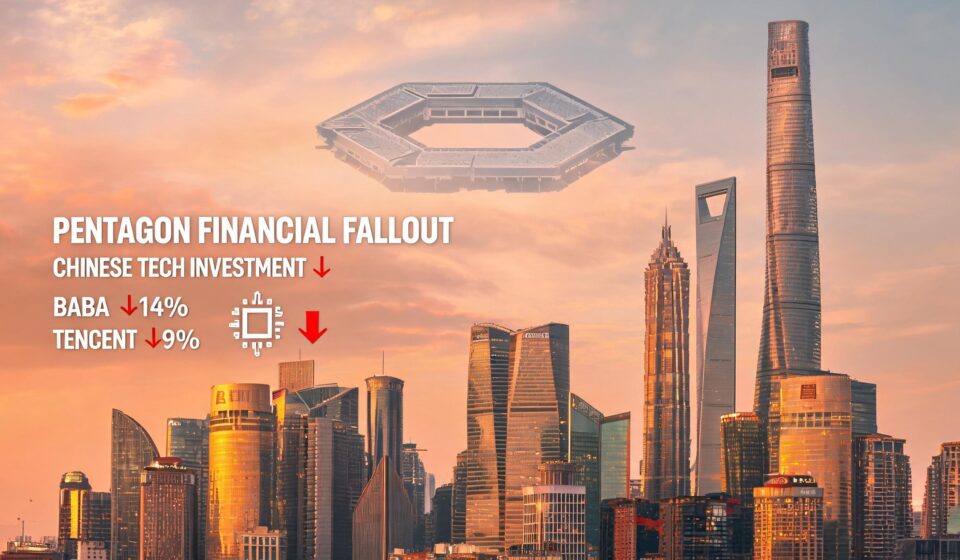
The immediate market reaction was sharp. Alibaba’s NYSE-listed ADR (BABA) dropped 6.3 percent in the two trading sessions following the June 8 announcement, wiping approximately $18 billion from its market capitalization. Baidu (BIDU) fell 5.1 percent on NASDAQ. NIO declined 7.8 percent. BYD’s OTC-listed ADR (BYDDY) dropped 4.2 percent, though its Shenzhen-listed shares, accessible primarily to mainland Chinese investors, fell just 1.9 percent — a divergence that underscores the disproportionate impact of U.S. regulatory designations on internationally traded securities.
Drillr terminal institutional flow data estimates that U.S.-based holders — including the California Public Employees’ Retirement System (CalPERS), the Teacher Retirement System of Texas, the Florida State Board of Administration, and endowments at Harvard, Yale, and Stanford — collectively hold between $4 billion and $7 billion in securities of the newly designated companies. Under OFAC’s Non-SDN Chinese Military-Industrial Complex Companies (NS-CMIC) framework, once these entities advance from the 1260H list to the CMIC list, U.S. persons will be prohibited from purchasing or selling their publicly traded securities. Historical precedent suggests a lag of six to eighteen months between 1260H designation and CMIC listing, but the forced selling will begin earlier as compliance-conscious institutions exit preemptively.
“The selling pressure is not speculative — it is structural,” said Mark Sobel, a former Treasury official now at the Official Monetary and Financial Institutions Forum. “Once a name appears on the 1260H list, the fiduciary calculus changes. No pension fund board wants to explain why it held a position in a Pentagon-designated military-linked company.”
Company Profiles: What Each Firm Faces
BYD Co. — The Battery Giant with the Most to Lose
BYD’s inclusion on the Section 1260H list represents perhaps the most consequential designation of any single company. BYD is the world’s largest electric vehicle manufacturer by unit volume and, through its subsidiary FinDreams Battery, one of the two dominant global battery producers alongside CATL. The company delivered 4.3 million vehicles in 2025 and is on pace to exceed 5.5 million in 2026, according to data from the China Association of Automobile Manufacturers.
BYD’s designation rests on the dual-use nature of its blade battery technology and the substantial government subsidies it has received as a designated “national champion” under MIIT’s industrial policy framework. The Pentagon cited BYD’s participation in military-civil fusion research programs and its supply of batteries for military applications as grounds for inclusion.
The financial impact extends beyond ADR selling. BYD has been aggressively pursuing a European expansion, with factories under construction in Hungary and planned facilities in Turkey. Any EU member state that follows the U.S. designation pattern would complicate those investments. BYD’s planned U.S. market entry — long discussed but never formalized — is now effectively dead for the foreseeable future. The company has not issued a public statement on the designation.
BYD’s stock market performance tells two stories. In Hong Kong, where the company’s primary listing trades under ticker 1211, shares fell just 2.8 percent on June 9 — moderate by the standards of geopolitical shocks. The resilience reflects the composition of BYD’s investor base: predominantly mainland Chinese and Hong Kong institutional holders who are not bound by U.S. regulatory constraints. The divergence between Hong Kong and OTC ADR pricing creates an arbitrage window, but one that few Western institutional investors can exploit given compliance restrictions.
Baidu Inc. — AI Ambitions Meets National Security Scrutiny
Baidu, China’s dominant search engine and a leading artificial intelligence developer, was designated on the basis of its AI research activities in military-civil fusion zones and its autonomous driving platform Apollo, which the Pentagon characterized as having dual-use potential. Baidu’s ADR (BIDU) fell 5.1 percent on June 9, and the company issued a statement within hours calling the designation “unjustified” and pledging to “pursue all available legal remedies.”
Baidu’s vulnerability is compounded by its position in the global AI race. The company’s ERNIE large language model and its autonomous driving taxi service, Apollo Go, operate in sectors where U.S.-China competition is intensifying. The 1260H designation does not directly restrict Baidu’s technology exports, but it creates a reputational cloud that may deter Western enterprise customers from adopting Baidu Cloud services or ERNIE-based solutions.
From a financial perspective, Baidu’s exposure is moderate. The company generates the vast majority of its revenue from domestic Chinese advertising and cloud services. International revenue accounts for less than 5 percent of total sales. However, Baidu’s $4.2 billion in U.S.-listed ADRs represents a significant channel for international capital, and forced selling from index funds and passive vehicles will create downward pressure that has nothing to do with Baidu’s operating fundamentals.
Alibaba Group — The Highest-Profile Target
Alibaba’s designation is the single most impactful addition in terms of market capitalization and global visibility. The company, which operates China’s largest cloud computing platform, the world’s largest e-commerce ecosystem by gross merchandise value, and a sprawling logistics network through Cainiao, had a market capitalization of approximately $280 billion at the time of designation.
The Pentagon cited Alibaba’s MIIT affiliation and its provision of cloud infrastructure to Chinese government entities as grounds for inclusion. The designation does not distinguish between Alibaba’s commercial cloud services and its government-facing business — a distinction that Alibaba’s legal team will likely challenge in court.
Alibaba’s response was the most assertive of the four major additions. “Alibaba Group has no affiliation with the Chinese military, has never provided services to the Chinese military, and operates entirely in the civilian commercial sector,” the company said in a statement issued on June 9. “We will vigorously contest this designation through all available legal channels.”
Alibaba’s $4.2 billion in U.S. ADRs and its inclusion in major indices — including the MSCI Emerging Markets Index and the FTSE China 50 — mean that index fund managers and ETF providers face forced rebalancing. Goldman Sachs estimated in a June 10 research note that passive selling of BABA ADRs could reach $1.8 to $2.5 billion over the next six months, with an additional $500 million to $800 million in active fund liquidation driven by compliance mandates.
Nio Inc. — The EV Startup Caught in the Crossfire
Nio, the Shanghai-based premium electric vehicle maker, was designated on the basis of its autonomous driving and battery-swap technology, which the Pentagon characterized as having dual-use military applications. Nio’s NYSE-listed ADR (NIO) fell 7.8 percent on June 9 — the steepest decline among the four major additions — reflecting the company’s greater dependence on international capital markets relative to its larger peers.
Nio is the most financially vulnerable of the four designated companies. Unlike BYD, which is profitable and cash-generative, Nio has yet to achieve sustained profitability, reporting a net loss of RMB 18.4 billion ($2.5 billion) in 2025. The company’s ADR holders include a disproportionate share of U.S. retail investors and growth-oriented mutual funds, many of whom will face pressure to liquidate.
Nio disputed the designation in a June 9 filing with the SEC, stating that it “has no military affiliations, has never developed military technology, and is a purely civilian electric vehicle company.” The company said it was evaluating legal options.
Unitree Robotics — The Robotics Firm with Military Crossover
Unitree, the Hangzhou-based robotics company known for its consumer and industrial quadruped and humanoid robots, represents a different category of designation. Unlike the four publicly traded companies, Unitree is privately held and has no U.S.-listed securities. The financial impact is therefore limited to its venture capital investors and any U.S. entities that hold direct equity stakes.
Unitree’s designation is based on its robotics R&D activities, which the Pentagon characterized as having clear military application potential. The company’s Unitree Go2 quadruped robot and its H1 humanoid robot have been demonstrated in configurations that include surveillance and reconnaissance capabilities. While Unitree markets these products primarily to consumers and industrial users, the dual-use nature of the technology made it a natural candidate for the expanded list.
The designation will complicate Unitree’s international sales and distribution. Several U.S.-based robotics distributors carry Unitree products, and the 1260H listing — while not an export ban — creates reputational and compliance risks that may cause distributors to drop the brand preemptively.
The Legal Path: Xiaomi’s Precedent
The most important legal precedent for the newly designated companies is Xiaomi’s 2021 case. In January 2021, the Pentagon placed Xiaomi on the Section 1260H list under the Trump administration. Xiaomi sued in the U.S. District Court for the District of Columbia, arguing that the designation was arbitrary and unsupported by evidence. In March 2021, Judge Rudolph Contreras granted Xiaomi a preliminary injunction, finding that the government had not demonstrated a sufficient basis for the designation. The Biden administration subsequently reversed the listing, and Xiaomi was removed from the 1260H list by May 2021.
The Xiaomi precedent established several principles that the newly designated companies will likely invoke. First, that the designation must be based on specific, articulable evidence of military affiliation — not merely on the general character of a company’s technology sector. Second, that companies have due process rights that are not extinguished by executive branch national security determinations. Third, that courts are willing to second-guess the factual basis for 1260H designations when the evidence is thin.
Legal analysts expect Alibaba and Baidu to file for injunctive relief in the D.C. District Court by mid-August 2026. WuXi AppTec and Nio may follow. BYD’s decision is less clear, as the company has not publicly commented on the designation and may calculate that legal action draws more attention to the listing than quiet acceptance.
However, the legal landscape has shifted since 2021. The Section 1260H criteria were broadened by the FY 2024 NDAA, which expanded the definition of “military-civil fusion contribution” to include government industrial subsidies and MIIT affiliation — categories that are easier for the government to prove than direct PLA ownership or control. This means that the Xiaomi precedent, while still relevant, may not be as directly applicable as the newly designated companies hope.
Market Signal
Bull Case: Legal challenges succeed for at least two of the four major designations. Alibaba and Baidu secure injunctive relief by Q4 2026 based on the Xiaomi precedent. OFAC does not advance any of the four to the CMIC list. Forced selling is limited to $2 to $3 billion, and shares recover to pre-announcement levels by year-end. U.S.-China trade negotiations in the fall produce a partial delisting framework.
Bear Case: OFAC moves BABA, BIDU, and BYDDY to the CMIC list within 12 months. Forced selling from U.S. institutional holders reaches $5 to $7 billion. BABA ADR falls below $90. Allied nations (EU, UK, Japan) adopt parallel restrictions. BYD’s European expansion faces new barriers. Defense procurement reshoring costs add 15 to 25 percent to affected supply chains.
Base Case: Legal challenges produce mixed results — one or two removals, but the core list holds. OFAC designates Alibaba but not BYD or Baidu over the next 12 months. BABA trades in a $95 to $115 range through Q1 2027. Defense primes complete Phase 1 compliance by June 30 without major disruption. Phase 2 compliance requires 18-month supply chain audits and partial vendor substitution.
What to Watch
June 30, 2026 — Phase 1 Enforcement: The deadline for the DoD contracting ban. Any new, renewed, or extended contract with a listed entity or its controlled subsidiaries will be prohibited. Defense primes are already conducting emergency compliance reviews. Watch for contract termination filings with the SEC and DoD Inspector General.
Mid-August 2026 — Legal Filings: The window for injunctive relief filings in D.C. District Court. The speed and specificity of these filings will signal how seriously the companies intend to contest the designations.
Q4 2026 — OFAC CMIC Update: The Treasury’s Office of Foreign Assets Control updates its Non-SDN CMIC list on its own schedule. A rapid advancement of any newly designated company to the CMIC list would trigger the securities-purchase prohibition and represent a significant escalation.
June 30, 2027 — Phase 2 Enforcement: The indirect procurement ban takes effect, requiring prime defense contractors to trace components through multi-tier subcontractor networks. This will be the most operationally disruptive phase and will accelerate supply chain reshoring away from Chinese sources.
China’s Ministry of Foreign Affairs condemned the expanded list on June 9, calling it “an abuse of state power to suppress Chinese enterprises under the pretext of national security” and warning that Beijing would “take necessary measures to safeguard the legitimate rights and interests of Chinese companies.” The statement did not specify what retaliatory actions are under consideration.
The 188-entity Section 1260H list represents the broadest single assertion to date that China’s civilian technology sector is inseparable from its military apparatus. Whether that assertion survives judicial scrutiny — and whether it triggers the financial cascade that CMIC designation would bring — is the defining question for U.S.-China technology policy through 2027.
Further Reading:
- Pentagon Adds Alibaba, Baidu, BYD and Nio to Chinese Military-Linked List
- Hong Kong Auto Stocks Surge as Geely, BYD Lead China’s EV Boom
- Alibaba, Tencent and ByteDance: How China’s Tech Giants Are Pivoting to AI in 2026
Disclaimer: This article is for informational purposes only and does not constitute investment advice. Market scenarios presented are analytical frameworks, not predictions. China Industry Intel has no position in any securities mentioned.