

































China Consumer Spending Falls for First Time Since COVID Reopening
By China Industry Intel | June 21, 2026
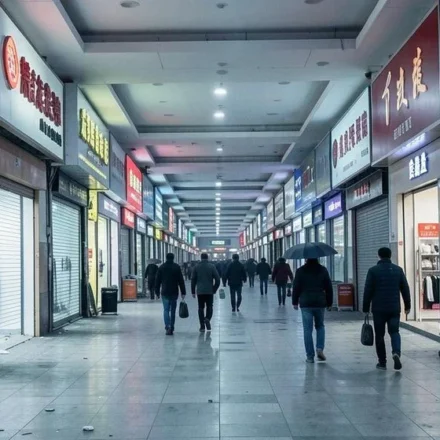
China’s consumer spending has recorded its first year-on-year decline since the country abandoned its zero-COVID policy in late 2022, marking a significant deterioration in the economic outlook and raising fresh questions about the effectiveness of government stimulus measures. The data, published by China’s National Bureau of Statistics, shows retail sales falling 1.2% year-on-year in May 2026 — the first negative reading in over three years.
The Numbers: A Closer Look
The May retail sales decline was broad-based across categories, with particular weakness in discretionary spending segments. While the headline number of -1.2% was modest, the underlying details paint a more concerning picture of consumer retrenchment.
| Category | May 2026 YoY Change | April 2026 YoY | Trend |
|---|---|---|---|
| Total Retail Sales | -1.2% | +0.8% | ↓ Sharp deterioration |
| Catering & Restaurants | -3.5% | -1.2% | ↓ Accelerating decline |
| Apparel & Footwear | -4.1% | -2.3% | ↓ Accelerating decline |
| Cosmetics & Personal Care | -5.8% | -3.1% | ↓ Sharp decline |
| Home Appliances | +2.3% | +4.1% | ↓ Slowing growth |
| Automobiles | +6.7% | +8.2% | ↓ Slowing growth |
| Online Retail (Physical Goods) | +3.2% | +5.8% | ↓ Slowing growth |
| Gold, Silver & Jewelry | +12.4% | +15.1% | ↓ Still strong, slowing |
Youth Unemployment: The Hidden Crisis

The consumer spending decline is closely linked to China’s persistent youth unemployment problem. The surveyed urban unemployment rate for the 16-24 age group (excluding students) stood at 14.8% in May 2026, more than double the overall urban unemployment rate of 5.1%. For the 25-29 cohort, unemployment was 7.2%.
Young Chinese consumers, who historically drove spending in categories like dining out, fashion, cosmetics, and electronics, have become markedly more cautious. The phenomenon of “consumption downgrade” — choosing cheaper alternatives, delaying purchases, and prioritizing savings — has become deeply embedded among urban millennials and Gen-Z consumers.
The job market weakness extends beyond new graduates. Layoffs in the technology, real estate, and education sectors over the past three years have created a persistent pool of underemployed workers, many of whom have accepted positions paying significantly less than their previous roles.
Government Stimulus Measures

Beijing has responded with a series of targeted stimulus measures, but their impact has been limited:
Consumer Voucher Programs: Over 200 cities have issued consumer vouchers worth a combined ¥50 billion ($6.9 billion) in 2026, covering categories from dining to electronics. However, studies show these vouchers primarily bring forward spending rather than create new demand, with minimal lasting impact on consumption levels.
Trade-in Subsidies: The national vehicle and home appliance trade-in program, expanded in March 2026, offers subsidies of up to ¥20,000 for new car purchases and ¥5,000 for major appliances. This has propped up auto sales (+6.7% in May) but has not been sufficient to lift the broader retail sector.
Interest Rate Cuts: The People’s Bank of China has cut the loan prime rate (LPR) three times since September 2025, bringing the one-year LPR to 2.8% and the five-year rate to 3.4%. Mortgage rates have followed, but the housing market remains depressed, with new home prices falling 6.2% year-on-year nationally.
Implications for Global Brands
China’s consumer weakness has significant implications for global brands that depend on the Chinese market. Luxury goods companies — including LVMH, Kering, and Hermès — have reported declining China revenues for two consecutive quarters. Fast-fashion retailers like Zara and H&M are facing intense competition from ultra-low-cost domestic platforms like Pinduoduo and Douyin e-commerce.
Consumer electronics companies are particularly exposed. Apple’s Greater China revenue fell 8% year-on-year in Q1 2026, while domestic brands like Xiaomi and Huawei have gained market share by offering competitive products at lower price points. The “consumption downgrade” trend is benefiting companies that can offer value-for-money positioning.
Structural vs. Cyclical Factors
Economists are divided on whether the consumer spending decline is primarily cyclical or reflects deeper structural changes. Optimists point to the government’s capacity for targeted stimulus and argue that spending will recover as the job market stabilizes. Pessimists note that China’s demographic decline, household debt overhang from the property bubble, and the absence of a robust social safety net create persistent headwinds for consumer spending growth.
What is clear is that the post-COVID consumption recovery that many expected has failed to materialize. China’s consumer economy is entering a new phase characterized by lower growth, greater price sensitivity, and a fundamental shift in spending patterns that will reshape both domestic and global markets for years to come.
Sources
- Trading Economics — China Retail Sales
- National Bureau of Statistics of China
- Reuters — China consumer spending analysis
- Bloomberg — China youth unemployment data