China Builds Grid-Forming Renewable Project to Solve Stability
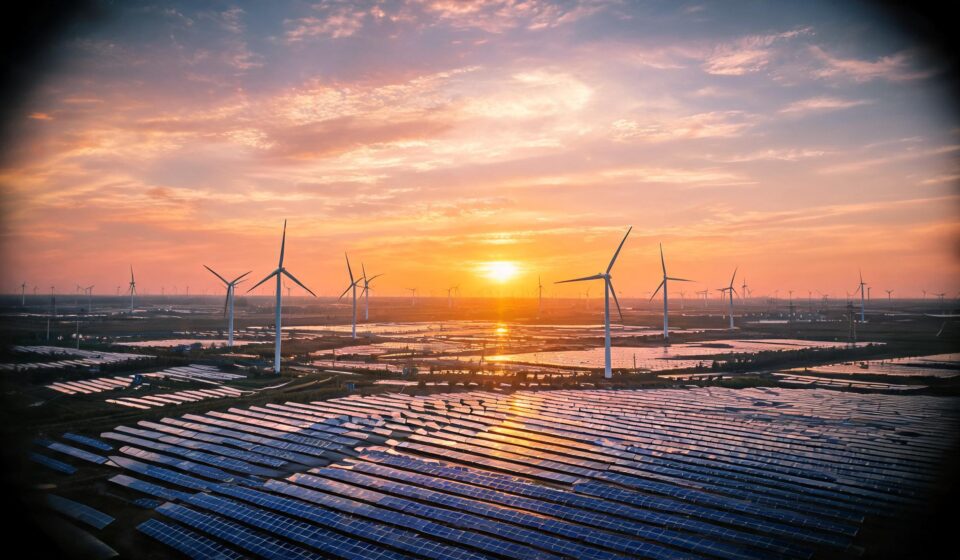
A 220 kV step-up substation in Zhangjiakou, Hebei Province, is entering the civil construction phase as part of China’s most ambitious effort to date to solve the grid stability problems created by large-scale renewable energy. The Zhangbei grid-forming renewable energy project, developed by State Grid Jibei Zhangjiakou Wind-Solar-Storage New Energy Co., is designed to demonstrate that wind and solar installations can actively support grid stability rather than destabilizing it.
Why this matters
Most people don’t think about grid stability until the lights go out. But as countries add more wind and solar power, the challenge of keeping electricity grids balanced grows more difficult. Traditional power plants — coal, gas, nuclear — spin heavy turbines that naturally resist changes in frequency, providing what engineers call “inertia.” Inverter-based generation from wind and solar doesn’t provide this inertia, which means grids with high renewable penetration are more vulnerable to sudden frequency drops.
The International Energy Agency expects global renewable capacity to nearly double between 2025 and 2030. That’s good for emissions but potentially bad for grid reliability unless the stability problem is solved.
Grid-forming technology is one answer. Unlike conventional inverters that simply feed power into the grid, grid-forming inverters can actively regulate voltage and frequency, essentially mimicking the stabilizing behavior of traditional generators. Scaling this technology from small microgrids to large centralized renewable installations is what the Zhangbei project aims to prove.
What the project involves
The Zhangbei project links wind, solar, and battery storage resources through a coordinated control system. The 220 kV substation, whose design was completed in November 2025, serves as the connection point between the renewable generation and the broader grid.
Project lead Yin Zhang, who has worked on grid projects in South Africa and South Sudan, said the design embeds grid-forming requirements into every component of the substation. “A solution only matters if it works in the real world,” Zhang said. “Working across different countries showed me how much grid standards, environmental constraints, and operational systems can vary.”
The project addresses several technical challenges simultaneously: adapting substation systems to support grid-forming functionality, coordinating multiple energy sources under varying conditions, and maintaining reliable operation across different environmental scenarios. Zhang’s team established a cross-disciplinary coordination framework and conducted multiple rounds of technical validation to get the design right.
China is ahead on this
China has a structural advantage in developing grid-forming technology. The country’s centralized power grid, operated by state-owned companies like State Grid Corporation, allows for large-scale demonstration projects that would be difficult to coordinate in more fragmented markets like the U.S. or Europe.
The Zhangbei project builds on a smaller grid-forming demonstration that State Grid operated in the same region starting in 2023. That project proved the concept at a smaller scale; the current expansion aims to show it can work at grid scale.
Other countries are pursuing similar technology. The UK’s National Grid ESO has invested in grid-forming inverter trials, and Australia’s Energy Market Operator has flagged grid stability as a critical challenge for its renewable-heavy grid. But China’s ability to deploy capital quickly through state-directed investment means it’s likely to be the first to demonstrate grid-forming technology at full scale.
Implications for global renewable deployment
If the Zhangbei project succeeds, it could provide a template for other countries struggling with grid stability. The IEA has identified grid integration as one of the biggest bottlenecks to renewable deployment worldwide, and grid-forming technology could ease that constraint.
For China specifically, the technology could help the country meet its target of 1,200 GW of wind and solar capacity by 2030. Much of that capacity is planned for remote regions in the north and west, far from the population centers where electricity is consumed. Long-distance transmission and grid stability solutions like grid-forming are essential to making that buildout work.
The project also has commercial implications. If State Grid can demonstrate reliable grid-forming operation at scale, Chinese inverter manufacturers — including Huawei, Sungrow, and Goodwe — could export the technology globally, adding another category to China’s growing clean-energy equipment dominance.