China’s Factory Activity Beats Forecasts as Manufacturing Resilience Surprises Analysts
Private PMI data tells a different story from the official numbers
China’s manufacturing activity expanded faster than expected in May 2026, according to the Caixin Manufacturing PMI released on June 1. The index came in at 51.7, above the Reuters consensus of 51.2 and marking the eighth consecutive month of expansion. The official NBS PMI, released the same day, showed growth but at a slower pace than April.
The divergence between the two surveys tells an important story. The Caixin PMI covers more small and medium-sized, export-oriented firms, while the NBS survey skews toward larger state-owned enterprises. The stronger Caixin reading suggests that China’s private manufacturing sector — the engine of innovation and employment — is performing better than the headline numbers suggest.
New export orders rise for the fifth straight month
The most encouraging signal in the Caixin data was the new export orders sub-index, which rose for the fifth consecutive month. This suggests that global demand for Chinese manufactured goods remains robust despite tariff pressures and geopolitical tensions.
The export strength is concentrated in three categories: electronics (particularly components for AI infrastructure), electric vehicles and batteries, and industrial machinery. Traditional low-value exports like textiles and basic consumer goods continue to migrate to Southeast Asia.
The automation dividend
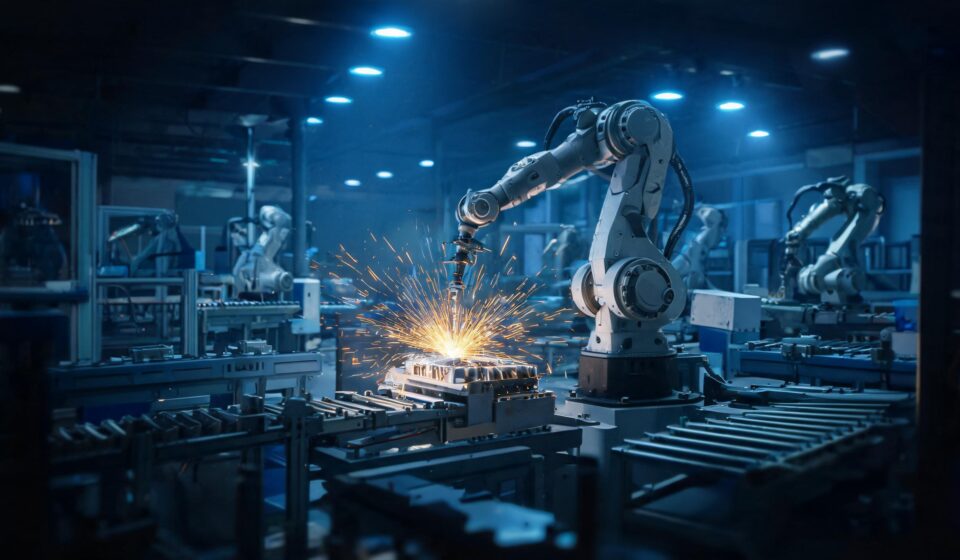
Chinese manufacturers are investing heavily in automation, which improves both productivity and quality. China installed 276,000 industrial robots in 2025, according to the International Federation of Robotics — more than the rest of the world combined. The robot density in China’s manufacturing sector reached 392 robots per 10,000 workers, surpassing Germany and approaching South Korea’s level.
“Automation is China’s answer to rising labor costs,” said Dr. Wang He, a manufacturing economist at Tsinghua University. “The average factory worker in the Yangtze River Delta earns 3x what they did 10 years ago. Robots make that sustainable.”
Sector-by-sector performance
Manufacturing performance varies significantly by sector:
- EV and battery: booming, with capacity expansion continuing at 30%+ annual rates
- Solar and wind equipment: overcapacity pressure, but deployment demand remains strong
- Consumer electronics: stable, with AI hardware driving new demand
- Traditional manufacturing (textiles, furniture): declining share, migrating offshore
- Industrial machinery: strong, driven by domestic automation investment
Outlook
The manufacturing sector faces headwinds from the Iran conflict (energy costs), tariff uncertainty, and a weak domestic property market. But the structural advantages — infrastructure quality, supplier density, automation investment, and workforce skill — continue to support China’s position as the world’s manufacturing hub.
Sources
- CNBC, “China’s factory activity beats forecasts in May,” June 1, 2026
- Caixin/S&P Global, Manufacturing PMI, May 2026
- International Federation of Robotics, World Robotics Report 2026
- National Bureau of Statistics, Manufacturing data, May 2026