ChangXin Technology IPO Reshapes China DRAM Industry on STAR Market
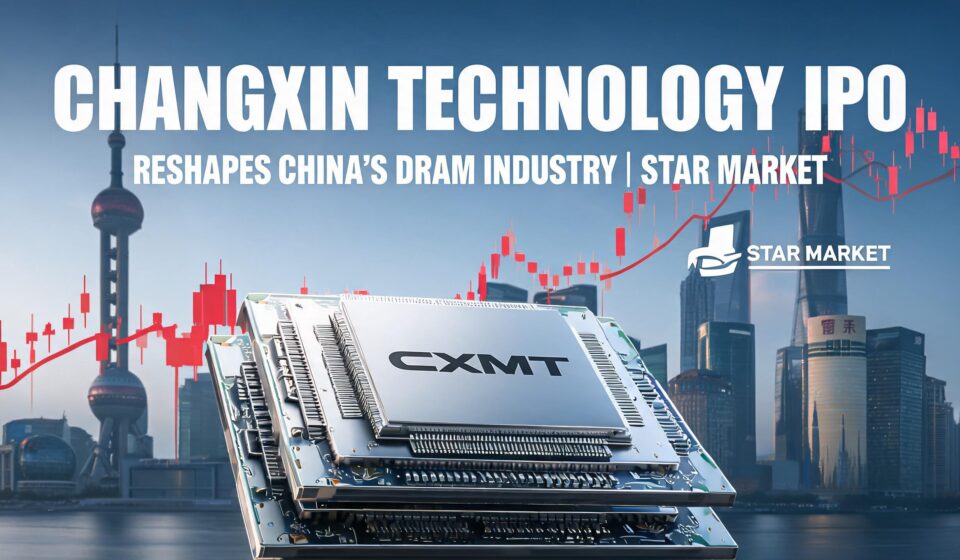
On May 27, 2026, the Shanghai Stock Exchange’s listing committee approved the initial public offering of ChangXin Technology Co., Ltd. (长鑫科技, also known as CXMT), clearing the way for what is expected to be the largest semiconductor IPO in Chinese history. The company plans to raise up to 295 billion yuan — approximately $41 billion — on the Science and Technology Innovation Board, known as the STAR Market (科创板). For context, that fundraising target would make it one of the five largest IPOs globally in the past decade, and by far the biggest listing in China’s semiconductor sector.
ChangXin Technology is China’s largest DRAM chip manufacturer and the world’s fourth-largest by capacity and shipment volume, according to data from Omdia. The company operates three 12-inch DRAM wafer fabrication facilities across Hefei and Beijing, producing DDR and LPDDR series memory chips that serve servers, smartphones, personal computers, and increasingly, smart vehicles. In a global memory market dominated for decades by Samsung, SK Hynix, and Micron, ChangXin’s rise represents the most credible Chinese challenge yet to the established triopoly. And its decision to go public on the STAR Market — rather than in Hong Kong or New York — signals that Beijing views domestic DRAM production as a matter of national strategic importance.
What Happened — From Pre-Review to Approval
ChangXin Technology’s IPO was the first pre-review case approved in the current cycle, meaning the company navigated the regulatory process ahead of a backlog of applicants. The Shanghai Stock Exchange listing committee gave its formal sign-off on May 27, 2026, following months of scrutiny over the company’s financials, technology roadmap, and shareholder structure.
The financial disclosures that accompanied the filing stunned the market. For the first quarter of 2026, ChangXin reported revenue of 50.8 billion yuan — a staggering 719% increase year-over-year. Net profit surged to 33 billion yuan, up 1,268% from the same period in 2025. The company’s capacity utilization rate stood at 95.73% for full-year 2025, indicating that its fabs were running near maximum output to meet surging demand.
Management’s guidance for the first half of 2026 was equally aggressive: revenue between 110 and 120 billion yuan, with net profit expected to reach 50 to 57 billion yuan. These numbers reflect a company firing on all cylinders, benefiting from a global memory supercycle driven by artificial intelligence workloads, data center expansion, and the insatiable demand for high-bandwidth memory (HBM) in AI accelerators.
The 295 billion yuan target dwarfs any previous semiconductor listing on the STAR Market. SMIC’s 2020 STAR Market IPO raised approximately 53.2 billion yuan — roughly one-sixth of what ChangXin is seeking. The proceeds are expected to fund expansion of existing fabs, next-generation DRAM process development, and crucially, the scaling of HBM production to serve China’s booming AI infrastructure sector.
Why It Matters — DRAM Is the New Battleground
The global DRAM market reached $137.14 billion in the first quarter of 2026, a 245% year-over-year increase that reflects the explosive growth in AI-related memory demand. This is no longer a commodity market defined by cyclical ups and downs — it has become a strategic chokepoint in the US-China technology competition.
For decades, three companies — Samsung Electronics (South Korea), SK Hynix (South Korea), and Micron Technology (United States) — controlled more than 90% of global DRAM production. This concentration gave Western-aligned nations enormous leverage over the global semiconductor supply chain. ChangXin Technology represents China’s most advanced attempt to break that stranglehold.
The company’s importance extends beyond standard DDR and LPDDR chips. ChangXin has been developing high-bandwidth memory (HBM) products used in AI accelerators — the GPUs and custom chips that power large language models and data center inference workloads. With the United States imposing increasingly strict export controls on advanced semiconductors to China, including restrictions on HBM technology, the ability to produce HBM domestically has become a matter of national security for Beijing. ChangXin’s IPO is, in effect, a national mobilization of capital toward that goal.
The timing is deliberate. US export controls have cut Chinese AI chip developers off from Samsung and SK Hynix HBM supply. Chinese firms building AI training clusters — including Huawei, Baidu, and Alibaba — need a domestic HBM source. ChangXin is the only Chinese company with a realistic path to volume HBM production. The $41 billion IPO will give it the financial firepower to accelerate that roadmap.
Key Players — The Companies Shaping China’s DRAM Future
| Company | Role | Position & Strategy |
|---|---|---|
| ChangXin Technology (CXMT) (Hefei, China) | DRAM manufacturer, IPO issuer | China’s #1 and world’s #4 DRAM maker. Operates three 12-inch fabs in Hefei and Beijing. Products cover DDR, LPDDR, and emerging HBM for AI chips. Raised 295B yuan via STAR Market IPO. Q1 2026 revenue: 50.8B yuan (+719% YoY). Strategy: capture domestic market share, develop HBM, reduce China’s dependence on foreign memory chips. |
| Samsung Electronics (Suwon, South Korea) | Global DRAM market leader | Holds approximately 40% of global DRAM market share. Dominates HBM supply alongside SK Hynix. Faces growing competition from ChangXin in standard DRAM and eventual HBM competition. Also a major NAND flash producer. Invested $28 billion in new memory fabs in 2025-2026. |
| SK Hynix (Icheon, South Korea) | HBM market leader | Controls approximately 50% of the global HBM market. Primary supplier of HBM3E to NVIDIA for AI accelerators. Faces direct strategic threat from ChangXin’s HBM ambitions. Reported record Q1 2026 earnings driven by AI demand. Also investing heavily in next-generation HBM5 development. |
| Micron Technology (Boise, US) | US DRAM producer, HBM competitor | Third-largest global DRAM maker. Benefiting from US government CHIPS Act subsidies for domestic production. Supplies HBM3E but trails SK Hynix in market share. Faces indirect competition from ChangXin in the Chinese market, where US export controls have already limited its ability to sell advanced products. |
| AMEC (中微半导体) (Shanghai, China) | Equipment supplier | China’s leading semiconductor etching equipment manufacturer. A key upstream supplier to ChangXin’s fabs. As US and Dutch export controls restrict ASML and Applied Materials from selling advanced tools to Chinese fabs, domestic equipment makers like AMEC become critical enablers of ChangXin’s expansion plans. |
| National IC Fund Phase II (Beijing, China) | Strategic investor | China’s government-backed semiconductor investment fund, also known as the “Big Fund.” Holds 8.73% of ChangXin Technology. Has deployed over $50 billion across China’s semiconductor supply chain. Its investment in ChangXin signals that DRAM production is a national priority on par with advanced logic chips. |
Supply Chain Impact — Upstream Dependencies and the Equipment Question
ChangXin’s IPO will ripple through China’s entire semiconductor supply chain, creating opportunities for upstream suppliers while raising questions about the company’s ability to scale without access to the most advanced manufacturing equipment.
Upstream Materials and Equipment: ChangXin’s fabs depend on a network of Chinese suppliers for critical inputs. Jiangfeng Electronics provides sputtering targets used in wafer fabrication. Shengong Shares (神工股份) supplies high-purity silicon materials. Xingfu Electronics (兴福电子) provides semiconductor-grade specialty chemicals. Each of these companies stands to benefit from ChangXin’s expansion plans funded by the IPO proceeds.
The Equipment Bottleneck: The more pressing question is equipment. ChangXin’s current fabs use a mix of domestic and imported equipment, with etching tools from AMEC and deposition and lithography equipment from foreign suppliers. As US export controls continue to tighten, particularly restrictions on EUV lithography systems and advanced deposition tools, ChangXin’s ability to move to more advanced DRAM nodes (below 15nm) will depend heavily on the progress of China’s domestic equipment industry. AMEC’s etching tools are competitive at current nodes, but next-generation DRAM manufacturing may require capabilities that domestic equipment makers have not yet demonstrated at production scale.
Downstream Impact: The IPO will also benefit Chinese AI chip companies that currently lack access to foreign HBM supply. Huawei’s Ascend AI accelerators, Baidu’s Kunlun chips, and Alibaba’s custom inference processors all require HBM for competitive performance. A domestic HBM source would reduce China’s vulnerability to supply disruptions and allow these companies to scale AI infrastructure without depending on Samsung or SK Hynix — suppliers that must comply with US export restrictions.
HBM as the Strategic Prize: High-bandwidth memory is the technology that connects ChangXin’s IPO to the broader AI competition. HBM stacks multiple DRAM dies vertically using through-silicon via (TSV) interconnects, delivering the bandwidth needed for AI training and inference workloads. Currently, SK Hynix and Samsung dominate HBM production. ChangXin’s ability to produce competitive HBM at scale would represent a structural shift in the global AI hardware supply chain — one that could insulate China’s AI industry from future supply shocks.
Market Signal — What the $41 Billion Question Tells Us
The Bull Case: ChangXin’s IPO marks the beginning of China’s DRAM independence. The $41 billion in fresh capital allows the company to expand capacity aggressively, advance its process technology, and bring HBM to market within 12-18 months. With domestic demand far exceeding supply, ChangXin captures 15-20% of the global DRAM market by 2028, forcing the established triopoly to compete on price. The IPO also validates the STAR Market as a viable venue for mega-cap semiconductor listings, attracting more chip companies to list domestically rather than offshore.
The Bear Case: ChangXin’s technology remains 1-2 generations behind Samsung and SK Hynix. Without access to EUV lithography and advanced process equipment, the company cannot compete at the leading edge. The IPO raises capital but cannot manufacture the equipment or process knowledge needed for next-generation DRAM. HBM development stalls at the HBM2E level while competitors move to HBM5. The stock becomes a proxy for government policy rather than commercial competitiveness, and the 295 billion yuan valuation proves unsustainable.
The Base Case: ChangXin successfully captures a significant share of China’s domestic DRAM market — which is large enough to sustain the business — while making incremental progress on HBM. The company becomes a profitable, government-supported champion in a market where import substitution is effectively mandated. Global DRAM prices remain competitive because Samsung, SK Hynix, and Micron retain their technology edge at the leading edge. ChangXin doesn’t break the triopoly but does reduce China’s absolute dependence on foreign memory chips. The IPO succeeds, and ChangXin becomes the anchor of China’s memory semiconductor ecosystem.
What to Watch: Three developments will determine which scenario plays out. First, the pace of ChangXin’s HBM qualification with Chinese AI chip designers — early samples to Huawei and Baidu would signal real technical progress. Second, the US government’s response to the IPO, including whether new export controls target ChangXin specifically. Third, Samsung and SK Hynix’s pricing strategy in the Chinese market — aggressive price cuts could squeeze ChangXin’s margins and test the government’s willingness to subsidize losses. The growing institutional interest in Chinese semiconductor stocks suggests that global investors are already positioning for the outcome.
For a detailed analysis of the companies supplying ChangXin Technology’s manufacturing ecosystem, see our companion report: CXMT IPO Creates Windfall for China’s Chip Supply Chain.
Sources
- Shanghai Stock Exchange — Listing Committee Approval Notice (May 27, 2026)
- Omdia — Global DRAM Market Share and Capacity Data (Q1 2026)
- TrendForce — Global DRAM Market Revenue Reaches $137.14B in Q1 2026
- Sina Finance — ChangXin Technology IPO Prospectus Financial Highlights
- ICBC Securities — ChangXin Technology IPO Analysis Report (May 2026)