China Sets Formal Solid-State Battery Standard for Electric Vehicles
China Sets Formal Solid-State Battery Standard for EVs
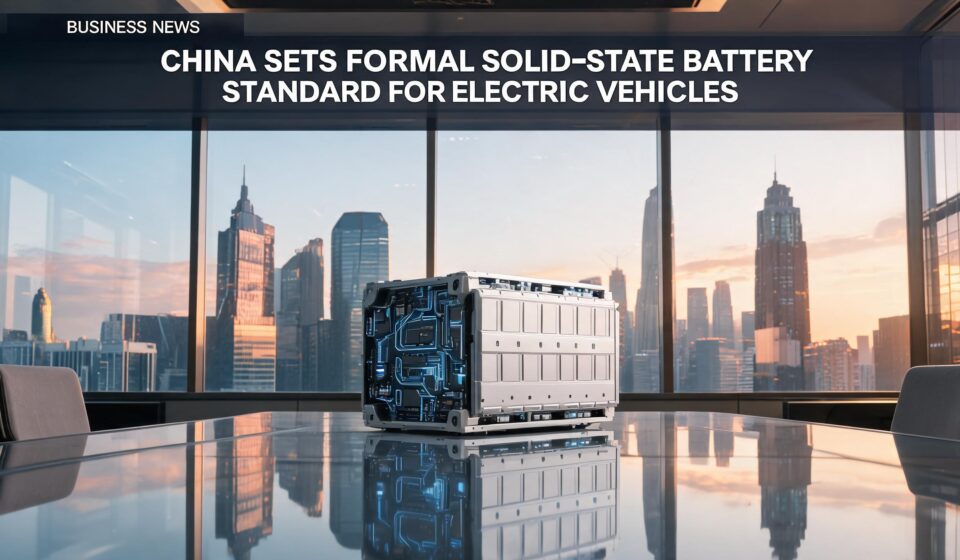
China is moving to codify the first national standard for solid-state batteries used in electric vehicles, a regulatory step that signals the technology is transitioning from laboratory curiosity to industrial priority. The standard, expected to be finalized in the second half of 2026, will define testing protocols, safety benchmarks, and performance thresholds for next-generation cells that replace the liquid electrolyte in conventional lithium-ion batteries with a solid material.
CASIP Alliance Drives Standardization
The initiative is being shepherded through the China Automotive Standardization International Platform (CASIP), a government-backed consortium whose members include the country’s largest battery makers: CATL (Ningde, Fujian Province; market capitalization approximately 295 billion yuan as of June 2026), BYD through its FinDreams Battery subsidiary, Gotion High-tech (backed by Volkswagen Group), CALB, and Eve Energy. The breadth of participation matters: when the companies that collectively supply more than 70 percent of the world’s EV batteries agree on a common framework, the resulting standard tends to become a de facto global reference.
“Standardization is the prerequisite for scaling,” said Dr. Li Jian, director of the battery division at the China Automotive Technology and Research Center (CATARC), speaking at the China EV100 forum in Beijing on May 18, 2026. “Without a national standard, every manufacturer runs its own test regime, and OEMs cannot compare performance across suppliers.”
CATL’s Sulfide-Based Breakthrough
The push for a standard coincides with tangible technical progress. In March 2026, CATL filed a patent with the World Intellectual Property Organization (WIPO) covering a sulfide-based solid-state electrolyte architecture that the company says achieves an energy density of 500 watt-hours per kilogram (Wh/kg). For context, CATL’s best commercial lithium iron phosphate (LFP) cells today deliver roughly 200 Wh/kg, while its ternary NMC cells top out near 300 Wh/kg. A 500 Wh/kg cell would nearly double the range of a mid-size EV without increasing battery weight.
CATL has confirmed that pilot production lines for the sulfide-based cells are operational at its Ningde headquarters. The company’s target, disclosed in its Q1 2026 earnings call on April 29, 2026, is to begin small-series production for premium vehicle programs by 2027. Industry sources indicate the technology readiness level (TRL) has moved from 4 — component validation in a laboratory environment — to 7 or 8, meaning the system is demonstrated in an operational environment and ready for final qualification.
CATL’s progress extends beyond solid-state technology. The company has built a vast supplier network that shapes China’s entire battery supply chain, and its investment empire has turned the battery giant into a VC powerhouse backing dozens of upstream material and equipment firms.
The LFP Advantage Under Threat
Not everyone in China views solid-state progress as unalloyed good news. Professor Ouyang Minggao, a Tsinghua University academician and one of China’s most respected EV technologists, warned at the SAE China Congress in Shanghai on April 12, 2026, that a premature pivot to solid-state could erode the cost advantage that Chinese manufacturers have built with LFP chemistry over the past decade.
“China dominates global LFP production — we have the supply chain, the cost structure, and the manufacturing know-how,” Ouyang said. “If solid-state batteries become the next paradigm and we are not careful, that advantage could be overturned by companies with different strengths.”
The implicit reference is to Toyota Motor Corporation (Tokyo; market capitalization approximately 35 trillion yen). Toyota holds more than 1,000 patents related to solid-state battery technology, more than any other automaker globally. The Japanese company has targeted 2027-2028 for the launch of its first production vehicle with a solid-state battery, promising a range exceeding 1,000 kilometers on a single charge. Toyota’s preferred chemistry is also sulfide-based, putting it on a direct collision course with CATL’s approach.
Impact on the Lithium-Ion Supply Chain
The shift to solid-state has implications that extend far beyond the battery cell itself. The traditional lithium-ion supply chain — from lithium mining in Australia and Chile, to cathode production in Hunan Province, to cell assembly in Jiangsu — would need to adapt. Solid-state cells require different separator materials (or none at all), different electrode formulations, and substantially different dry-room manufacturing environments.
A research note published by UBS on May 5, 2026, estimated that a full transition to solid-state could reduce demand for liquid electrolyte solvents by 90 percent while increasing demand for sulfide precursors such as lithium sulfide and phosphorus pentasulfide by a factor of 15 within a decade. Companies positioned to benefit include Shenzhen Capchem Technology (a leading electrolyte producer that has been quietly developing solid-state precursors) and Guangzhou Tinci Materials Technology.
For BYD (Shenzhen; 1211.HK; market capitalization approximately HK$950 billion), which has built its vertical integration around LFP blade cells through its FinDreams Battery subsidiary, the standard presents both risk and opportunity. On one hand, BYD’s entire cell architecture is optimized for LFP. On the other, its scale and manufacturing flexibility — it produces batteries, vehicles, and semiconductor chips under one corporate umbrella — give it the ability to pivot faster than most rivals.
Gotion High-tech (Hefei, Anhui Province; listed on the Shenzhen Stock Exchange; approximately 26 percent owned by Volkswagen AG) has taken a different path. The company announced in February 2026 a 15 billion yuan investment in a solid-state pilot line in Hefei’s Xinzhan High-tech Zone, with first samples expected by Q4 2026. Gotion’s CTO, Dr. Cheng Saifei, told reporters at the Hefei facility groundbreaking on February 20, 2026, that the company’s approach uses an oxide-based electrolyte rather than sulfide, which he argued is safer but currently less energy-dense.
What the Standard Covers
Drafts of the standard, portions of which were reviewed by China Industry Intelligence, cover four principal areas:
| Area | Key Requirements |
|---|---|
| Energy Density | Minimum 350 Wh/kg at cell level for classification as “solid-state” |
| Cycle Life | At least 1,000 cycles to 80 percent state of health |
| Safety | No thermal runaway or fire under nail penetration and overcharge tests at 60°C |
| Operating Temperature | Functional performance from -30°C to +60°C |
The 350 Wh/kg threshold is notable because it is above what most current semi-solid or “hybrid” designs achieve. This means the standard effectively excludes quasi-solid-state products — cells that use a gel electrolyte or a very thin layer of liquid — from being marketed as true solid-state under Chinese regulations.
Global Competition Heats Up
China is not the only country pursuing solid-state standards. Japan’s Ministry of Economy, Trade and Industry (METI) published draft guidelines in January 2026, and the European Battery Alliance is expected to release its own framework by early 2027. South Korea’s three major battery makers — LG Energy Solution, Samsung SDI, and SK On — are all developing solid-state prototypes, though none has announced a standard comparable to China’s CASIP initiative.
The race to set the standard is as much about commercial strategy as it is about safety. Whichever country establishes its testing and certification regime first gives its domestic manufacturers a head start in filing certifications, securing supply contracts, and locking in OEM adoption. China’s move to finalize its standard in 2026 puts it roughly 12 months ahead of Europe and on a par with Japan.
Timeline and Next Steps
The CASIP standard is currently in the public comment phase, which closes on August 31, 2026. After incorporating feedback, the final version is expected to be published by the end of 2026 and take effect in Q1 2027. Manufacturers that wish to claim “solid-state” designation for their cells will then need to submit products for third-party testing at CATARC-affiliated laboratories in Tianjin.
The practical upshot for the global EV industry is clear: China is not content to merely manufacture the world’s batteries. It intends to define what counts as the next generation of batteries — and in doing so, set the terms of competition for a decade or more. As the industry navigates this transition, investors are watching closely how auto stocks surge as BYD and Geely lead China’s EV boom and whether the LFP dominance can survive the solid-state era.