MIIT Blueprint: How China Plans to Digitize Every Factory by 2027
SEO Title: MIIT Blueprint: China’s Plan to Digitize All Factories by 2027
Meta Description: China’s MIIT released a comprehensive digital transformation guide targeting industrial internet platforms in all large enterprises by 2027 and 50,000 smart factories by 2030.
Focus Keyword: MIIT digital transformation manufacturing
What Happened
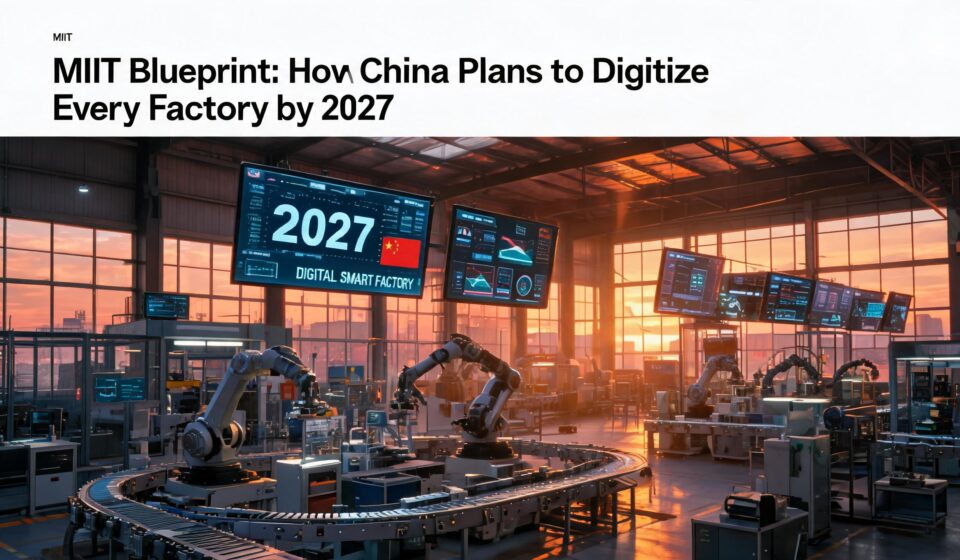
China’s Ministry of Industry and Information Technology (MIIT) released a landmark scenario-based digital transformation guide in September 2025, establishing the most comprehensive framework yet for modernizing the country’s manufacturing sector. The guide, developed under the New Quality Productive Forces (NQPF) policy umbrella, provides specific implementation roadmaps for factories across 15 major industrial sectors, from automotive and electronics to textiles and food processing.
The document represents a significant escalation in China’s manufacturing digitization ambitions. Rather than offering general guidance, the MIIT blueprint specifies exact technology deployment scenarios—covering industrial IoT integration, digital twin implementation, AI-powered quality inspection systems, and predictive maintenance platforms. The ministry outlined clear milestones: industrial internet platforms must be operational in all large enterprises by 2027, with a target of 50,000 smart factories nationwide by 2030.
This initiative builds on China’s existing industrial internet infrastructure, which already encompasses over 340 provincial-level platforms and connects more than 80 million industrial devices. The new guide standardizes deployment protocols and establishes certification requirements, effectively creating a national blueprint for manufacturing digitization that provincial governments and enterprises must follow.
Key Developments
Standardized Technology Deployment Framework: The MIIT guide categorizes factory digital transformation into five maturity levels—from basic connectivity to fully autonomous operations. Each level specifies required technologies, data integration standards, and performance benchmarks. This standardization removes ambiguity that previously slowed adoption, particularly among small and medium manufacturers lacking technical expertise.
Industrial Internet Platform Expansion: Under the new framework, the number of nationally certified industrial internet platforms will expand from the current 50 to over 200 by 2027. These platforms serve as centralized hubs for data analytics, supply chain coordination, and production optimization. Major platforms like Haier COSMOPlat and Huawei FusionPlant will anchor regional networks, while specialized platforms will serve niche sectors such as pharmaceutical manufacturing and semiconductor fabrication.
AI Integration Mandates: For the first time, the MIIT has established binding requirements for AI deployment in manufacturing quality control. Factories above a certain production volume must implement computer vision inspection systems capable of detecting defects at speeds exceeding human capacity. The guide specifies that AI quality inspection must achieve accuracy rates above 99.5% for certified smart factory designation.
Digital Twin Standards: The blueprint introduces China’s first national standards for manufacturing digital twins—virtual replicas of physical production lines that enable real-time monitoring and simulation. These standards define data formats, communication protocols, and interoperability requirements, addressing a critical barrier that previously prevented cross-platform data sharing.
Financial Incentive Structure: Provincial governments have been directed to establish dedicated transformation funds totaling RMB 50 billion collectively. These funds will subsidize 30-50% of technology deployment costs for qualifying enterprises, with higher subsidies available for companies in China’s western regions to prevent geographic concentration of advanced manufacturing capabilities.
Why It Matters
China’s manufacturing sector produces approximately 30% of global manufacturing output, making this digitization push significant far beyond national borders. The MIIT blueprint effectively sets the technical standards that millions of factories—including those supplying multinational corporations—will adopt. Companies sourcing from China will increasingly encounter suppliers operating on standardized industrial internet platforms with interoperable data systems.
The timing is strategic. As geopolitical tensions reshape global supply chains, China is accelerating the modernization of its manufacturing base to maintain cost competitiveness while moving up the value chain. The 2027 deadline for large enterprise platform adoption aligns with China’s broader economic planning cycles, creating urgency that previous guidance lacked.
For global competitors, the scale of this transformation is unprecedented. While Germany’s Industry 4.0 and America’s smart manufacturing initiatives operate through voluntary adoption and market incentives, China’s approach combines regulatory mandates with substantial subsidies. The result is likely to be faster, more uniform adoption across the world’s largest manufacturing ecosystem.
China Industry Impact
Manufacturing Sector Restructuring: The digitization mandate will accelerate consolidation in fragmented industries. Smaller manufacturers unable to meet smart factory certification requirements face pressure to merge with larger enterprises or join industrial internet platform ecosystems. This consolidation aligns with China’s broader industrial policy of creating globally competitive manufacturing champions.
Technology Provider Boom: Companies providing industrial IoT hardware, manufacturing execution systems, and AI quality inspection solutions stand to benefit enormously. Domestic providers including Huawei, Haier, and Foxconn’s industrial internet division are positioned to capture the majority of deployment contracts, though the framework technically remains open to foreign technology providers like Siemens and SAP.
Workforce Transformation: The MIIT estimates that full implementation will require retraining approximately 50 million manufacturing workers over the next five years. The guide mandates that enterprises above designated thresholds allocate at least 2% of payroll to digital skills training. This requirement creates a secondary market for industrial training platforms and certification programs.
Regional Development Implications: The differential subsidy structure aims to prevent advanced manufacturing capabilities from concentrating exclusively in coastal provinces. However, infrastructure gaps in inland regions—including reliable high-speed connectivity and skilled technical workforces—may limit the equalizing effect of financial incentives alone.
Supply Chain Implications
The MIIT digitization blueprint will fundamentally alter supply chain dynamics for companies sourcing from Chinese manufacturers. Standardized data platforms enable unprecedented supply chain visibility, with real-time production data flowing from factory floors to procurement systems. This transparency benefits buyers seeking to monitor supplier performance but also creates new data security considerations.
For global supply chains, the standardization of digital twin technology across Chinese factories enables virtual supply chain modeling at scale. Companies can simulate disruptions, optimize inventory positions, and coordinate production schedules across multiple Chinese suppliers operating on compatible platforms. This capability represents a significant competitive advantage for supply chains heavily dependent on Chinese manufacturing.
The framework’s emphasis on predictive maintenance has direct supply chain reliability implications. Factories implementing certified predictive maintenance systems report 30-40% reductions in unplanned downtime, translating to more consistent delivery schedules and reduced safety stock requirements for downstream customers.
However, the push toward platform consolidation also creates concentration risks. As production data flows through a smaller number of nationally certified platforms, supply chain participants become more dependent on the security and availability of these centralized systems.
CII Analysis
Our Take: The MIIT’s September 2025 digital transformation guide represents the most ambitious industrial digitization program in history, and its implications extend well beyond China’s borders. While previous Chinese manufacturing policies focused on capacity expansion and cost reduction, this framework prioritizes intelligence and connectivity—signaling a fundamental shift in how China views its manufacturing competitiveness.
The scenario-based approach is particularly noteworthy. Rather than imposing a one-size-fits-all solution, the MIIT has created a flexible framework that accommodates different industry requirements while maintaining interoperability standards. This pragmatism suggests the policy has been shaped by lessons learned from earlier, less successful digitization initiatives.
For international businesses, the key question is whether to engage with China’s emerging industrial internet ecosystem or risk being excluded from it. As Chinese suppliers increasingly operate on standardized platforms, companies that fail to integrate with these systems may face growing friction in their supply chain operations. The 2027 deadline creates a relatively compressed timeline for evaluating this strategic choice.
We expect the financial incentive structure to drive rapid adoption among large enterprises, but penetration into China’s vast small and medium manufacturing base will remain uneven. The true test of this policy will come in 2027-2028, when the first cohort of certified smart factories demonstrates whether the promised productivity gains materialize at scale.
For deeper coverage: China Manufacturing Intelligence 2026
Sources
Ministry of Industry and Information Technology (MIIT) – Digital transformation guide for manufacturing sector, September 2025
Haier Group – COSMOPlat industrial internet platform documentation
Huawei Technologies – FusionPlant industrial internet platform specifications
New Quality Productive Forces (NQPF) Policy Framework
IDC Research – China smart manufacturing market analysis, Q4 2025