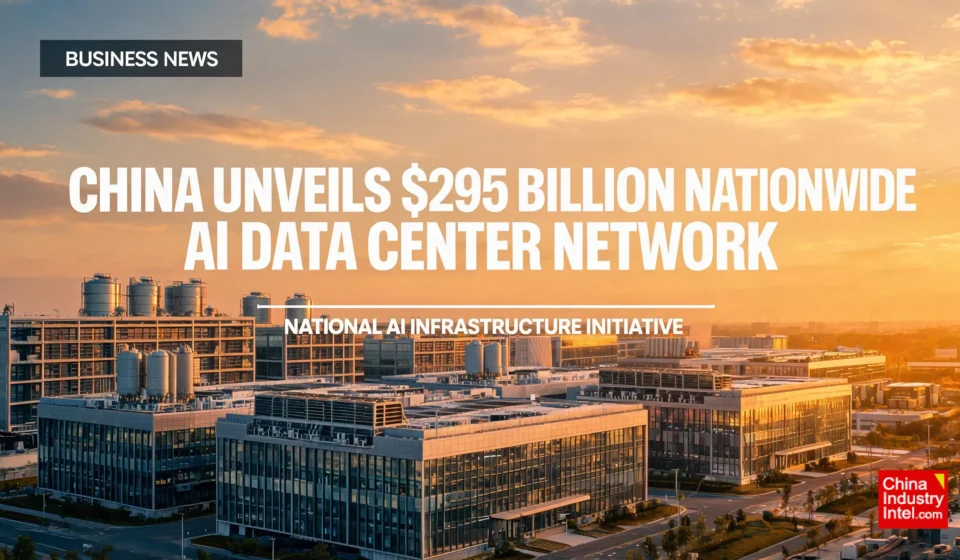
China Unveils $295 Billion Nationwide AI Data Center Network
China has committed to the single largest AI infrastructure program in history. On June 9, 2026, Bloomberg reported that Beijing has unveiled a 2 trillion yuan ($295 billion) plan to build a nationwide network of AI data centers over the next five years. The program, backed by a combination of central government funding, state-owned enterprise investment, and mandated public-private partnerships, represents a decisive escalation in China’s strategy to achieve AI compute sovereignty — the ability to train and deploy advanced AI models entirely on domestic infrastructure, without relying on US-designed chips or American cloud platforms.
The scale of the commitment dwarfs anything previously attempted. For comparison, the entire US CHIPS and Science Act allocated $52.7 billion over five years. Microsoft’s global AI infrastructure spending in 2025 reached approximately $80 billion. China’s new program is nearly six times the CHIPS Act and nearly four times Microsoft’s annual capex — concentrated specifically on AI compute capacity rather than general semiconductor manufacturing. The signal is unmistakable: Beijing views AI infrastructure as the defining national investment of the decade.

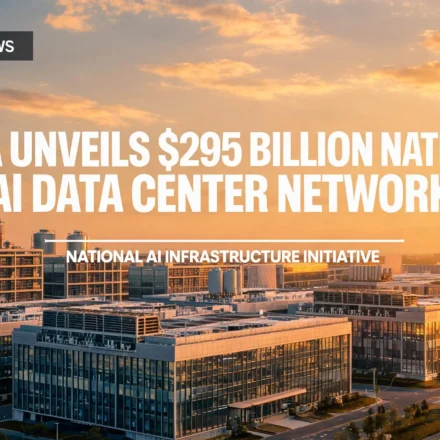
Image: Unsplash / Data center infrastructure at scale — China plans 10 national AI compute hubs
What Happened
According to Bloomberg’s June 9 report, China’s National Development and Reform Commission (NDRC) has approved a comprehensive plan to construct a nationwide AI data center network spanning at least 10 national hub cities and dozens of regional nodes. The 2 trillion yuan ($295 billion) investment will be deployed over five years, from 2026 through 2030, with the explicit goal of reducing China’s dependence on imported AI chips — particularly NVIDIA GPUs — and creating a self-sufficient ecosystem for training and running large-scale AI models.
The plan builds on China’s existing “Eastern Data, Western Computing” initiative launched in 2022, which sought to distribute data center capacity from congested eastern cities to western provinces with cheaper electricity and land. The new program dramatically expands that vision. Rather than simply relocating data centers, it aims to create an integrated national compute grid — interconnected facilities that can dynamically allocate AI training and inference workloads across the country, powered predominantly by domestically manufactured chips.
Key provisions of the plan include: mandatory use of domestically produced AI accelerators in government-funded facilities (with a target of 70% domestic chip content by 2028), tax incentives for private companies that build AI data centers using approved domestic hardware, a new national AI compute allocation authority that will distribute compute resources to priority projects, and requirements that all major cloud providers operating in China maintain a minimum percentage of domestic-chip-powered capacity.
Key Developments
1. Domestic Chip Mandate Reshapes Procurement
The most consequential provision is the domestic chip mandate. Government-funded data centers must source at least 50% of their AI accelerators from domestic manufacturers by end of 2027, rising to 70% by 2028 and 85% by 2030. This directly benefits Huawei’s Ascend series, which has emerged as the only credible domestic alternative to NVIDIA’s A100/H100 lineup. Huawei’s Ascend 910C chip, now in mass production, delivers approximately 70-80% of the inference performance of NVIDIA’s H100 at significantly lower cost. For training workloads, the gap remains larger, but Huawei’s software ecosystem (CANN and MindSpore) has matured sufficiently for enterprise-grade deployment.
3. Ten National Hub Cities Selected
The NDRC has identified 10 cities for the first wave of national AI compute hubs: Beijing, Shanghai, Shenzhen, Chengdu, Chongqing, Guiyang, Hohhot, Zhengzhou, Hangzhou, and Wuhan. Each hub will house a minimum of 10,000 AI accelerator chips in its initial phase, scaling to 50,000+ by 2029. Western cities like Guiyang, Hohhot, and Chengdu were selected for their access to cheap hydroelectric or wind power — a critical factor given that a single large AI training cluster can consume 50-100 megawatts of electricity.
3. Cross-Region Interconnect Backbone
Beyond individual data centers, the plan includes construction of a dedicated high-bandwidth optical fiber backbone connecting all 10 hubs, with latency targets of under 5 milliseconds between adjacent nodes. This backbone will enable distributed training — splitting massive AI model training jobs across multiple data centers simultaneously, effectively pooling compute resources nationally. China Telecom, China Mobile, and China Unicom have been designated as the primary network infrastructure partners.
| Year | Investment (B yuan) | Cumulative (B yuan) | Key Milestone |
|---|---|---|---|
| 2026 | 300 | 300 | Planning & pilot cities selected; pilot hubs break ground |
| 2027 | 400 | 700 | 10 national hubs operational; backbone network Phase 1 |
| 2028 | 450 | 1,150 | 70% domestic chip integration; distributed training enabled |
| 2029 | 400 | 1,550 | Cross-region interconnect complete; 30+ regional nodes |
| 2030 | 450 | 2,000 | Full network operational; 85% domestic chip target |

Image: Unsplash / Semiconductor technology — domestic chip production is central to the plan’s success
Why It Matters
This program is not simply a data center construction project. It is China’s most explicit declaration yet that AI compute capacity is a matter of national security — on par with energy independence or food security. The strategic calculus is straightforward: whoever controls the compute infrastructure controls the pace of AI development, and whoever controls AI development controls the next generation of economic and military power.
The timing is deeply geopolitical. US export controls, tightened significantly in October 2023 and again in 2024, have effectively cut China off from NVIDIA’s most advanced GPUs. While Chinese companies have found workarounds — stockpiling older chips, using domestic alternatives, optimizing software to extract more performance from less hardware — these are stopgap measures. The $295 billion plan represents Beijing’s conclusion that workarounds are insufficient; only a comprehensive national infrastructure build can guarantee long-term AI compute access.
For the global AI industry, the implications are profound. If China successfully builds a self-sufficient AI compute ecosystem, the world’s AI landscape bifurcates into two parallel stacks: a US-led ecosystem built on NVIDIA, AMD, and Intel hardware running CUDA and Western cloud platforms, and a Chinese ecosystem built on Huawei Ascend, SMIC-manufactured chips, and domestic cloud infrastructure. This bifurcation would reshape global technology trade, create new standards wars, and force every multinational company to choose — or maintain — two separate AI strategies.
The investment also has immediate market implications. The sheer volume of procurement — potentially 500,000+ AI accelerator chips over five years — will create enormous demand for both domestic chip manufacturers and the upstream supply chain (packaging, substrates, power systems, cooling). Companies positioned in this supply chain stand to benefit enormously, while US chip firms face the prospect of being permanently locked out of what will soon be the world’s second-largest AI compute market.
China Industry Impact
The ripple effects across China’s technology sector will be massive. Every major domestic technology company is repositioning to capture a share of this investment cycle.
Huawei is the clearest immediate beneficiary. As the only Chinese company producing AI accelerators at scale (the Ascend 910C), Huawei is positioned to capture the lion’s share of the domestic chip mandate. The company’s cloud division, Huawei Cloud, is already bidding on multiple hub city contracts. Industry estimates suggest Huawei’s AI chip revenue could triple from approximately ¥30 billion in 2025 to ¥90 billion by 2028.
Alibaba Cloud and Tencent Cloud face a more complex calculus. Both are major cloud infrastructure providers that currently rely heavily on NVIDIA hardware. The domestic chip mandate forces them to rapidly integrate Huawei Ascend and other domestic chips into their data centers — a costly transition that requires significant software re-engineering. However, both companies also stand to benefit from the overall expansion of the market. Alibaba has already announced a $5 billion AI capital expenditure plan for 2026, a significant portion of which aligns with the national program.
SMIC, China’s leading foundry, faces both opportunity and pressure. The plan’s success depends heavily on SMIC’s ability to produce AI chips at sufficient volume and quality. SMIC’s 7nm process, while functional, has lower yields than TSMC’s equivalent. The national plan effectively makes SMIC’s production capacity a matter of national priority — expect additional government subsidies, equipment procurement assistance, and talent recruitment support for SMIC in the coming years.
Data center construction and equipment firms — including Inspur, Sugon, and H3C — will see a surge in orders for AI-optimized servers, cooling systems, and power infrastructure. Inspur, China’s largest server manufacturer, is already expanding production capacity by 40% in anticipation of demand.
| Company | Role | Recent Development | Market Cap / Revenue |
|---|---|---|---|
| Huawei | Ascend AI chips + Huawei Cloud | Ascend 910C mass production; MindSpore 3.0 ecosystem | $30B+ annual revenue (cloud + chips) |
| Alibaba Cloud | Cloud infrastructure & AI services | $5B AI capex announced for 2026; Tongyi Qwen model suite | ~$130B market cap (Alibaba Group) |
| Tencent Cloud | Cloud infrastructure & AI models | Hunyuan large model; expanding data center footprint | ~$450B market cap |
| SMIC | Chip manufacturing (foundry) | 7nm process node in production; capacity expansion underway | ~$35B market cap |
| Inspur | AI server manufacturing | Leading AI server supplier in China; 40% capacity expansion | ~¥100B ($15B) annual revenue |
Supply Chain Implications
The $295 billion program will create demand shockwaves across the entire AI infrastructure supply chain, from upstream components to downstream services.
Upstream (Chips and Equipment): The domestic chip mandate creates guaranteed demand for Chinese AI chip designers and manufacturers. Beyond Huawei, companies like Cambricon, Biren Technology, and Moore Threads will benefit from accelerated procurement. However, the upstream bottleneck remains SMIC’s fabrication capacity and the availability of advanced packaging technology. China currently lacks domestic EUV lithography capability, meaning all domestic chips must be manufactured using DUV-based multi-patterning — a viable but less efficient approach. Expect significant government investment in semiconductor equipment companies like Naura Technology and AMEC (Advanced Micro-Fabrication Equipment) to close this gap.
Midstream (Data Center Construction): The construction phase will require massive quantities of specialized equipment: liquid cooling systems (AI chips generate enormous heat), high-density power distribution units, uninterruptible power supplies, and optical networking gear. Companies like Sugon, which specializes in liquid-cooled data center infrastructure, and fiber optic suppliers like Hengtong and ZTT are positioned for significant order growth. The construction workforce required — electricians, HVAC specialists, network engineers — will be substantial, creating localized labor market pressure in hub cities.
Downstream (AI Services and Applications): The end goal of this infrastructure is to enable a massive expansion of AI services — cloud-based AI model training, inference-as-a-service, and enterprise AI deployment. With abundant compute capacity, Chinese AI companies like DeepSeek, Moonshot AI, Zhipu AI, and Baichuan will be able to train larger models more frequently, potentially accelerating the pace at which Chinese models close the gap with frontier US models. Enterprise adoption of AI in manufacturing, healthcare, finance, and government services will accelerate as compute costs decline.
The geopolitical supply chain risk is real, however. The program assumes that China can source sufficient quantities of HBM (High Bandwidth Memory) chips — currently dominated by Samsung and SK Hynix — and advanced packaging substrates. If the US extends export controls to these components, the timeline could face significant delays. China’s domestic HBM production (primarily through CXMT/ChangXin Memory Technologies) remains at least two generations behind Samsung’s HBM3E.

Image: Unsplash / Global AI infrastructure competition — China’s plan reshapes the worldwide compute landscape
CII Analysis
Our Take: The $295 billion headline number is eye-catching, but the real story is the domestic chip mandate. This is where Beijing’s plan diverges from typical infrastructure stimulus. China has a long history of building impressive physical infrastructure — high-speed rail, 5G networks, expressways — that outpaces Western equivalents in scale. But AI data centers are only as valuable as the chips inside them. The plan’s success hinges on whether Huawei’s Ascend ecosystem, and the broader domestic chip supply chain, can deliver performance competitive enough to attract voluntary adoption rather than forced compliance.
Our contrarian view: the domestic chip mandate may actually slow China’s AI progress in the short term (2026–2028) by forcing companies to use inferior hardware when better imported alternatives exist. The 70% domestic chip target by 2028 is aggressive given current Ascend 910C yields and the software ecosystem gap between Huawei’s CANN framework and NVIDIA’s CUDA. However, in the medium term (2028–2031), the guaranteed demand from this program could be precisely the catalyst that forces domestic chip makers to close the quality gap. NVIDIA became dominant partly because of massive, guaranteed demand from hyperscalers. China is attempting to replicate that virtuous cycle with state-directed demand instead of market-driven demand. It’s a gamble — but a calculated one with historical precedent in other industries.
For deeper coverage: China AI Industry 2026
By CII Research Team | China Industry Intel
Market Signal
| Scenario | Probability | Description |
|---|---|---|
| 🟢 Bull | 60% | Full 2 trillion yuan deployed on schedule. Huawei Ascend and SMIC production scale successfully. Domestic chips achieve ~85% of NVIDIA H100 performance by 2028. China establishes self-sufficient AI compute ecosystem. Major beneficiaries: Huawei, SMIC, Inspur, domestic chip designers. |
| 🟡 Base | 30% | Partial deployment (~70% of budget). Mixed domestic/imported chip procurement. Some hubs delayed. Domestic chips lag NVIDIA by 1.5-2 generations. China achieves compute independence but at higher cost and lower performance than US ecosystem. |
| 🔴 Bear | 10% | Budget cuts due to economic slowdown. US extends export controls to HBM and packaging. SMIC yields disappoint. Domestic chip mandate forces inefficient allocation. Program delivers infrastructure but not competitive AI capability. |
Company Profiles
Huawei Technologies
What it does: Huawei is China’s largest technology conglomerate, operating across telecommunications equipment, consumer electronics, cloud computing, and — critically — AI chip design. Its Ascend series of AI accelerators (910B, 910C) are the only domestically designed chips that approach NVIDIA’s performance for AI workloads.
Key figures: Approximately ¥700 billion ($100B+) total revenue in 2025. Cloud and AI chip business estimated at $30B+ and growing rapidly. Privately held — no public market cap.
Competitive position: Huawei is the linchpin of China’s entire AI infrastructure strategy. The Ascend 910C, now in mass production, delivers competitive inference performance. Its software ecosystem (CANN framework, MindSpore) has matured significantly but still trails NVIDIA’s CUDA in developer adoption. Huawei’s advantage is structural: it is the only Chinese company with end-to-end capability from chip design to cloud platform.
Alibaba Cloud (Alibaba Group)
What it does: China’s largest cloud computing provider and the world’s fourth-largest. Operates AI infrastructure, develops foundation models (Tongyi Qwen series), and provides enterprise AI services.
Key figures: Alibaba Group market cap ~$130B. Alibaba Cloud revenue ~$14B annually (FY2025). Announced $5B AI capex for 2026.
Competitive position: Alibaba Cloud has the largest market share in China’s public cloud market (~36%). Its Tongyi Qwen models are among the most capable Chinese foundation models. The company must now rapidly integrate domestic chips into its infrastructure to comply with the mandate — a significant engineering challenge but also an opportunity to differentiate.
SMIC (Semiconductor Manufacturing International Corporation)
What it does: China’s largest semiconductor foundry. Manufactures chips designed by other companies, including Huawei’s Ascend AI processors.
Key figures: Market cap ~$35B. Revenue ~$8B annually. 7nm process in production using DUV multi-patterning.
Competitive position: SMIC is the most strategically important company in this entire program. Without SMIC’s ability to fabricate advanced AI chips domestically, the $295 billion plan’s domestic chip mandate collapses. SMIC’s 7nm process works but has lower yields than TSMC’s equivalent, and it cannot access EUV lithography due to export controls. The company is investing aggressively in capacity expansion and is likely to receive additional government support as a direct result of this program.
Inspur Group
What it does: China’s largest server manufacturer and a leading provider of AI-optimized server infrastructure. Supplies servers to cloud providers, telecom operators, and government data centers.
Key figures: Revenue ~¥100B ($15B) annually. Publicly listed subsidiary Inspur Electronic Information.
Competitive position: Inspur is the primary hardware integration partner for data center construction in China. It designs and manufactures AI server systems using both NVIDIA and domestic AI chips. The company is expanding production capacity by 40% in 2026 to meet anticipated demand from the national program.
Tencent Holdings
What it does: China’s largest gaming and social media company, with a significant and growing cloud and AI business. Operates Tencent Cloud and develops the Hunyuan large language model.
Key figures: Market cap ~$450B. Total revenue ~$90B (2025). Cloud revenue growing at 25%+ annually.
Competitive position: Tencent Cloud is China’s second-largest cloud provider. Its Hunyuan model powers AI features across WeChat, QQ, and its gaming ecosystem. Tencent’s massive user base (1.3B+ WeChat users) provides an unparalleled distribution advantage for AI services. Like Alibaba, it must now navigate the domestic chip transition while maintaining service quality.
Sources
- Bloomberg — “China Plans $295 Billion AI Data Center Network to Cut US Chip Reliance” (June 9, 2026)
- National Development and Reform Commission (NDRC) — Eastern Data Western Computing expansion program documentation
- China Academy of Information and Communications Technology (CAICT) — AI infrastructure planning documents
- Huawei Technologies — Ascend 910C product specifications and cloud division announcements
- SMIC — Q1 2026 earnings call and technology roadmap disclosures
- Alibaba Group — FY2026 capital expenditure guidance and AI infrastructure plans