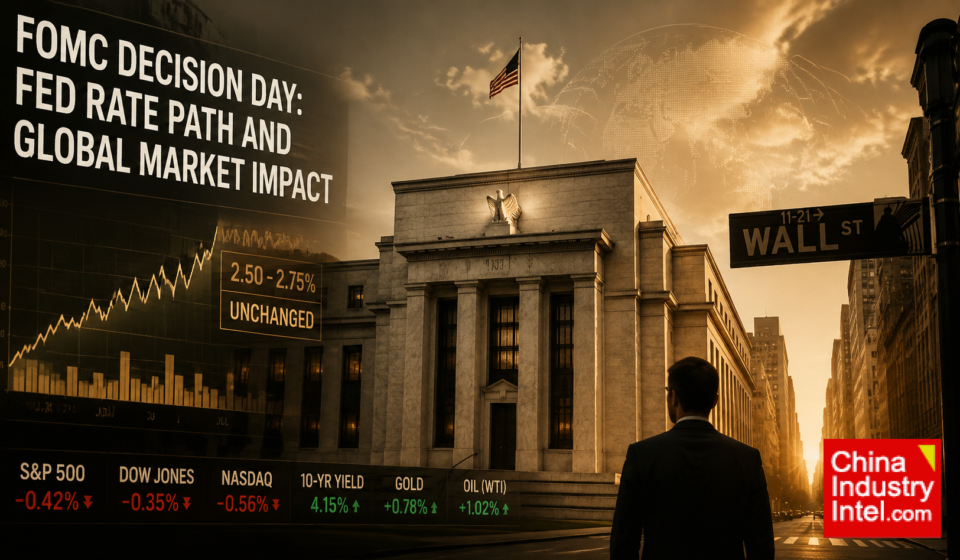
FOMC Decision Day: Fed Rate Path and Global Market Impact
What Happened
Markets worldwide are holding their breath as the Federal Open Market Committee convenes today for its most consequential meeting of 2026. The two-day FOMC session (June 16-17) culminates in a rate decision at 2:00 PM ET on Tuesday, followed by Chair Jerome Powell’s press conference at 2:30 PM ET. Crucially, this meeting includes updated Summary of Economic Projections (SEP) and the closely watched Dot Plot — the quarterly chart that maps each FOMC member’s expectations for the federal funds rate over the next three years.
The timing is extraordinary. Just 48 hours before the committee sat down, the White House announced a ceasefire framework between Iran and the United States, sending Brent crude tumbling below $90 per barrel after weeks of geopolitical tension that had pushed oil above $82. The diplomatic breakthrough dramatically reshapes the inflation outlook that Fed officials must consider when updating their projections.
Meanwhile, SpaceX’s highly anticipated IPO is set to begin trading this week, adding to a risk-on environment that has pushed AI-related valuations to levels that several regional Fed presidents have publicly questioned. The convergence of geopolitical relief, speculative exuberance, and a labor market showing signs of fatigue — February payrolls nearly stalled — creates a uniquely complex decision environment for the 12 voting members of the FOMC.
The FedWatch Tool from CME Group shows markets pricing in a 92%+ probability that the committee holds rates steady at the current 3.50%-3.75% range. But the real action lies in the SEP projections. At the March meeting, the median dot pointed to a single 25-basis-point cut in 2026. The question reverberating through trading desks from Wall Street to Shanghai: will the ceasefire-driven drop in oil prices push the committee to signal two or more cuts this year?
Key Developments
The June SEP update arrives against a backdrop of conflicting signals. UNCTAD has revised global growth down to 2.7%, the weakest reading since the pandemic recovery. The 15% global tariff regime implemented earlier this year continues to weigh on trade volumes, with container shipping indices down 12% year-over-year. Yet the ceasefire has removed the most acute upside risk to energy prices that had dominated the committee’s inflation calculus since March.
Chair Powell’s term ends in May 2026, and the nomination of Kevin Warsh to succeed him adds a layer of political uncertainty to every signal the committee sends. Markets will parse Powell’s language for any indication of the transition timeline and whether Warsh’s more hawkish reputation influences the forward guidance.
The implied federal funds rate derived from fed funds futures tells a nuanced story. At 3.29% for the June 17 fixing, the market is pricing in approximately 1.4 cuts over the remainder of 2026 — suggesting investors expect more easing than the Fed’s own March projection of a single cut.
| Meeting Date | Implied Rate | Market Probability of Cut |
|---|---|---|
| June 17, 2026 | 3.29% | 55.2% |
| July 29, 2026 | 3.22% | 28.8% |
| September 16, 2026 | 3.13% | 34.4% |
| December 9, 2026 | 3.06% | 14.0% |
Source: CME FedWatch Tool, fed funds futures pricing as of June 15, 2026

Image: Unsplash / Financial markets monitoring ahead of FOMC decision
The probability distribution reveals that September is the most likely month for the next cut at 34.4%, followed by June at 55.2% — but the June figure reflects the conditional probability given a cut occurs, not the unconditional likelihood. The market’s base case remains a hold today, with easing resuming in the second half of the year.
Why It Matters
The FOMC decision reverberates far beyond U.S. borders. With the dollar serving as the world’s reserve currency and U.S. Treasury yields functioning as the global risk-free rate, the Fed’s dot plot effectively sets the cost of capital for every economy on earth. A signal of faster easing weakens the dollar, reduces borrowing costs for emerging markets, and channels capital toward risk assets. A hawkish surprise does the opposite — and the consequences are amplified by the 15% tariff regime that has already strained global trade flows.
For the China AI industry and the broader technology sector, the rate path is existential. AI valuations have reached levels where even modest increases in discount rates can trigger significant repricing. The SpaceX IPO this week is emblematic of the exuberance: a company valued at roughly $350 billion in private markets now entering public trading. If Powell signals concern about speculative excess — as several FOMC members have hinted in recent speeches — the correction could cascade through AI, quantum computing, and space technology stocks simultaneously.
The ceasefire’s impact on the inflation outlook cannot be overstated. Oil prices had been the single largest upside risk to the committee’s 2026 inflation forecast. With Brent now below $90 and potentially falling further as Middle East tensions de-escalate, the case for maintaining a restrictive stance weakens materially. This could embolden the dovish faction on the committee — led by Governors Waller and Bowman — to push for a revised median dot of two cuts instead of one.
Image: Unsplash / The Federal Reserve headquarters, Washington D.C.
China Industry Impact
China’s industrial sector hangs on every basis point of the Fed’s guidance. A dovish shift — signaling two or more cuts in 2026 — would weaken the dollar against the yuan, easing pressure on the People’s Bank of China to maintain tight monetary conditions. Beijing has been constrained in its own easing cycle by the need to defend the yuan, which has depreciated approximately 4.5% against the dollar since the tariff regime took effect. Faster Fed cuts would give the PBOC room to lower the Loan Prime Rate, directly reducing borrowing costs for Chinese manufacturers and real estate developers.
The impact flows through to China’s AI industry with particular force. Chinese tech companies like Alibaba, Tencent, and ByteDance have been competing with U.S. counterparts in a capital-intensive AI arms race. Lower U.S. rates reduce the cost of dollar-denominated debt that many Chinese tech firms carry, while also narrowing the yield advantage that has drawn capital away from Chinese equities toward U.S. Treasury bills.
For Chinese exporters, the picture is more complex. A weaker dollar improves competitiveness of RMB-denominated goods, but the 15% tariff baseline offsets much of the currency advantage. The net effect depends on which sectors are analyzed: heavy industrial equipment manufacturers benefit from dollar weakness, while consumer electronics exporters face continued tariff headwinds regardless of the exchange rate.
Supply Chain Implications
The FOMC’s rate path has cascading effects on global supply chain financing. With 70% of international trade conducted in U.S. dollars, the cost of letters of credit, trade finance, and working capital facilities all move in tandem with the federal funds rate. A dovish signal reduces the carrying cost of inventory — a meaningful consideration for companies that have been running lean stockpiles since the tariff-driven supply chain disruptions of early 2025.
Shipping and logistics operators are particularly sensitive. Container leasing rates have declined 8% year-to-date as global trade volumes softened. A rate cut trajectory would support a recovery in trade finance activity, potentially reversing the decline in container volumes by Q4 2026. For Chinese port operators and logistics firms — many of whom carry significant dollar-denominated debt — lower rates translate directly to improved margins.
The ceasefire’s effect on energy supply chains adds another dimension. If Iranian oil returns to global markets in meaningful volumes, energy-intensive Chinese industries (steel, aluminum, chemicals, cement) would benefit from lower input costs. Combined with a dovish Fed, this could catalyze a re-acceleration of Chinese industrial output in the second half of 2026 — a scenario that commodity traders are already beginning to price.
CII Analysis
Our Take: The FOMC will hold rates at 3.50%-3.75% today — that is near-certain. The critical variable is the SEP median dot. We expect the committee to maintain its one-cut projection for 2026, but the distribution of individual dots will skew dovish compared to March, with two or three members moving their projections down by 25 basis points. The ceasefire removes the oil inflation tail risk that had anchored the hawkish position, and February’s near-stall in hiring provides a domestic labor market justification for easing. However, Powell will resist telegraphing a cut at the July meeting, preferring to maintain optionality through the summer. The most likely outcome is a “hawkish hold” — rates unchanged, dot plot unchanged, but with language in the statement acknowledging improved inflation risks from lower energy prices. For China, this means the PBOC remains constrained through Q3, with relief arriving in Q4 if the Fed follows through on a September or December cut. The real wildcard is AI valuations: if the SpaceX IPO trades to a premium this week, expect Powell to inject caution into his press conference language, which could trigger a broader risk-off move that temporarily strengthens the dollar despite the dovish undertone.
For deeper: China AI Industry 2026