Moonshot AI Launches Kimi AI-Native Credit Card: Spending Earns Compute Credits in China Fintech First
By CII (China Industry Intel) – Contributing Analyst | June 24, 2026
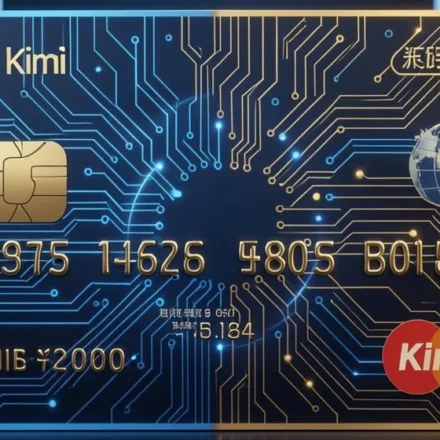
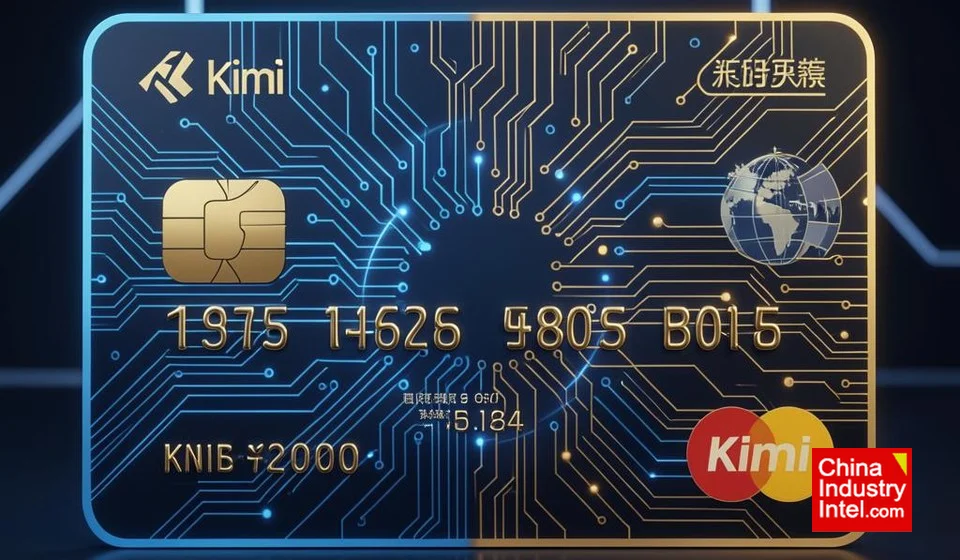
Moonshot AI (月之暗面), one of China’s leading artificial intelligence startups and the creator of the popular Kimi chatbot, has taken a bold step into financial services with the announcement of China’s first AI-native credit card. In partnership with a major state-owned bank, the new Kimi-branded credit card introduces a revolutionary concept: spending earns compute credits. Under the slogan “消费即算力” — “spending is computing power” — every purchase made with the card converts into AI compute resources that users can apply toward running models, generating content, or accessing premium AI features on the Kimi platform. The move represents the most direct fusion of consumer finance and artificial intelligence yet seen in China, and signals a new phase of competition among Chinese AI firms to embed themselves into users’ daily financial lives.
The announcement, which surfaced across Chinese financial and technology media in mid-June 2026, positions Moonshot AI at the frontier of AI-fintech convergence. While details of the state-owned banking partner remain pending official disclosure, multiple reports confirm that the card will be issued under a co-branded arrangement with one of China’s “Big Five” state-owned commercial banks — a partnership that lends the product both regulatory legitimacy and access to China’s vast bank card payment infrastructure. The card is expected to launch officially in Q3 2026, with pilot programs already underway among Kimi’s existing user base of over 30 million monthly active users.
Spending as Compute: How the AI-Native Credit Card Works
The core innovation of the Kimi AI-native credit card is its compute-back rewards model, which fundamentally reimagines what a credit card can offer. Instead of traditional cashback, airline miles, or loyalty points, cardholders earn “Kimi Compute Credits” — denominated in token-equivalent compute units — based on their spending volume. These credits can be redeemed directly within the Kimi ecosystem for AI services including long-context processing, image generation, code generation, document analysis, and priority access during peak usage periods.
The rewards structure operates on a tiered basis, with higher spending categories yielding proportionally more compute credits. Everyday purchases such as groceries, dining, and transportation earn base-level compute, while spending in technology-adjacent categories — electronics, online education, software subscriptions, and coworking spaces — earns accelerated compute multipliers. A premium tier, rumored to be called “Kimi Pro,” offers unlimited standard compute access for cardholders who meet a minimum monthly spending threshold, effectively creating an all-you-can-use AI subscription bundled into a credit card product.
| Spending Category | Compute Credit Rate | Example (Monthly Spend) | Compute Earned (Tokens) | Equivalent Kimi Usage |
|---|---|---|---|---|
| Base: Groceries, Dining, Transport | 1 compute token per ¥1 spent | ¥5,000 | 5,000 tokens | ~10 standard queries |
| Accelerated: Tech, Education, Software | 3 compute tokens per ¥1 spent | ¥2,000 | 6,000 tokens | ~15 standard queries or 3 long-context analyses |
| Premium Tier (Min. ¥15,000/mo) | Unlimited standard compute | ¥15,000 | Unlimited | All-standard features unlocked |
| Signup Bonus | One-time | Card activation | 50,000 tokens | ~100 standard queries |
Sources: Eastmoney Caifuhao report (June 12, 2026); Sohu Technology coverage (June 2026). Token-to-usage equivalents are illustrative and based on current Kimi platform consumption rates. Official terms and compute credit values subject to final product disclosure.
Beyond the rewards structure, the card integrates Kimi’s AI capabilities directly into the banking experience. Cardholders can manage their accounts, analyze spending patterns, receive personalized budgeting recommendations, and dispute transactions through natural-language interactions with Kimi. The AI assistant can parse transaction data to provide monthly spending summaries, flag unusual charges, and suggest optimizations — all through the same conversational interface that Kimi users already know. This embeds AI not as an external rewards layer but as the primary interface for the financial product itself.
Strategic Rationale: Why Moonshot AI is Entering Finance

Moonshot AI’s move into consumer finance reflects several converging strategic imperatives. First among them is user acquisition and retention in an increasingly crowded Chinese AI market. With competitors including ByteDance’s Doubao, Baidu’s ERNIE Bot, Alibaba’s Tongyi Qianwen, and Zhipu AI all vying for consumer attention, differentiation through ecosystem integration has become a critical battleground. A credit card that turns everyday spending into AI access creates a powerful retention loop — the more a user spends on the card, the more invested they become in the Kimi ecosystem.
Second, the partnership with a state-owned bank provides Moonshot AI with a distribution channel that reaches hundreds of millions of Chinese consumers. China’s state-owned banks collectively issue over 8 billion bank cards and maintain branch networks in every city and most towns across the country. Co-branding with one of these institutions gives Kimi physical-world presence and credibility that pure-digital competitors cannot easily replicate. It also opens access to customer acquisition through bank branches, mobile banking apps, and existing credit card marketing channels.
Third, the compute-credit model addresses a genuine pain point for AI power users. As AI models become more capable and context windows expand to millions of tokens, the compute cost per interaction rises. For heavy users — professionals, researchers, students, and content creators — AI subscription costs can become a meaningful monthly expense. By bundling compute credits with spending that users would do anyway, Moonshot AI effectively makes AI access feel free at the margin, reducing price sensitivity and increasing platform stickiness.
Fourth, the partnership creates a valuable data flywheel. Spending data — with appropriate privacy safeguards and user consent — provides rich signals about user behavior, preferences, and financial health that can inform AI model training and personalization. This data advantage, if managed within China’s strict personal information protection framework, could give Kimi insights that pure AI companies without financial services arms cannot access.
China’s AI-Fintech Convergence: A Broader Trend

The Kimi AI-native credit card is not an isolated development but rather the leading edge of a broader convergence between artificial intelligence and financial services in China. Over the past two years, Chinese financial institutions have rapidly adopted AI across customer service, risk assessment, fraud detection, and wealth management. Ant Group’s MYbank uses AI for SME credit scoring; WeBank applies large language models to customer support; and China Merchants Bank has deployed AI advisors for retail wealth management. The Kimi card represents the first time an AI company — rather than a bank — has initiated the product and embedded AI as the core value proposition rather than a backend efficiency tool.
This convergence is enabled by China’s uniquely integrated digital payments ecosystem. With WeChat Pay and Alipay processing the vast majority of consumer transactions, and with China UnionPay providing the underlying card network infrastructure, new financial products can launch with immediate access to a nationwide acceptance network. The Kimi card, presumably operating on the UnionPay network, will be usable at tens of millions of merchants across China from day one.
The regulatory environment also supports such innovation, albeit within careful boundaries. The People’s Bank of China has encouraged fintech innovation through its regulatory sandbox program, which has approved over 100 pilot projects since 2020. Financial products that embed technology services into traditional banking instruments fall squarely within the policy objectives of promoting financial inclusion and technological modernization of the financial sector — goals repeatedly emphasized in China’s Five-Year Plans and financial regulatory guidance.
Competitive Landscape and Market Implications
The Kimi AI-native credit card enters a Chinese credit card market that is both mature and fiercely competitive. By the end of 2025, China had over 780 million credit cards in circulation, with state-owned banks dominating issuance. The market has seen slowing growth in recent years as mobile payments reduce the marginal utility of physical cards, pushing issuers to differentiate through rewards, lifestyle benefits, and ecosystem integration. The compute-credit model represents the most novel differentiation to emerge in years.
For the state-owned banking partner, the collaboration offers access to Kimi’s young, tech-savvy user base — a demographic that traditional banks have struggled to engage. Kimi’s users skew heavily toward professionals aged 20-40 in China’s first- and second-tier cities, precisely the cohort that banks covet for long-term customer lifetime value. The AI angle also generates media buzz and brand rejuvenation that state-owned banks, often perceived as staid and bureaucratic, actively seek.
Competitors are unlikely to stand still. ByteDance, which operates both the Doubao AI assistant and holds a consumer finance license through its subsidiary, could conceivably launch a competing Doubao-linked financial product. Alibaba’s Ant Group, with its Alipay ecosystem and Tongyi Qianwen AI platform, possesses all the components for an integrated AI-finance offering. Baidu, which has invested heavily in ERNIE Bot and holds financial services licenses through Du Xiaoman Financial, represents another potential entrant. The Kimi card may prove to be the first mover in a new category rather than a durable monopoly.
The Economics: Why “Spending = Compute” Makes Sense
The underlying economics of the compute-credit model are more favorable than they might first appear. Credit cards in China typically generate revenue through merchant discount fees (interchange), typically 0.3-0.6% of transaction value, plus interest on revolving balances and annual fees. For a card with ¥10,000 monthly spending, the issuing bank earns roughly ¥30-60 in interchange fees. The marginal cost of providing AI compute for a cardholder spending at that level — even at generous credit rates — is measured in fractions of a renminbi when computed at Moonshot AI’s inference cost structure.
This creates a substantial margin buffer. The compute credits function more as a marketing expense and retention tool than a direct financial cost. And unlike traditional rewards — cashback reduces revenue dollar-for-dollar; airline miles require purchasing seat inventory — compute credits consume Moonshot AI’s own infrastructure, which has high fixed costs but near-zero marginal cost for incremental usage. Every compute credit redeemed keeps the user within the Kimi ecosystem, creating additional opportunities for premium feature upsells and data generation.
The partnership likely involves revenue sharing between Moonshot AI and the state-owned bank, though specific terms remain confidential. The bank brings the regulatory license, card issuance infrastructure, risk management, and customer service operations, while Moonshot AI contributes the brand, AI technology, user base, and the compute-credit rewards inventory. Both parties gain strategic assets they could not easily develop independently — the bank gains AI differentiation, and Moonshot AI gains financial services distribution.
Outlook: The Future of AI-Native Finance
The Kimi AI-native credit card points toward a future where the boundary between technology platforms and financial services becomes increasingly porous. If the model succeeds — measured by card issuance volumes, activation rates, spending volumes, and Kimi platform engagement uplift — it will almost certainly spawn imitators across China’s tech landscape. The logical extension is AI-native banking more broadly: deposit accounts that earn compute interest, AI-underwritten loans that use conversational interfaces for application and servicing, and investment products where AI advisory is the primary value proposition rather than an add-on feature.
International implications are also worth watching. While the specific regulatory alignment between a Chinese AI startup and a state-owned bank is unique to China’s institutional environment, the concept of embedding AI services into financial products is universally applicable. Western fintech companies and neobanks — from Revolut and Monzo to Chime and Nubank — could potentially pursue similar integrations with AI providers. Apple Card’s integration with Apple Intelligence, Google’s potential Gemini-powered financial tools, and Amazon’s growing financial services footprint all represent vectors along which AI-native finance could develop outside China.
For now, the Kimi AI-native credit card stands as a landmark experiment at the intersection of two of China’s most dynamic technology sectors. Its slogan captures the ambition succinctly: in an AI-driven world, spending truly becomes computing power.
Sources
- 东方财富 (Eastmoney Caifuhao) — 消费即算力!月之暗面推出Kimi AI原生信用卡 (June 12, 2026)
- 搜狐 (Sohu) — 月之暗面Kimi将与一国有银行发行AI原生信用卡 (June 2026)
- LinkedIn — Moonshot AI Launches Kimi AI-Native Credit Card
- People’s Bank of China — Fintech Development Plan (2022-2025)
- Moonshot AI (月之暗面) — Company Overview and Kimi Platform