China Intensifies AI Infrastructure Push as Data Center Construction Boom Accelerates
China’s AI infrastructure CAPEX exceeds 0B in 2026. Data center construction boom accelerates as domestic GPU supply chain expands. US-China compute gap narrows.
China’s AI Infrastructure Investment Reaches Unprecedented Scale
China is executing the world’s largest coordinated artificial intelligence infrastructure buildout, with data center construction and AI chip deployment accelerating at a pace that is reshaping global compute markets. According to multiple industry reports and government disclosures, China’s AI infrastructure capital expenditure is on track to exceed $60 billion in 2026, as state-backed telecom operators, cloud providers, and regional governments race to build the physical foundation for the country’s AI ambitions.
The National Development and Reform Commission (NDRC) confirmed in its May 2026 infrastructure report that 42 large-scale AI data center projects broke ground in Q1 2026 — more than in all of 2024 combined. The projects span 18 provinces, with the heaviest concentration in Inner Mongolia (cool climate, cheap coal and renewable power), Guizhou (the established “China Data Valley”), Gansu (wind and solar abundance), and Ningxia (land and cooling advantages). Together, these four provinces will add an estimated 18 GW of new data center power capacity by 2028.
China Mobile, China Telecom, and China Unicom — the three state-owned telecom carriers — are the primary infrastructure operators. China Mobile alone has allocated 120 billion yuan ($16.5 billion) for AI data center construction in its 2026-2028 capital plan, targeting 200,000 AI accelerator deployments by end-2028. China Telecom’s “Cloudification and Digital Transformation” strategy commits 95 billion yuan ($13.1 billion) over the same period. Combined, the three telecom giants are building at a pace that rivals the hyperscale cloud providers globally.
The GPU Supply Chain: Domestic Chips Fill the Gap

| GPU/Accelerator | Developer | Process Node | FP16 Performance (TFLOPS) | 2026 Est. Shipments (units) | Primary Deployments |
|---|---|---|---|---|---|
| Ascend 910C | Huawei HiSilicon | 7nm (SMIC N+2) | 320 | 350,000-400,000 | China Mobile, government AI, Baidu |
| Ascend 920 (Q4 2026) | Huawei HiSilicon | 5nm-class chiplet | 600+ (est.) | 50,000 (initial) | Top-tier AI labs, cloud providers |
| Biren BR100 | Biren Technology | 7nm (TSMC, pre-sanction) | 512 | 120,000-150,000 | Alibaba Cloud, Tencent Cloud |
| Cambricon MLU590 | Cambricon Technologies | 7nm (SMIC N+2) | 256 | 200,000-250,000 | China Telecom, provincial data centers |
| Moore Threads MTT S4000 | Moore Threads | 12nm (GlobalFoundries) | 200 | 100,000-130,000 | Desktop AI, enterprise inference |
| Enflame DTU 2.0 | Enflame (Tencent-backed) | 12nm | 180 | 80,000-100,000 | Tencent Cloud, AI inference |
| H20 (China-legal variant) | NVIDIA | 4nm (TSMC) | 148 | 400,000-500,000 | ByteDance, Tencent, Alibaba, startups |
| Intel Gaudi 3 | Intel (Habana Labs) | 5nm (TSMC) | 185 | 80,000-100,000 | Enterprise AI, OEM servers |
The domestic GPU supply chain has expanded dramatically. Huawei’s Ascend 910C, manufactured on SMIC’s 7nm (N+2) process, has become the workhorse accelerator for state-backed AI deployments in 2026. Despite single-chip performance that trails NVIDIA’s restricted H20 by approximately 20% on raw FP16 throughput, the Ascend’s advantage lies in unrestricted supply and full software stack integration with Huawei’s MindSpore framework and CANN (Compute Architecture for Neural Networks) libraries.
NVIDIA’s China-legal H20 GPU — a compliance variant designed to meet US export control performance thresholds — remains the most widely deployed accelerator among Chinese AI startups and internet companies. ByteDance, Tencent, and Alibaba collectively purchased an estimated 300,000-350,000 H20 units in the first five months of 2026, according to supply chain data compiled by SemiAnalysis. However, the H20’s 148 TFLOPS FP16 throughput (with sparsity) is less than half the performance of the unrestricted H100 (312 TFLOPS), creating a parallel compute tier where Chinese labs optimize around lower per-chip performance through scale.
Huawei’s upcoming Ascend 920, expected in Q4 2026, represents a significant architectural leap. The chip employs a chiplet design — ironic given US restrictions — interconnecting multiple compute dies via Huawei’s proprietary interposer technology. Early benchmarks leaked to Chinese tech media suggest FP16 performance exceeding 600 TFLOPS, which would place it between NVIDIA H100 (312 TFLOPS) and B200 (1,400+ TFLOPS) territory. If achievable at volume, the 920 would dramatically narrow China’s per-chip performance gap.
US vs. China AI CAPEX: The Numbers Behind the Narrative

The AI infrastructure investment race between the United States and China has become one of the defining economic competitions of the decade. In 2025, US hyperscale cloud providers — Microsoft, Amazon (AWS), Google (GCP), and Meta — spent a combined $218 billion on capital expenditure, with approximately 60% ($131 billion) directed toward AI-related infrastructure including data centers, GPUs, and networking. Goldman Sachs estimates US hyperscale AI CAPEX will reach $165-180 billion in 2026.
China’s AI infrastructure spending is harder to quantify precisely due to the mix of state and private investment, but Dell’Oro Group estimates China’s total AI data center CAPEX at $58-62 billion for 2026 — roughly one-third of the US figure. However, the gap narrows when adjusted for purchasing power and construction costs. Chinese data center construction costs average $6-8 million per megawatt, compared to $9-12 million in the US, giving China approximately 40-50% more physical infrastructure per dollar spent.
The GPU cost differential is even more pronounced. A Huawei Ascend 910C server node (8 GPUs) costs approximately 800,000-1,000,000 yuan ($110,000-$138,000) from Chinese system integrators, while an equivalent NVIDIA H100 node costs $250,000-$300,000 at US list prices (and far more in practice given allocation constraints). Chinese cloud providers deploying Ascend infrastructure therefore achieve 2-3x more GPU-hours per dollar of CAPEX — a metric that matters enormously for large-scale training runs.
China’s approach is fundamentally different in philosophy. Where US hyperscalers deploy bleeding-edge chips in relatively fewer, highly optimized facilities, Chinese operators deploy larger fleets of less powerful domestic accelerators across many more distributed data centers. The result is an “aggregate compute” strategy that prioritizes total available FLOPs over per-chip performance. As one senior engineer at a Chinese cloud provider told SemiAnalysis: “We can’t win on peak performance, so we win on total throughput across the grid.”
Power and Cooling: The Hidden Infrastructure Challenge
The scale of the data center buildout is creating a parallel challenge in power and cooling infrastructure. China’s AI data centers are projected to consume approximately 85 TWh of electricity in 2026, up from 52 TWh in 2024, according to the China Electricity Council. That represents roughly 0.9% of China’s total electricity consumption — a figure expected to reach 2.5% by 2030.
To manage this load, new AI data centers in northern China are being co-located with renewable energy projects. The Hohhot Data Center Cluster in Inner Mongolia, which houses facilities for China Mobile, Alibaba, and ByteDance, is powered by a mix of on-site wind, solar, and coal — with an average Power Usage Effectiveness (PUE) of 1.25, below the global average of 1.55. Guizhou’s data centers benefit from year-round average temperatures of 15°C, reducing cooling costs by an estimated 30-40% versus facilities in warmer climates.
Liquid cooling adoption is accelerating faster in China than anywhere else. Inspur, China’s largest server manufacturer, reported that 65% of its AI server shipments in Q1 2026 used direct-to-chip liquid cooling — up from 28% a year earlier. Sugon’s immersion cooling solutions have been deployed in over 50 Chinese data centers, with PUE ratings as low as 1.05. The government’s “Eastern Data, Western Computing” policy explicitly mandates a PUE below 1.25 for new large-scale data centers, effectively requiring liquid cooling for all AI workloads.
What This Means for Global AI Competition
The infrastructure buildout carries profound implications. China’s total AI compute capacity, while still trailing the US, is growing at 40-45% annually versus 30-35% in the US, according to estimates from the Center for Security and Emerging Technology (CSET) at Georgetown University. At current trajectories, China’s total AI training compute could reach 60-70% of US levels by 2028 — up from an estimated 30% in 2024.
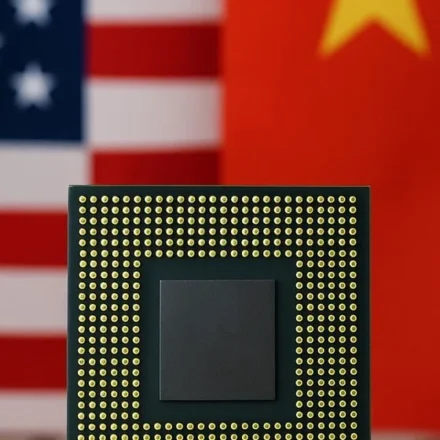
Export controls remain the primary constraint. The US has tightened restrictions three times since October 2023, most recently in March 2026 when the Bureau of Industry and Security (BIS) added 24 Chinese AI chip design firms to the Entity List and expanded semiconductor manufacturing equipment restrictions to cover additional DUV immersion tools. Each tightening creates a short-term supply shock in China but also intensifies the domestic chip development effort, creating what analysts call a “sanctions flywheel” — restrictions drive investment in alternatives, which reduces dependence, which prompts further restrictions.
OpenAI CEO Sam Altman acknowledged the dynamic in a May 2026 congressional testimony: “Export controls are necessary but insufficient. Without a massive domestic buildout of AI infrastructure in the United States and allied nations, the compute gap will narrow regardless of policy measures.” His call for a US government-backed $100 billion AI infrastructure fund reflects growing recognition in Washington that the AI competition is ultimately an infrastructure competition — and China is building fast.
Sources
- National Development and Reform Commission (NDRC), “New Infrastructure Construction Progress Report,” May 2026
- SemiAnalysis, “China AI Compute Assessment and GPU Supply Chain Analysis,” May 2026 — semianalysis.com
- Dell’Oro Group, “AI Data Center CAPEX Tracker Q1 2026,” May 2026
- Goldman Sachs Equity Research, “US Hyperscale CAPEX Outlook 2026,” April 2026
- Center for Security and Emerging Technology (CSET), Georgetown University, “Global AI Compute Capacity Assessment,” March 2026
- China Electricity Council, “Data Center Power Consumption Report,” March 2026
- Inspur Electronic Information Industry Co., AI Server Market Report Q1 2026
- US Bureau of Industry and Security (BIS), Entity List Additions, March 14, 2026