China Vows Retaliation Against New US Semiconductor Tariffs as Trade War Escalates
By CII (China Industry Intel) – Contributing Analyst | June 23, 2026
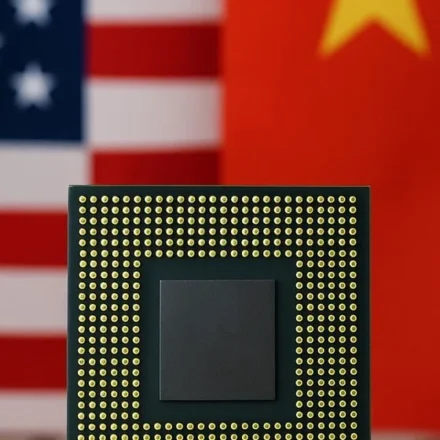
The United States is preparing to impose a new wave of semiconductor tariffs on Chinese chip imports, escalating the already intense technology trade war between the world’s two largest economies. According to a report by the South China Morning Post, the proposed tariffs — which would target a broad range of semiconductor products including legacy chips, memory components, and advanced packaging — have drawn an immediate and forceful response from Beijing. China’s Ministry of Commerce stated on Monday that the measures are “unreasonable and discriminatory,” vowing to take “all necessary countermeasures” to protect China’s interests. The latest escalation marks a dangerous new phase in a conflict that has already reshaped global semiconductor supply chains and forced companies worldwide to navigate an increasingly fragmented technology landscape.
The proposed US tariffs are the latest in a series of actions that began during the first Trump administration and have been intensified under subsequent administrations. Sources familiar with the deliberations told the SCMP that the new tariff package could cover up to $30 billion worth of semiconductor imports from China, with rates ranging from 25% to 100% depending on the product category. The measures are reportedly designed to close loopholes that allowed Chinese chipmakers to circumvent previous export controls by routing products through third countries or by developing alternative manufacturing processes that fall outside existing restrictions.
China’s retaliatory stance has been unambiguous. Foreign Ministry spokesperson Wang Wenbin told reporters that China “resolutely opposes” the new tariffs and accused Washington of “weaponizing economic and trade issues.” The Ministry of Commerce indicated that China’s countermeasures could include export restrictions on critical raw materials used in semiconductor manufacturing — a especially potent threat given China’s dominant position in rare earth elements and gallium/germanium production. China already demonstrated its willingness to use this leverage in 2023, when it imposed export controls on gallium and germanium, two elements essential for advanced semiconductor and defense applications. Industry analysts warn that further restrictions could disrupt the global chip supply chain far beyond the immediate US-China bilateral relationship.
Impact on the Global Semiconductor Supply Chain
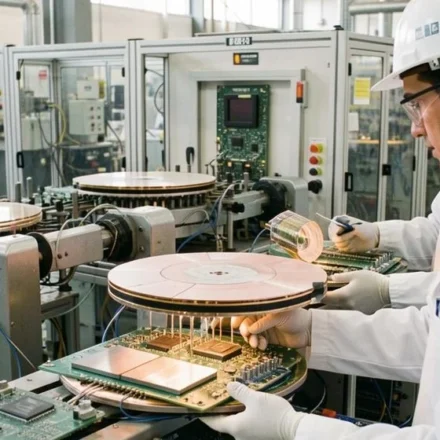
The semiconductor supply chain is one of the most complex and globally integrated industrial ecosystems in existence. A single advanced chip may cross international borders dozens of times during its journey from raw silicon to finished product, with design occurring in the United States or United Kingdom, fabrication in Taiwan or South Korea, packaging in Malaysia or Vietnam, and final assembly in China. The new US tariffs threaten to disrupt this carefully calibrated system at multiple points simultaneously.
The most immediate impact will be felt in the market for legacy chips — semiconductors manufactured on older process nodes (28nm and above) that are used extensively in automobiles, industrial equipment, home appliances, and telecommunications infrastructure. China has invested heavily in legacy chip production capacity over the past five years and now accounts for an estimated 30% of global legacy chip output. Many Western companies, including major automakers and industrial conglomerates, depend on these Chinese-made chips for their products. Tariffs of 50% or more would significantly increase costs for downstream manufacturers and could force a rapid reconfiguration of procurement strategies that have been optimized over decades.
At the advanced end of the spectrum, the tariffs compound existing export controls that already restrict China’s access to cutting-edge chipmaking equipment from ASML, Applied Materials, and Lam Research. The combination of equipment restrictions and import tariffs creates a pincer movement designed to constrain China’s semiconductor ambitions at both the input and output ends. However, industry experts caution that this strategy carries significant risks. By forcing China to accelerate its domestic semiconductor development programs, the United States may be inadvertently fast-tracking the emergence of a competitive Chinese chip industry that could eventually challenge the dominance of incumbents in Taiwan, South Korea, and the United States itself.
Key Companies in the Crossfire

The new tariffs will affect a broad spectrum of companies across the semiconductor value chain. Chinese chipmakers, including Semiconductor Manufacturing International Corporation (SMIC), Hua Hong Semiconductor, and Yangtze Memory Technologies (YMTC), face the most direct impact. SMIC, China’s largest contract chipmaker, has already been cut off from advanced equipment due to entity-list restrictions; the new tariffs would further constrain its ability to sell into the US market and to US-allied countries that align with Washington’s export control regime.
Huawei, which has been the primary target of US semiconductor restrictions since 2019, faces a particularly complex situation. The company’s HiSilicon chip design unit has developed advanced processors including the Kirin 9000S and subsequent generations, but remains dependent on SMIC for manufacturing. While Huawei does not export large volumes of finished chips to the United States, the tariffs affect the broader ecosystem of components that go into Huawei’s telecommunications equipment, smartphones, and cloud computing infrastructure. The company’s resilience in the face of sanctions has become a symbol of China’s technological self-reliance push, and any new restrictions are likely to intensify Huawei’s already substantial R&D investment in alternative chip architectures and manufacturing processes.
On the US side, companies like Qualcomm, Intel, AMD, NVIDIA, and Broadcom face significant exposure. These firms derive substantial revenue from the Chinese market — for Qualcomm, China represents over 60% of total revenue. While most of their chips are manufactured in Taiwan or South Korea rather than China, the retaliatory measures threatened by Beijing could directly target these companies through expanded export controls, antitrust investigations, or market access restrictions. NVIDIA’s experience is instructive: the company has already been forced to develop China-specific versions of its AI accelerators that comply with US export controls, sacrificing performance for market access. Further escalation could make even these compromise products untenable.
| Company | Country | Revenue Exposure to China | Primary Risk | Mitigation Strategy |
|---|---|---|---|---|
| SMIC | China | ~85% domestic | US tariffs on chip exports, equipment restrictions | Accelerating domestic equipment development, 7nm breakthrough |
| Huawei (HiSilicon) | China | ~70% domestic | Foundry access, component sourcing | Vertical integration, RISC-V architecture, domestic EDA tools |
| YMTC | China | ~60% domestic | Equipment restrictions, memory price competition | Xtacking architecture, domestic equipment partnerships |
| Qualcomm | US | ~62% of revenue | Chinese retaliation, Huawei competition | Diversification into automotive and IoT |
| NVIDIA | US | ~20% of revenue (estimated) | AI chip export controls, China-specific SKU viability | China-compliant H20/B20 chips, server OEM partnerships |
| ASML | Netherlands | ~15% of revenue (direct China) | Expanded equipment export bans | Lithography dominance, service contracts for installed base |
| TSMC | Taiwan | ~12% of revenue (direct China) | Geopolitical risk, customer diversification pressure | Global fab expansion (US, Japan, Germany) |
Sources: Company financial reports (FY2025), SCMP, Reuters, SIA industry data. Revenue exposure estimates reflect direct sales to China-based customers; indirect exposure through supply chains may be significantly higher.
Historical Context: The US-China Chip War from Trump to 2026

The current tariff escalation is the latest chapter in a conflict that has been building for nearly a decade. The US-China semiconductor confrontation can be traced through several distinct phases, each marked by escalating restrictions and increasingly sophisticated responses from both sides.
Phase One (2018-2019): Opening Shots. The Trump administration initiated the trade war with broad tariffs on Chinese imports, but the semiconductor-specific dimension emerged when the Commerce Department added Huawei to the Entity List in May 2019. This action prohibited US companies from supplying technology to Huawei without a license, effectively cutting the company off from Google’s Android ecosystem, Qualcomm’s chips, and a wide range of US-origin components. The move was unprecedented in its targeting of a single company and signaled that semiconductors would be a central battleground in the broader US-China strategic competition.
Phase Two (2020-2022): Foundry Restrictions. The Biden administration expanded the semiconductor campaign dramatically. In October 2022, the Commerce Department’s Bureau of Industry and Security (BIS) unveiled comprehensive export controls that restricted China’s access to advanced computing chips, semiconductor manufacturing equipment, and the US-person support that had enabled Chinese chipmaking progress. The rules specifically targeted advanced logic chips (below 16nm), NAND flash memory (above 128 layers), and DRAM (below 18nm). The CHIPS and Science Act, passed in August 2022, complemented these restrictions with $52.7 billion in subsidies to rebuild US semiconductor manufacturing capacity — an explicit effort to reduce dependence on Asian supply chains.
Phase Three (2023-2025): The Dutch and Japanese Fronts. The United States successfully pressured the Netherlands and Japan — home to critical lithography and materials suppliers — to align with its export control regime. ASML was restricted from shipping its most advanced extreme ultraviolet (EUV) lithography systems to China, and later restrictions extended to certain deep ultraviolet (DUV) systems as well. Japanese firms Tokyo Electron and Shin-Etsu Chemical faced similar constraints. China responded with its gallium and germanium export controls in July 2023, followed by expanded rare earth processing restrictions in 2024-2025. These moves demonstrated Beijing’s willingness to leverage its own choke points in the global supply chain.
Phase Four (2026-Present): Tariff Escalation and Retaliation. The new tariff package represents a shift from technology-specific controls to broad economic measures targeting the entire spectrum of Chinese semiconductor output. By imposing tariffs rather than (or in addition to) entity-list restrictions, Washington is using a trade policy tool that is more visible, more easily escalated, and more directly felt by consumers and businesses. The approach also provides political flexibility — tariffs can be adjusted up or down in response to negotiations, making them a more dynamic instrument than the relatively binary entity-list framework.
China’s Retaliatory Toolkit: What Beijing Can Do
China’s threat of retaliation is not empty. Over the past five years, Beijing has developed a sophisticated set of countermeasures that target specific vulnerabilities in the US and allied technology ecosystems. The most potent tools in China’s retaliatory arsenal include:
Rare Earth Export Controls. China controls approximately 60% of global rare earth mining and over 85% of rare earth processing capacity. Rare earth elements are essential for a vast range of defense and commercial applications, including missile guidance systems, electric vehicle motors, wind turbines, and consumer electronics. China has already demonstrated its willingness to restrict rare earth exports — in 2024, it imposed processing technology export bans that effectively prevent Chinese rare earth processing know-how from being transferred abroad. Further restrictions could significantly increase costs and create supply bottlenecks for defense contractors and clean energy manufacturers worldwide.
Raw Material Restrictions. Beyond rare earths, China dominates the production of several materials critical to semiconductor manufacturing. The country produces over 90% of the world’s gallium and approximately 68% of its germanium — both essential for advanced semiconductor applications. China also controls major shares of tungsten, graphite, and magnesium production. Expanded export controls on these materials would directly impact chipmakers and defense manufacturers globally, potentially more severely than the US tariffs impact Chinese chip exports.
Market Access Restrictions. China can retaliate by making its domestic market less accessible to US semiconductor companies. This could take the form of antitrust investigations (China has already launched probes into Micron Technology and Broadcom), cybersecurity reviews that block specific products, or procurement policies that favor domestic alternatives. For companies like Qualcomm and Intel, which derive a large portion of their revenue from China, even partial market exclusion would be devastating. The Chinese government has also signaled that it may accelerate the “localization” requirements in its government and state-owned enterprise procurement policies, potentially redirecting tens of billions of dollars in annual chip purchases away from US suppliers.
Supply Chain Restructuring Incentives. China can offer incentives to non-US companies to relocate their supply chains away from the United States and US-allied jurisdictions. This “carrot” approach complements the “stick” of export controls and has already shown results: Samsung, SK Hynix, and Infineon have all expanded their Chinese manufacturing operations despite US pressure to diversify away from China. By creating a bifurcated incentive structure — access to the massive Chinese market for companies that cooperate, exclusion for those that align with US restrictions — Beijing is forcing global companies to make increasingly difficult strategic choices.
Global Economic Implications and Supply Chain Reconfiguration
The semiconductor tariff escalation is accelerating a fundamental restructuring of global technology supply chains. Companies that once optimized purely for cost and efficiency are now prioritizing resilience, redundancy, and geopolitical alignment in their procurement strategies. The implications of this shift extend far beyond the semiconductor industry itself, affecting everything from automobile manufacturing to artificial intelligence infrastructure to national defense systems.
The most visible manifestation of supply chain reconfiguration is the wave of new semiconductor fabrication facilities being built worldwide. The United States, Europe, Japan, India, and Southeast Asian nations are all investing heavily in domestic or regional chip manufacturing capabilities. According to SEMI, the global semiconductor industry is projected to invest over $500 billion in new fabrication facilities between 2024 and 2028 — more than the total investment of the preceding two decades combined. This capital expenditure boom is driven partly by genuine demand growth but also significantly by geopolitical risk premiums that are being built into supply chain planning.
However, this fragmentation comes at a substantial cost. Building a semiconductor fabrication facility is enormously expensive, with leading-edge fabs costing $20 billion or more. The economics of chip manufacturing rely on enormous scale to amortize these fixed costs across high volumes. By fragmenting production across multiple geographies and restricting the free flow of technology and products, the US-China tariff war is increasing the unit cost of chips — a cost that will ultimately be borne by consumers and businesses worldwide. Industry association SIA estimates that a full decoupling of US and Chinese semiconductor supply chains could increase global chip costs by 35-65% and reduce industry revenue by $150-200 billion annually.
For China, the tariffs accelerate an already urgent push toward semiconductor self-sufficiency. Beijing has committed an estimated $150 billion to domestic semiconductor development through its “Big Fund” (国家集成电路产业投资基金) and related initiatives. While China remains years behind the cutting edge in advanced logic chips, its progress in legacy chips, memory, packaging, and semiconductor equipment is substantial and accelerating. The tariffs, by increasing the cost of importing chips, strengthen the economic case for domestic alternatives and may ultimately accelerate the very outcome Washington seeks to prevent: a technologically self-sufficient China that can compete globally without dependence on Western technology.
Sources
- South China Morning Post — China vows to retaliate against ‘unreasonable’ US semiconductor tariffs (June 2026)
- Reuters — US plans new semiconductor tariffs on Chinese chip imports (June 2026)
- Semiconductor Industry Association (SIA) — Impact of Decoupling on Global Semiconductor Supply Chains
- US Bureau of Industry and Security — Semiconductor Export Controls (October 2022, updated 2025)
- China.org.cn — MOFCOM: China strongly opposes new US semiconductor tariffs (June 2026)
- Nikkei Asia — Timeline: The US-China chip war from Huawei ban to new tariffs
- SEMI — Global Semiconductor Fab Investment Forecast 2024-2028
- Center for Strategic and International Studies (CSIS) — China’s Semiconductor Ecosystem: Progress and Challenges
- Financial Times — Why the semiconductor supply chain can’t easily decouple from China (June 2026)
- Reuters — China’s gallium and germanium export controls: one year on (2025)