
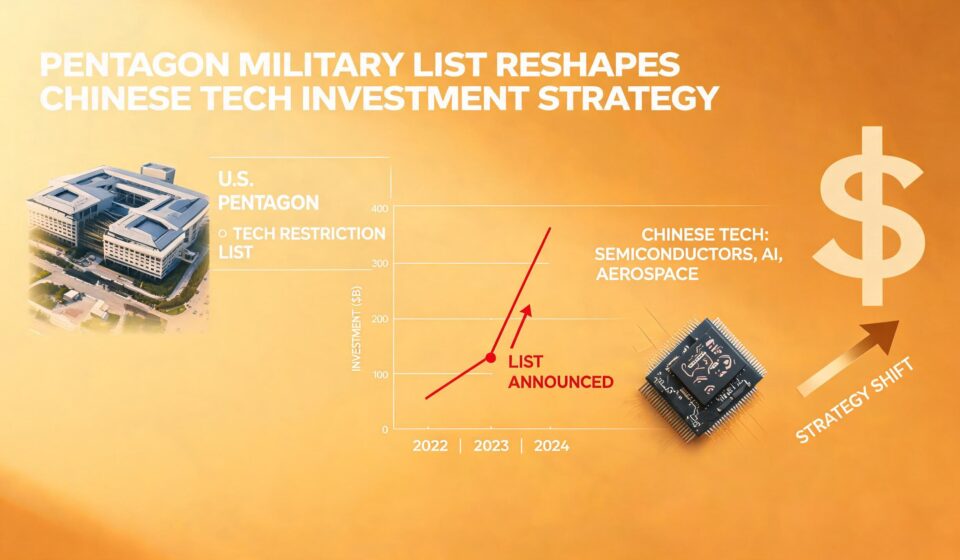
Pentagon Military List Reshapes Chinese Tech Investment Strategy
Pentagon Financial Fallout: How the Military List Reshapes Chinese Tech Investment
When the US Department of Defense expanded its Chinese Military Companies (CMC) list in January 2026, adding Alibaba (NYSE: BABA), Baidu (NASDAQ: BIDU), BYD (HK: 1211), and NIO (NYSE: NIO) to a roster that now exceeds 130 entities, the immediate market reaction was sharp but short-lived. The financial consequences, however, are only beginning to unfold. An estimated $4-7 billion in forced selling by US institutional investors is expected over the next 12 months, driven not by investment conviction but by regulatory compliance requirements that leave fund managers with little choice.
The Mechanics of Forced Selling
The CMC list itself does not impose direct sanctions. It does not freeze assets or prohibit transactions. What it does — and what makes it financially potent — is trigger a cascade of compliance obligations across the US investment ecosystem.
The first mechanism is internal policy. Most large US pension funds, endowments, and asset managers maintain investment policy statements that prohibit or restrict holdings in companies identified by the US government as having military affiliations. When the Pentagon updates the CMC list, compliance teams have 90 to 180 days to divest affected positions, regardless of the investment merits.
The second mechanism is the Office of Foreign Assets Control (OFAC) Chinese Military-Industrial Complex Companies (CMIC) list, which overlaps significantly with the CMC list but carries actual sanctions weight. OFAC-listed entities face restrictions on US persons engaging in certain transactions, including the purchase or sale of publicly traded securities. While OFAC has not yet added all of the Pentagon’s latest designees, the expectation among compliance officers is that the lists will converge by late 2026.
The numbers are substantial. The Pentagon’s addition of Alibaba, Baidu, BYD, and Nio to the military-linked list affects companies with a combined market capitalization exceeding $500 billion. US institutional investors held an estimated $18 billion in securities of CMC-listed companies as of December 2025, according to data compiled by the Coalition for a Prosperous America. Of that, approximately $4-7 billion is held by investors with hard compliance deadlines requiring divestment by June 30, 2026 — the Phase 1 cutoff.
Who Is Selling
Three categories of US institutional investors face the most immediate pressure:
Public pension funds. The California Public Employees’ Retirement System (CalPERS), the nation’s largest public pension fund with approximately $470 billion in assets under management, disclosed in its March 2026 board meeting that it held positions in 12 CMC-listed companies totaling approximately $850 million. CalPERS’ investment policy, adopted in 2023, requires divestment from CMC-listed entities within 180 days of designation. The Teachers Retirement System of Texas (TRS), with $210 billion in assets, faces a similar obligation and disclosed holdings of approximately $320 million in affected securities.
University endowments. Harvard Management Company, which oversees the university’s $53 billion endowment, has historically maintained a diversified emerging markets allocation that includes Chinese equities. While Harvard has not disclosed its specific exposure to CMC-listed companies, a review of 13-F filings indicates positions in Alibaba and Baidu totaling approximately $180 million as of December 31, 2025. The endowment’s investment policy prohibits holdings in companies designated by the Department of Defense.
Index funds and ETFs. The forced selling by passive funds is potentially the largest channel. MSCI, FTSE Russell, and S&P Dow Jones Indices have all announced removals of CMC-listed companies from their standard indices, effective at various dates between March and September 2026. Each removal forces billions in passive fund outflows. iShares MSCI China ETF (MCHI), with approximately $5.2 billion in assets, removed three CMC-listed companies from its holdings in its March 2026 rebalance, resulting in estimated sales of $240 million.
Phase 1 and Phase 2 Timeline
The Pentagon’s enforcement framework operates in two phases:
| Phase | Deadline | Requirement |
|---|---|---|
| Phase 1 | June 30, 2026 | US persons must divest from publicly traded securities of entities added to the CMC list in January 2026. This applies to direct holdings in Alibaba, Baidu, BYD, NIO, and approximately 20 other companies. |
| Phase 2 | June 30, 2027 | Extended divestment deadline for holdings in entities added to earlier CMC list updates (2021-2025). Also covers derivative positions, index fund exposure through non-compliant indices, and indirect holdings through commingled vehicles. |
The Phase 1 deadline is the near-term catalyst. Compliance teams at major asset managers have been working since the January announcement to unwind positions, but the process is not straightforward. Selling large blocks of Alibaba or Baidu shares on the open market would move prices, so firms are using a combination of block trades, dark pools, and algorithmic execution to minimize market impact.
The Xiaomi Precedent
Companies on the CMC list are not without recourse. The most instructive precedent is Xiaomi Corporation (HK:1810), which was added to the CMC list in January 2021 under the Trump administration. Xiaomi challenged the designation in US federal court, and in March 2021, Judge Rudolph Contreras of the US District Court for the District of Columbia issued a preliminary injunction blocking enforcement, finding that the Pentagon’s evidence was “hardly robust” and that Xiaomi had demonstrated a likelihood of success on the merits.
The Biden administration subsequently removed Xiaomi from the list in May 2021, and the company’s stock recovered most of its losses within months. The Xiaomi case established that CMC designations are subject to judicial review and that the government bears the burden of demonstrating a reasonable basis for the listing.
Several of the companies added in January 2026 are expected to pursue similar legal challenges. Alibaba’s general counsel, in a statement issued on January 8, 2026, said the company “strongly disagrees with the designation and is evaluating all available legal options.” Baidu issued a comparable statement on the same date. BYD and NIO have been more circumspect but are understood to have retained US law firms specializing in sanctions and national security litigation.
However, the legal process takes time — typically 6 to 18 months for a federal court to rule on a preliminary injunction. During that period, the forced selling continues regardless of the legal outcome, because institutional investors cannot afford the compliance risk of maintaining positions that might later be found to violate OFAC regulations.
Market Impact and Price Discovery
The forced selling has created pricing distortions in the affected securities. Alibaba’s Hong Kong-listed shares (HK:9988) traded at a 4.2 percent discount to its New York-listed ADRs as of June 10, 2026 — the widest differential in over a year — reflecting the additional selling pressure on the US-listed instrument. NIO’s ADR discount to its Hong Kong-listed shares (HK:9866) reached 6.8 percent, a level that typically attracts arbitrageurs but has persisted due to the scale of one-way selling.
For non-US investors — European pension funds, Middle Eastern sovereign wealth funds, and Asian family offices — the forced selling represents an opportunity. These investors face no comparable divestment obligation and can acquire shares of high-quality Chinese technology companies at prices depressed by regulatory-driven selling rather than fundamental deterioration.
Goldman Sachs’ prime brokerage data, reported in the firm’s June 2026 hedge fund trend monitor, showed that non-US long-short funds increased their net exposure to Chinese technology stocks by 18 percent in May 2026, with the heaviest buying concentrated in Alibaba and Baidu.
Broader Implications for US-China Investment
The financial fallout from the CMC list extends beyond the specific companies affected. The precedent of forced divestment — effectively, the US government directing private capital allocation through regulatory designation — has introduced a new category of political risk into Chinese equity investment that did not exist five years ago.
This risk premium is now priced into every Chinese company’s cost of capital. A study published by the Brookings Institution in April 2026 estimated that the average Chinese company listed in the US now carries a 1.2 percentage point higher cost of equity compared with an equivalent company listed only in Hong Kong or on the mainland, attributable to the “designation risk” premium.
The long-term trajectory depends on whether the CMC list continues to expand. If the list stabilizes, investors can adapt and price the risk. If it continues to grow — adding companies from sectors like electric vehicles, biotechnology, or consumer internet — the investable universe of Chinese equities for US institutions will shrink further, accelerating the broader decoupling of US and Chinese capital markets that has been underway since 2020.
As the June 30, 2026, Phase 1 deadline approaches, the US-China chip war and semiconductor decoupling continues to deepen, and the financial consequences of the military list serve as a reminder that in the current geopolitical environment, regulatory risk can be as destructive to investment returns as any fundamental factor. The era of treating Chinese equities as a simple allocation decision is over; investors must now navigate a landscape where the Pentagon’s pen can reshape portfolios overnight.