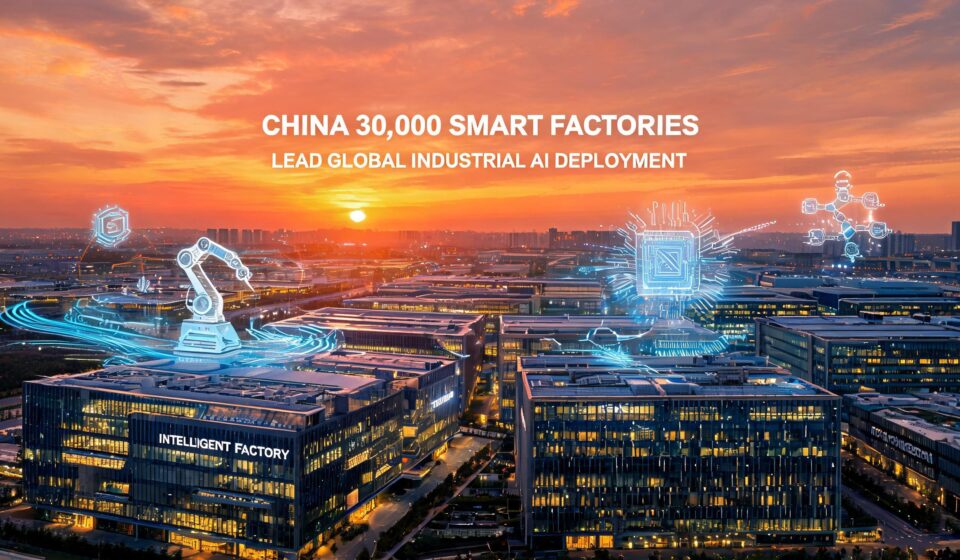
China 30,000 Smart Factories Lead Global Industrial AI Deployment
What Happened
China has established over 30,000 basic-level smart factories as of early 2025, cementing its position as the world’s largest deployer of industrial automation and connected manufacturing systems. The Ministry of Industry and Information Technology (MIIT), alongside five other state agencies, confirmed the milestone under the smart factory gradient cultivation action — a national initiative that classifies smart factories into four tiers based on technological maturity and integration depth.
Alongside the 30,000 basic-level facilities, China has built 1,200 advanced-level and 230 excellence-level smart factories. The 230 excellence-level plants span all 31 provincial regions and cover more than 80 percent of manufacturing sectors, carrying out nearly 2,000 advanced scenarios including smart warehousing, AI-powered quality inspections, and digital research and development. These top-tier factories report product development cycles 28.4 percent shorter, production efficiency 22.3 percent higher, defect rates 50.2 percent lower, and carbon emissions 20.4 percent below conventional benchmarks.
The achievement marks the most extensive national-scale smart manufacturing deployment anywhere in the world. No other country has attempted — let alone achieved — a comparable rollout of digitally connected production facilities across such a broad industrial base.
Key Developments
MIIT’s Four-Tier Gradient Cultivation Framework
The smart factory gradient cultivation action, launched jointly by MIIT and five other central government agencies in 2024, established a clear hierarchy for classifying and advancing factory digitalization. Basic-level smart factories must develop foundational capabilities in digitization and networking, deploying smart manufacturing equipment, industrial software, and systems centered around typical manufacturing scenarios to achieve real-time data collection and automation of key production processes. Advanced-level factories integrate these systems more deeply. Excellence-level facilities execute nearly 2,000 advanced scenarios. The fourth tier — pioneer-level — is now under preparation, with MIIT planning to launch cultivation programs for factories pushing the boundaries of autonomous production.
Scenario-Based Digital Transformation Guide
In September 2025, MIIT released the Scenario-based and Graph-based Reference Guide for Promoting Digital Transformation in Key Industries, a detailed operational document mapping specific digital tools to concrete production scenarios. The guide specifies where and how technologies such as industrial internet platforms, intelligent manufacturing systems, and data-driven management tools should be deployed along the industrial value chain — moving China’s manufacturing digitization from policy aspiration to operational roadmap.
5G-Connected Factory Infrastructure
China’s 5G network rollout has provided the connectivity backbone for smart factory expansion. Over 4 million 5G base stations are now operational nationwide, with dedicated enterprise networks deployed in manufacturing clusters across Guangdong, Jiangsu, Zhejiang, and Shandong provinces. Huawei’s 5G industrial solutions have been deployed across multiple smart factory campuses, enabling real-time machine-to-machine communication, remote equipment monitoring, and edge computing applications that support predictive maintenance and quality control systems.
Digital Twin and Predictive Maintenance Adoption
Excellence-level smart factories have widely adopted digital twin technology — virtual replicas of physical production lines that enable simulation, optimization, and predictive analysis before changes are implemented on the factory floor. Combined with IoT sensor networks and machine learning models, these systems support predictive maintenance programs that reduce unplanned downtime by 30 to 50 percent in facilities that have fully deployed them, according to industry estimates.
Factory Automation Market Expansion
China’s industrial control and factory automation market is projected to grow from $198.2 billion in 2025 to $342.7 billion by 2031, registering a compound annual growth rate of 9.6 percent, according to Mobility Foresights. Growth is driven by increasing demand for operational efficiency, rising labor costs, and accelerating digital transformation across the manufacturing ecosystem. Industrial robots, PLCs, SCADA systems, and motion control technologies are seeing broad adoption across automotive, electronics, food processing, and chemical sectors.
Key Companies Driving Smart Factory Adoption
Huawei (Shenzhen; est. 1987; revenue CNY 862B / ~$128B in 2024) has positioned itself as the backbone provider for China’s smart factory infrastructure. The company’s 5G industrial solutions — including dedicated enterprise networks, edge computing platforms, and industrial IoT gateways — are deployed across manufacturing campuses nationwide. Huawei’s FusionPlant industrial internet platform connects production equipment, enables real-time data analytics, and supports predictive maintenance workflows. With over 208,000 employees and R&D spending of CNY 179.7 billion (20.8% of revenue), Huawei’s scale gives it a structural advantage in serving the smart factory market. The company holds 150,000+ active patents, many covering industrial connectivity and edge computing technologies critical to factory automation.
Haier Group (Qingdao; est. 1984; global revenue ~$55.9B in 2024) operates one of China’s most advanced smart manufacturing ecosystems. Haier Smart Home, the group’s flagship listed entity (SSE: 600690), surpassed RMB 300 billion in global revenue in 2025. The company runs 163 manufacturing centers worldwide, with its COSMOPlat industrial internet platform enabling mass customization and connected production. Haier has been ranked the world’s number one major appliances brand for 16 consecutive years by Euromonitor, and its smart factory network spans over 200 countries. The group’s six listed companies — including Haier Smart Home, Haier Biomedical, and THUNDEROBOT — represent a diversified smart manufacturing portfolio covering consumer electronics, healthcare equipment, and computing hardware.
Foxconn Industrial Internet (Shenzhen; est. 2015; SHA: 601138) is the listed arm of Hon Hai Precision Industry focused on industrial internet and smart manufacturing services. The company manufactures communication network equipment, cloud computing devices, and precision components across massive production campuses in Shenzhen, Zhengzhou, and Chengdu. Foxconn’s smart factory operations deploy tens of thousands of industrial robots and automated inspection systems, making it one of the world’s largest single operators of connected manufacturing equipment. The company’s scale — producing components for global technology brands — positions it as a bellwether for smart factory adoption in contract manufacturing.
Midea Group (Foshan; est. 1968; revenue ~CNY 400B) has evolved from a local workshop into a Fortune 500 technology group with seven business segments spanning smart home, industrial technology, robotics and automation, and building technologies. Midea operates 43 main production bases and 41 R&D centers across 200+ countries, with 190,000+ employees globally. The company’s industrial technology division — including KUKA robotics and GMCC compressors — runs 24 global smart factories with over 6,600 authorized patents. Midea’s five-year R&D investment of nearly CNY 60 billion reflects its commitment to connected manufacturing and industrial automation technologies.
Why It Matters
China’s smart factory deployment is not a laboratory exercise or a collection of pilot projects. It is a production-scale transformation of the world’s largest manufacturing economy, affecting sectors that supply global supply chains from consumer electronics to automotive components to industrial machinery. The 30,000-factory milestone signals that smart manufacturing in China has moved beyond early adoption into systemic integration.
The productivity gains reported by excellence-level factories — 22.3 percent higher production efficiency, 50.2 percent lower defect rates — translate directly into cost advantages that compound over time. For global manufacturers competing with Chinese producers, these are not marginal improvements. They represent a structural shift in the cost-quality equation that will reshape competitive dynamics across dozens of industries.
The four-tier framework also matters because it creates a visible upgrade path. Factories that begin at the basic level have a government-supported roadmap for advancing to higher tiers, with clear technical benchmarks at each stage. This structured approach accelerates adoption by reducing uncertainty for factory owners — particularly small and medium-sized enterprises that lack the internal expertise to design their own digitization strategies.
For international companies sourcing from China, the smart factory rollout changes the risk profile of Chinese suppliers. Facilities with real-time data collection, automated quality inspection, and predictive maintenance systems are more reliable, more transparent, and better equipped to meet stringent international quality and compliance standards.
China Industry Impact
Manufacturing Sector Restructuring
The smart factory initiative is accelerating the consolidation of China’s manufacturing base. Larger companies with the capital to invest in advanced automation are pulling ahead, while smaller producers face a choice between upgrading or losing contracts to digitally enabled competitors. MIIT’s tiered framework makes this dynamic explicit — buyers increasingly specify minimum smart factory tier levels in procurement requirements, creating market pressure for continuous improvement.
The automotive sector has been among the fastest adopters. Smart factory production lines in EV manufacturing now routinely feature flexible, multi-model assembly systems that can switch between vehicle variants without disruptive retooling. Semiconductor fabrication, aerospace components, and advanced materials production have also seen significant uptake of intelligent manufacturing systems.
Regional Industrial Clusters
Smart factory concentration mirrors China’s existing manufacturing geography. Guangdong, Jiangsu, Zhejiang, and Shandong — the four largest manufacturing provinces by output — account for the heaviest concentration of advanced and excellence-level facilities. Shanghai has added multiple World Economic Forum-recognized lighthouse factories and rolled out over 1,000 smart manufacturing scenarios during the current five-year planning period. This geographic clustering creates knowledge spillover effects, as workforce skills, supplier ecosystems, and technical service providers concentrate around smart factory hubs.
Workforce Transformation
The shift to smart manufacturing is reshaping labor demand across China’s factory floor. Traditional manual assembly roles are declining, while demand for technicians skilled in PLC programming, industrial networking, robotics maintenance, and data analytics is surging. Industry estimates place China’s digital manufacturing talent shortfall at over 4 million workers — a gap that government training programs and corporate partnerships with technical colleges are working to close, but which remains a binding constraint on the pace of further automation.
Supply Chain Implications
Supplier Qualification Standards
As smart factories become the norm in China’s Tier 1 manufacturing base, procurement standards are shifting downstream. Major OEMs — including automotive, electronics, and industrial equipment companies — are increasingly requiring suppliers to demonstrate minimum levels of digital connectivity, data transparency, and automated quality control. Suppliers operating basic-level or below smart factory capabilities face exclusion from premium supply chains. This creates a cascading effect that pulls smaller component makers into the smart manufacturing ecosystem, whether or not they initially planned to invest in digitization.
Global Competitiveness and Reshoring Calculus
China’s smart factory scale complicates the reshoring and nearshoring narratives that have gained traction in the United States, Europe, and Japan. While political pressure to diversify supply chains away from China remains strong, the productivity and quality gains from smart manufacturing make Chinese suppliers more competitive on technical grounds — not less. Companies evaluating reshoring decisions must now account for the cost of rebuilding not just physical production capacity, but the digital infrastructure and workforce capabilities that Chinese smart factories have spent years developing.
Technology Stack Dependencies
The smart factory ecosystem creates new technology dependencies within global supply chains. Factories running on Huawei’s 5G industrial networks, domestic PLC and SCADA systems, and Chinese-developed industrial internet platforms generate data and operational workflows that are increasingly self-contained within China’s technology ecosystem. For multinational companies with Chinese manufacturing operations, this raises questions about data governance, system interoperability, and the ability to integrate Chinese factory data with global enterprise systems.
Supply Chain Transparency Gains
On the positive side, smart factory adoption improves supply chain visibility. Real-time production data, automated quality records, and digital logistics tracking enable buyers to monitor supplier performance with unprecedented granularity. This reduces the information asymmetries that have historically made multi-tier Chinese supply chains opaque and difficult to audit.
CII Analysis
Our Take: China’s 30,000 smart factories represent the most consequential industrial policy execution of the decade. What makes this milestone significant is not the headline number — it is the structured, tiered approach that creates a self-reinforcing upgrade cycle. The four-tier framework transforms smart manufacturing from a discretionary investment into a competitive necessity. Once procurement departments begin specifying minimum smart factory tier levels, every supplier in the chain faces a binary choice: upgrade or lose business. This market-driven enforcement mechanism is far more effective than subsidies alone.
The implications for global manufacturing competition are underappreciated. Western economies debating reshoring strategies tend to focus on labor costs and tariff exposure. But China’s smart factory deployment is changing the competitive equation on dimensions that matter more in the long run: defect rates, production flexibility, time-to-market, and data-driven process optimization. A factory with 50 percent lower defect rates and 28 percent shorter development cycles is not competing on cost — it is competing on capability.
The risk for China lies in the talent bottleneck. A 4-million-worker shortfall in digital manufacturing skills is not a gap that can be closed quickly, and it will slow the advancement of factories from basic to higher tiers. The quality of smart manufacturing deployment also varies enormously across regions and sectors — the excellence-level metrics MIIT publishes represent the best performers, not the median. For international businesses, the practical takeaway is clear: evaluate Chinese suppliers on their actual smart factory tier, not on national averages.
For deeper coverage: China Manufacturing Intelligence 2026
Sources
- Xinhua — China establishes over 30,000 smart factories: ministry (February 2025)
- China Briefing — MIIT’s Industrial Digital Transformation Blueprint: How China Plans to Upgrade Manufacturing by 2026
- Mobility Foresights — China Industrial Control and Factory Automation Market Size and Forecasts 2031
- China Minutes — How Smart Factories Are Reshaping China’s Manufacturing (January 2026)
- Mordor Intelligence — China Factory Automation and Industrial Controls Market Report
- Huawei — Corporate Information
- Haier Group — About Haier
- Midea Group — About Midea