




























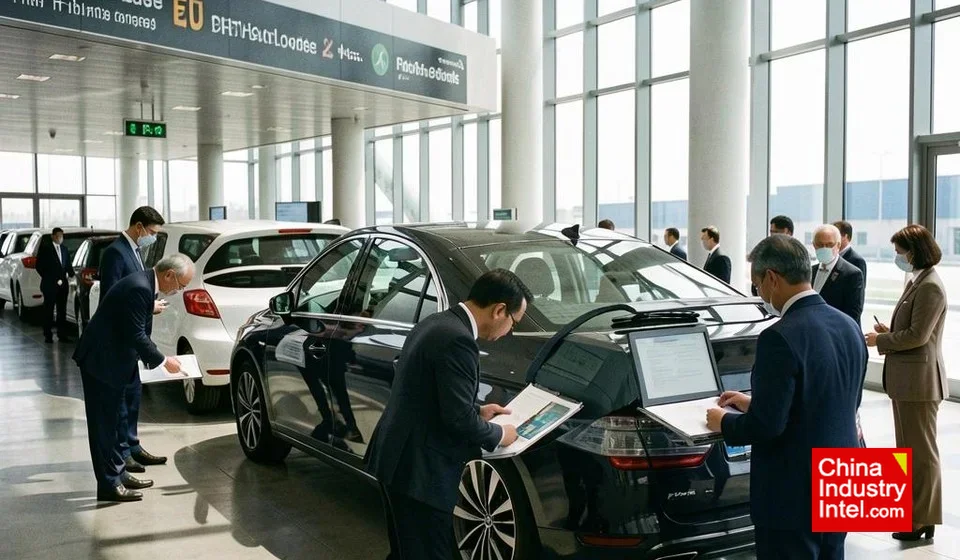
EU Closes PHEV Loophole: New Tariffs Coming for Chinese Plug-In Hybrids
The EU plans countervailing duties on Chinese PHEVs after BYD became Germany’s top plug-in hybrid brand. The tariff wall is closing.
By CII (China Industry Intel) – Contributing Analyst | June 20, 2026
EU Closes PHEV Loophole: New Tariffs Coming for Chinese Plug-In Hybrids
The European Commission is preparing to impose countervailing duties on Chinese plug-in hybrid electric vehicles, according to a June 19 report by German business daily Handelsblatt. The move would close a regulatory gap that Chinese automakers — led by BYD — have exploited aggressively since the EU slapped additional tariffs on battery-electric vehicle imports in October 2024.
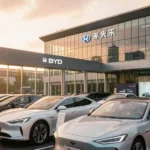
The numbers tell the story. In May 2026, BYD announced it had become Germany’s best-selling plug-in hybrid brand for the first time, recording 4,290 new registrations. Around 70% of BYD’s new registrations in Germany were PHEVs, while only 30% were fully electric. The compact Atto 2 DM-i SUV alone accounted for 2,113 registrations that month.
How BYD gamed the tariff gap
When the EU imposed anti-subsidy tariffs on Chinese BEVs in October 2024, plug-in hybrids were left out. The logic at the time was that PHEVs had smaller batteries and therefore benefited less from Chinese subsidies. BYD, Geely, and MG’s parent SAIC saw an opening and drove through it.
| Manufacturer | BEV Additional Tariff | Total BEV Duty | PHEV Status |
|---|---|---|---|
| BYD | +17% | 27% | Standard 10% only |
| Geely | +18.8% | 28.8% | Standard 10% only |
| SAIC (MG) | +35.3% | 45.3% | Standard 10% only |
| Other Chinese | +20.7-36.3% | 30.7-46.3% | Standard 10% only |
The shift was visible by summer 2025. BYD and MG started ramping PHEV launches in Europe. BYD expanded its portfolio with the Seal U DM-i, the Seal 6 DM-i Touring estate, and most recently the Dolphin G DM-i, launched in Europe on June 12, 2026. Each PHEV entered at the standard 10% tariff while equivalent BEVs faced 27% or higher.
German industry had complained about the loophole for months. As early as August 2025, electrive.com reported that BYD and MG were sidestepping EU tariffs with plug-in hybrids. The European Commission denied plans for hybrid tariffs as recently as January 2026.
The investigation and what comes next

According to Handelsblatt, a formal anti-subsidy investigation into Chinese PHEVs is already underway. Senior EU officials told the paper that heads of state and government were set to vote on the matter at the EU summit on Thursday evening, June 19.
The new tariffs, like the BEV duties, are expected to be manufacturer-specific rather than a flat rate. However, they are likely to be lower on average than the BEV tariffs because the battery accounts for a smaller share of the value added in a PHEV. A PHEV’s powertrain includes both an electric motor and an internal combustion engine, diluting the subsidy impact of the battery alone.
Notably, the German federal government — which opposed the BEV tariffs in 2024, partly to protect its own automakers’ China operations — appears not to resist this time. The political calculus has shifted: German automakers are losing domestic market share to Chinese PHEVs at a rate that outweighs concerns about retaliation in the Chinese market.
BYD’s broader European strategy

BYD (HKEX: 1211 / OTC: BYDDY) is not waiting around. The Shenzhen-based company reported global sales of approximately 425,000 vehicles in May 2026, with Europe becoming its fastest-growing export market. BYD’s strategy in Europe has been multi-pronged:
- PHEV flood: Launch DM-i hybrid variants of every model to exploit the tariff gap
- Local production: BYD’s Hungary plant is expected to begin operations in late 2026, which would make its vehicles tariff-exempt regardless of duty rates
- Price undercutting: The Atto 2 DM-i starts at approximately €28,000 in Germany, undercutting comparable European PHEVs by €5,000-8,000
Other Chinese brands are following the same playbook. Geely’s Zeekr and Lynk & Co brands are expanding PHEV offerings in Europe. SAIC’s MG brand has shifted its European mix heavily toward plug-in hybrids since the BEV tariffs took effect.
What the tariffs won’t fix
Even with PHEV tariffs, the structural advantages of Chinese automakers remain. BYD’s vertical integration — it manufactures its own batteries, semiconductors, and electric motors — gives it a cost base that European competitors cannot match through tariffs alone. The company’s Blade Battery LFP technology, which underpins its DM-i hybrid system, is produced at scale in China at costs estimated at $60-70/kWh, roughly 30% below European battery production costs.
The real question for European automakers is whether tariffs buy enough time to close the technology and cost gap. If BYD’s Hungary plant comes online as planned, the tariff advantage disappears entirely for locally produced vehicles. At that point, competition shifts to product quality, brand perception, and distribution networks — areas where European automakers still hold an edge, but one that is narrowing.
CII Analysis
The EU’s decision to extend tariffs to PHEVs was inevitable once the BEV-only framework created such an obvious arbitrage. The delay — nearly two years — gave Chinese brands ample time to establish PHEV market share in Europe. BYD’s 4,290 German registrations in a single month suggest the foothold is already firm.
The bigger picture is that tariffs are a temporary tool, not a strategy. China’s automakers have demonstrated repeatedly that they can adapt to trade barriers faster than regulators can erect them. BYD’s Hungary plant, Geely’s Volvo production network, and SAIC’s MG brand’s European manufacturing base all represent permanent structural advantages that no tariff can address.
For investors, the immediate impact is on BYD’s European revenue mix. If PHEV tariffs land at 15-20%, the Atto 2 DM-i’s price advantage in Germany narrows from €5,000-8,000 to roughly €2,000-4,000 — still competitive, but less decisive. The long-term play remains BYD’s vertical integration and its ability to produce at Chinese cost levels in European factories.
Follow CII on LinkedIn for daily analysis of China’s EV industry.
Sources
- electrive.com — EU plans additional tariffs on Chinese PHEVs (June 19, 2026)
- electrive.com — BYD and MG sidestep EU tariffs with PHEVs (August 2025)
- electrive.com — BYD launches Dolphin G PHEV in Europe (June 12, 2026)
- electrive.com — EU imposes special tariffs on Chinese EVs (October 2024)
- electrive.com — EU denies plans for hybrid tariffs (January 2026)