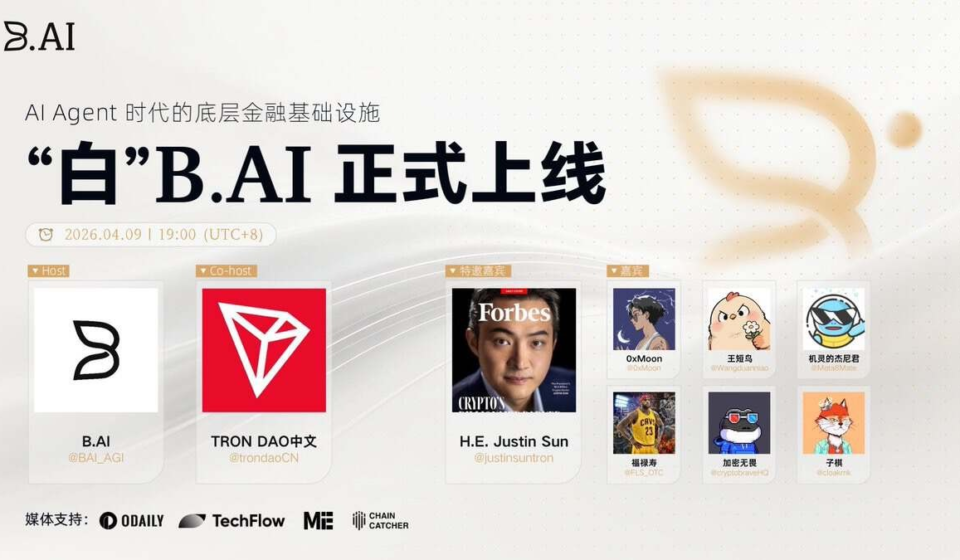
Justin Sun Launches B.AI: A Blockchain-Powered AI Relay Station Reshaping Model Access and Agent Economics
TRON founder Justin Sun has entered the AI infrastructure race with B.AI, a blockchain-native platform that aggregates top-tier large language models behind a single API — and aims to give AI agents their own financial identities.
On April 9, 2026, at the Hong Kong Web3 Festival, B.AI (also branded as “White B.AI” in Chinese) officially launched with Justin Sun — founder of the TRON blockchain and strategic advisor to B.AI — taking center stage. The platform positions itself not merely as another API relay station, but as the foundational financial infrastructure for the coming era of autonomous AI agents.
The launch drew major Chinese crypto and tech media including TechFlow, ChainCatcher, PANews, and MetaEra, along with prominent KOLs. The consensus: B.AI represents the most ambitious attempt yet to merge blockchain settlement with AI model access at scale.
What Exactly Is B.AI?
At its core, B.AI is an AI API aggregation and relay platform — sometimes called an “AI中转站” (AI relay station) in Chinese tech circles. The concept is straightforward: developers and businesses use a single API key to access multiple leading AI models, including GPT-5, Claude, Gemini, DeepSeek, Kimi, and others, without managing separate accounts or payment systems for each provider.

But B.AI goes beyond simple token reselling. The platform integrates three major product pillars:
1. LLM Smart Routing — One API, All Models
B.AI’s intelligent routing layer automatically directs API calls to the optimal model based on the user’s requirements — cost, latency, capability, or task type. This eliminates the fragmentation that forces developers to juggle multiple API keys, billing systems, and compatibility layers. The platform supports the x402 payment protocol, enabling AI agents to autonomously purchase tokens as needed.
2. BAIClaw — Free AI Assistant
BAIClaw is B.AI’s built-in AI assistant, offered free to all users. It serves as both a consumer-facing product demonstrating B.AI’s capabilities and a gateway tool that funnels usage toward the underlying API infrastructure. This “free tool drives API volume” strategy mirrors the playbook used by cloud providers.
3. AI Agent Financial Operating System
This is B.AI’s most distinctive feature and its long-term strategic bet. The platform enables AI agents to hold crypto wallets, execute agent-to-agent (A2A) payments, and settle transactions autonomously on the TRON blockchain. In B.AI’s vision, AI agents evolve from passive tools into independent economic entities capable of self-funding.

Who Is Justin Sun? A Profile of One of Crypto’s Most Controversial Figures
Understanding B.AI requires understanding its architect. Justin Sun (孙宇晨), born in 1990 in Xining, Qinghai Province, China, is one of the most polarizing figures in the cryptocurrency and blockchain industry.
Early Life and Education
Sun showed early intellectual promise, winning first prize in China’s prestigious “New Concept Writing Competition” in 2007, which earned him admission to Peking University. He graduated first in his class from the History department in 2011 and was featured on the cover of Asia Weekly. He then pursued a master’s degree in East Asian Studies at the University of Pennsylvania, where he first encountered Bitcoin.
Rise in Crypto
In 2013, Sun joined Ripple Labs in Silicon Valley as China’s chief representative. In 2015, he became the youngest student — and the only one born in the 1990s — selected for Jack Ma’s Hupan University, the elite entrepreneurship academy. In 2017, he founded TRON (波场), which grew into one of the world’s largest blockchain ecosystems, now processing more daily transactions than most competitors and hosting over 3.3 billion accounts.
In 2018, Sun acquired BitTorrent, the pioneering peer-to-peer file sharing protocol with over 1 billion users. In 2019, he famously paid $4.57 million for a charity lunch with Warren Buffett — the highest bid in the event’s history — though the lunch was repeatedly delayed and ultimately mired in controversy.
WTO Ambassador, Art Collector, and Political Player
In December 2021, Sun was appointed as Grenada’s Ambassador and Permanent Representative to the World Trade Organization (WTO), a diplomatic role he held until mid-2022. He has also made headlines as an art collector, purchasing works by Picasso, Warhol, and Maurizio Cattelan — the latter being the infamous $6.2 million banana taped to a wall, which Sun publicly ate.
In January 2025, Sun invested $30 million in World Liberty Financial (WLFI), the Trump family’s cryptocurrency project, and was appointed as its advisor. This investment coincided with the suspension of a 2023 SEC lawsuit against Sun, though the timing has drawn scrutiny.
TRON on Nasdaq
In August 2025, Sun took TRON public on Nasdaq (ticker: TRON) through a reverse merger with SRM Entertainment. The company adopted a MicroStrategy-like treasury strategy, holding over 365 million TRX tokens worth approximately $115 million. The move made TRON Inc. the first publicly listed company with a TRX-heavy balance sheet.

The AI Relay Station Market: Why It Matters
B.AI enters a rapidly heating market. The “AI API relay station” concept has become one of the hottest trends in Chinese tech in 2026. The economic logic is simple: relay platforms buy API capacity from model providers at enterprise bulk rates, then resell access to developers at prices often lower than direct API pricing, while profiting from volume-based margins.
Key players in this space include:
- WorldClaw/WorldRouter — Connected to the Trump family’s WLFI ecosystem, aggregating 300+ models with USD1 stablecoin payments
- Easy Router — Launched by NYSE-listed Cheetah Mobile (CMCM) CEO Fu Sheng, aggregating 40+ models with a compliance-first approach
- B.AI — TRON’s entry, combining model aggregation with blockchain-based AI agent payment infrastructure
According to ChinaModelAPI’s industry analysis, the market’s rapid growth reflects a structural shift: model access, not model capability, is becoming the primary bottleneck for AI adoption. Developers want simplicity — one key, one bill, one integration point.
B.AI’s Business Model and Revenue
In a detailed interview with TechFlow, Sun laid out B.AI’s business model clearly:
- Primary revenue: Token price differential on API calls plus a ~5% service fee
- Pricing advantage: Bulk purchasing from model providers means B.AI’s per-token cost is often lower than buying directly from OpenAI or Anthropic
- Free tools as traffic drivers: BAIClaw and other consumer-facing products are free, driving API volume and building the usage flywheel
- Future revenue: Settlement fees for agent-to-agent transactions as the autonomous AI economy grows
The platform currently offers 500,000 free credits to new users and a 1:1 deposit match up to $100, signaling an aggressive user acquisition strategy.
Objective Analysis: Strengths and Concerns
Strengths
- Genuine demand: The AI relay model solves a real developer pain point. Managing multiple API keys across providers is genuinely cumbersome, and the market’s rapid growth confirms organic demand.
- TRON’s payment infrastructure: With over $85 billion in USDT on TRON and 3-second settlement times, B.AI has a legitimate payment rail advantage for crypto-native AI agent transactions.
- Cost advantage: Bulk purchasing and the ~5% fee structure can genuinely undercut direct API pricing for many use cases.
- First-mover in agent payments: The concept of AI agents with autonomous wallets and self-funding capabilities is forward-looking and potentially transformative.
Concerns
- Sustainability of margins: As model providers themselves reduce prices (OpenAI has cut GPT-4 prices by over 90% since launch), the middleman margin compresses. B.AI’s value-add must evolve beyond simple arbitrage.
- Regulatory exposure: Sun’s ongoing legal history — including the SEC fraud allegations (paused but not dismissed) and the WLFI investment’s political optics — creates reputational and regulatory risk for institutional adoption.
- Agent economics remains speculative: The vision of AI agents autonomously paying for compute with crypto wallets is compelling as a narrative, but actual agent-to-agent commerce at meaningful scale remains years away.
- Competition from model providers: If OpenAI, Anthropic, or Google build their own aggregation layers or payment systems, B.AI’s position narrows. Sun argues these companies will focus on models, not payments — but history shows tech giants frequently expand into adjacent layers.
- Centralization vs. blockchain ethos: Despite the blockchain branding, B.AI is ultimately a centralized platform that routes through TRON. The degree of actual decentralization is limited.
The Bigger Picture: AI Meets Crypto Infrastructure
B.AI’s launch reflects a broader convergence trend in 2026: the merging of AI and blockchain infrastructure. TRON has declared 2026 its “AI Year” and joined the Agentic AI Foundation (AAIF) alongside OpenAI, JPMorgan, and Circle. The thesis is that as AI agents become more capable, they will need financial infrastructure — and blockchains, with their programmable payments and permissionless access, are natural candidates.
Whether this thesis proves correct — and whether B.AI specifically captures the value — remains an open question. What is clear is that Justin Sun, as he has done repeatedly throughout his career, has identified a narrative at the intersection of technology and finance and moved aggressively to position himself at its center.
For developers and businesses evaluating AI relay platforms, the decision comes down to pragmatics: pricing, reliability, model coverage, and data privacy. On those metrics, B.AI is a legitimate contender. But the broader “AI agent economy” vision that distinguishes it from simpler relay services will take years to validate.
Sources
- B.AI Official Website
- TechFlow — Interview with Justin Sun: B.AI and Its AGI Ambitions
- Blockchain News — Justin Sun Switches All AI to B.AI
- EuropeSays — B.AI Explained: Blockchain-Powered AI Relay Station
- ChinaModelAPI — AI API Relay Stations: Inside the Hottest Market of 2026
- Bitrue — What Is B.AI? Justin Sun’s Vision for AI and Crypto
- Wikipedia — Justin Sun
- The Sun Archives — Justin Sun Biography