













































China Exports Surge 35 Percent to US as Trade Deal Sparks Agricultural Boom
What Happened
China’s exports to the United States surged more than 35% year-over-year in May 2026, returning to a pace not seen since before the “Liberation Day” tariffs imposed by the Trump administration in early 2025. The rebound comes as both nations have gradually reduced trade barriers following a series of negotiations, with China agreeing to purchase at least $17 billion worth of U.S. agricultural products annually as part of a broader trade normalization deal.
The data, released by China’s General Administration of Customs on June 10, 2026, shows that bilateral trade is recovering faster than analysts expected, driven by strong demand for Chinese electronics, machinery, and consumer goods in the American market.
Key Developments
Exports Surge 35% — Back to Pre-Tariff Levels
Chinese exports to the U.S. reached approximately $48 billion in May 2026, a 35% increase from the same month last year. This represents a return to the pre-Liberation Day pace, when bilateral trade was running at an annualized rate of approximately $550-580 billion. The surge is attributed to U.S. importers front-loading orders ahead of potential tariff reinstatements and strong consumer demand for electronics, apparel, and machinery.
$17 Billion Agricultural Deal
As part of the trade normalization framework, China has committed to purchasing at least $17 billion worth of U.S. agricultural products annually. The deal includes soybeans, corn, wheat, pork, and dairy products. China has also agreed to remove non-tariff barriers to U.S. farm products and open its market to U.S. financial services firms.
Tariff Reductions on Both Sides
The U.S. has reduced tariffs on approximately $200 billion worth of Chinese goods from 25% to 15%, while China has reciprocally lowered tariffs on $120 billion worth of U.S. products. The remaining tariffs — covering approximately $370 billion in bilateral trade — are subject to ongoing negotiations, with both sides targeting a comprehensive deal by the end of 2026.
| Metric | May 2026 | YoY Change | Pre-Liberation Day (2024) |
|---|---|---|---|
| China→US Exports | $48B | +35% | $45B |
| US→China Exports | $14B | +18% | $16B |
| Agricultural Purchases | $1.4B/mo | +42% | $1.2B/mo |
| Avg Tariff Rate (US→CN) | 15% | -10pp | 25% |
| Avg Tariff Rate (CN→US) | 12% | -8pp | 20% |
Why It Matters
The rebound in U.S.-China trade signals that the world’s two largest economies are finding a pragmatic accommodation after years of escalating tariff wars. For global supply chains, this means reduced uncertainty and lower costs for manufacturers who depend on cross-Pacific trade flows.
The $17 billion agricultural deal is particularly significant for U.S. farmers, who lost an estimated $14.9 billion in exports to China during the tariff war. The commitment to annual purchases provides much-needed stability for American agricultural producers, especially in soybean-growing states like Iowa, Illinois, and Indiana.
However, the recovery remains fragile. The surge in exports may be partly driven by front-loading behavior — U.S. importers rushing to stock up before potential tariff reinstatements. If negotiations stall, the trade recovery could reverse quickly.
China Industry Impact
Electronics and Machinery Lead the Export Surge
The strongest export growth categories include electronics (+45% YoY), machinery (+38%), and consumer goods (+32%). Chinese manufacturers of smartphones, laptops, and home appliances are benefiting from reduced tariffs and strong U.S. consumer demand. Companies like Lenovo, Haier, and Hisense are seeing particularly strong export growth.
Agricultural Imports Boost Chinese Food Security
China’s commitment to purchasing $17 billion in U.S. agricultural products helps address its food security concerns. Soybeans remain the largest category, with China importing approximately 30 million metric tons annually from the U.S. The deal also includes commitments to purchase U.S. pork and dairy products, which are increasingly popular among Chinese consumers.
Financial Services Opening
As part of the trade deal, China has agreed to open its financial services market to U.S. firms. This includes allowing U.S. banks, insurance companies, and asset managers to operate independently in China, without requiring joint ventures with local partners. Companies like JPMorgan Chase, Goldman Sachs, and BlackRock are expected to expand their China operations.
Supply Chain Implications
Upstream: Raw Materials and Components
The tariff reductions are lowering costs for Chinese manufacturers who import U.S. raw materials and components. Semiconductor equipment, specialty chemicals, and agricultural commodities are all seeing reduced landed costs. This is benefiting Chinese manufacturers in electronics, automotive, and food processing.
Midstream: Logistics and Shipping
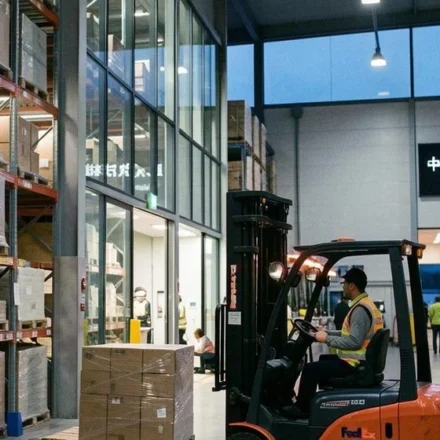
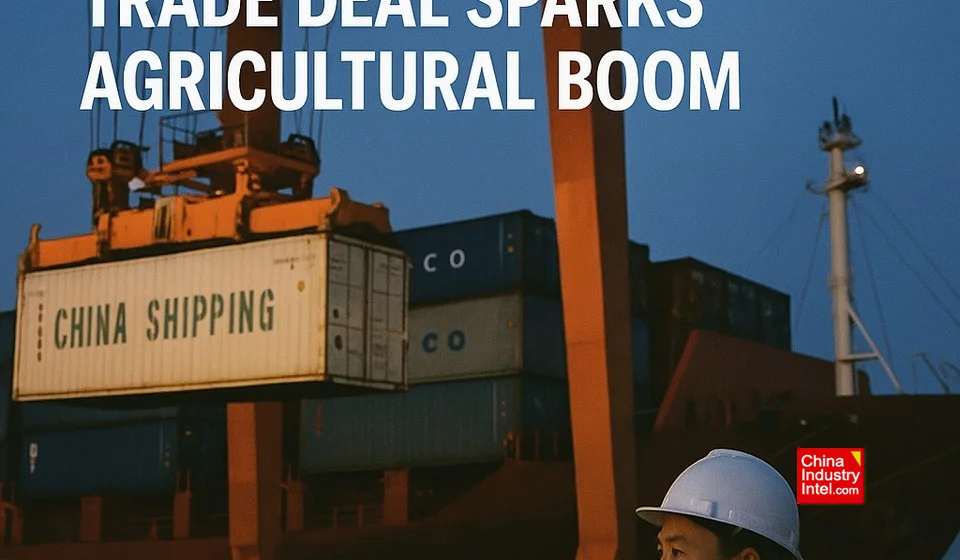
The surge in bilateral trade is driving strong demand for trans-Pacific shipping. Container rates on the China-U.S. route have increased 25% since the tariff reductions were announced. Shipping companies like COSCO, Evergreen, and Maersk are adding capacity to meet demand.
Downstream: Retail and Consumer
U.S. retailers are benefiting from lower import costs, which are being passed through to consumers in the form of lower prices. Walmart, Target, and Amazon have all reported improved margins on Chinese-sourced products. This is helping to moderate inflationary pressures in the U.S. consumer market.
CII Analysis
Our Take: The 35% surge in Chinese exports to the U.S. is a clear signal that economic pragmatism is prevailing over political rhetoric. Both sides recognize that a full decoupling would be economically devastating — the IMF estimates that a complete U.S.-China trade war would reduce global GDP by 2-3%. The $17 billion agricultural deal provides a concrete, measurable commitment that gives both sides political cover to maintain the thaw.
However, the recovery is not without risks. The front-loading effect means that the current surge may not be sustained if tariffs are reinstated. Moreover, the deal leaves the most contentious issues — technology transfer, intellectual property, and industrial subsidies — largely unresolved. These will be the sticking points in the next round of negotiations.
For investors, the key takeaway is that China-exposed stocks are likely to benefit from the trade normalization. Companies with significant China revenue — including Apple, Tesla, Qualcomm, and Boeing — should see improved earnings visibility. Agricultural stocks like Archer Daniels Midland and Deere & Company are also well-positioned to benefit from the $17 billion purchase commitment.
For deeper coverage of China’s trade dynamics, see our China EV Supply Chain 2026 and China AI Industry 2026 pillar pages.
By CII Research Team | China Industry Intel
Sources
1. Fortune, “China’s exports to the US are surging at a pre-Liberation Day pace,” June 11, 2026.
2. Peterson Institute for International Economics (PIIE), “China no longer buys US exports: Drawing the right lessons for the US-China trade deal,” June 2026.
3. American Enterprise Institute (AEI), “Evaluating the Impact of Tariffs on US Agriculture a Year After Liberation Day,” 2026.
4. Farm Policy News, “China’s Retaliatory Tariffs Cost US Ag Exporters $15 Billion,” 2026.
5. China General Administration of Customs, Trade Data May 2026, released June 10, 2026.
6. IMF World Economic Outlook, “US-China Trade War Scenarios,” April 2026.
Disclaimer: This article is for informational purposes only and does not constitute investment advice. Data sourced from official government statistics, trade organizations, and financial research institutions.