




































Memory Chip Frenzy Grips Asia as AI Demand Surges
Memory Chip Frenzy Grips Asia as AI Demand Surges
A frantic scramble for memory chips is sweeping across Asia’s semiconductor heartland as artificial intelligence infrastructure buildout pushes demand far beyond what the world’s leading manufacturers can supply. High Bandwidth Memory (HBM) — the specialized DRAM architecture now essential for training and running large AI models — sits at the epicenter of a supply-demand imbalance that has caught even the most optimistic analysts off guard.
HBM Supply Falls Short by 30–40 Percent as Data Centers Race to Deploy
The shortage is stark. Industry data compiled by TrendForce and corroborated by supply-chain checks in the second quarter of 2026 indicates that HBM demand exceeds available supply by 30–40 percent. Every unit produced is already allocated through purchase agreements stretching into 2027, and spot-market availability has effectively dried up. Hyperscale cloud operators — including Alibaba Cloud, Tencent, and ByteDance — are reportedly competing aggressively for allocation slots, driving contract premiums to record highs.
The root cause is architectural. A single AI-optimized server equipped with next-generation accelerators from NVIDIA or AMD requires eight times more memory than a traditional enterprise server. As global AI server shipments continue to climb — projected by IDC to exceed 2.4 million units in 2026 — the compounding effect on memory demand is extraordinary.
Memory Prices Climb 25–30 Percent in a Single Quarter
Price dynamics reflect the squeeze. DRAM spot and contract prices rose 25–30 percent in Q2 2026, according to market tracking data. HBM-specific pricing has surged even more steeply, with HBM3E modules commanding a 45–50 percent premium over their HBM3 predecessors due to yield constraints at the 1-beta node. For server OEMs and cloud providers, the memory line item in AI infrastructure CapEx is now the single fastest-growing cost center.
| Memory Segment | Q1 2026 Price ($/GB) | Q2 2026 Price ($/GB) | QoQ Change |
|---|---|---|---|
| HBM3E (16-Hi Stack) | $38.50 | $57.80 | +50.1% |
| HBM3 (8-Hi Stack) | $24.00 | $35.20 | +46.7% |
| DDR5 Server DRAM | $6.80 | $8.70 | +27.9% |
| DDR5 PC/Consumer DRAM | $4.20 | $5.30 | +26.2% |
| NAND (Enterprise SSD, per TB) | $72.00 | $86.50 | +20.1% |
Analysts at Morgan Stanley and Goldman Sachs have both revised their full-year 2026 DRAM revenue forecasts upward by more than 15 percent, citing the durability of AI-driven demand and the difficulty of rapidly expanding HBM production capacity.
Samsung and SK Hynix Push Capacity to the Limit
South Korea’s two memory giants remain the dominant suppliers, together controlling roughly 75 percent of global HBM output. Both companies are accelerating capital expenditure to narrow the gap between supply and demand.
Samsung Electronics
Samsung has allocated a record $28 billion to memory CapEx in 2026, with HBM and advanced DRAM accounting for more than 60 percent of the total. The company’s HBM3E qualification with NVIDIA’s H200 platform has reached volume production, though yield rates at the 1-beta node remain a challenge. Samsung is also investing heavily in Hybrid CUBE stacking technology to increase per-die capacity and improve thermal performance — critical for next-generation AI accelerators.
SK Hynix
SK Hynix continues to lead in HBM market share, estimated at 53 percent of global HBM revenue in Q1 2026. The company was first to mass-produce HBM3E and has secured long-term supply agreements with all three major AI accelerator vendors. SK Hynix is constructing a new HBM-focused fabrication facility in Cheongju, South Korea, with initial production targeted for Q3 2027. The company has signaled that HBM will contribute more than 40 percent of its total DRAM revenue by year-end 2026.
Chinese Memory Makers CXMT and YMTC Seize a Strategic Window
While Samsung and SK Hynix dominate at the leading edge, China’s domestic memory companies are finding their own opportunities in the current environment.
CXMT (ChangXin Memory Technologies)
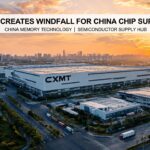
CXMT, China’s most advanced DRAM producer, has ramped production of DDR5 modules on its 17nm process node. Although the company does not yet produce HBM, surging conventional DRAM prices have improved its margins significantly. Industry sources indicate CXMT’s monthly wafer output has reached 120,000 wafers, up from approximately 85,000 at the start of 2025. The company is reportedly developing an HBM-compatible DRAM die, with initial engineering samples expected in late 2026. For more on China’s semiconductor ecosystem, see our analysis of the China semiconductor ecosystem.
YMTC (Yangtze Memory Technologies)
YMTC, focused on NAND flash, has benefited from the broader memory price upcycle. Enterprise SSD demand tied to AI training and inference data pipelines has lifted NAND prices and improved YMTC’s utilization rates. The company’s 232-layer Xtacking 3.0 technology is now in volume production, and YMTC is expanding its product lineup to include high-capacity enterprise SSDs targeting China’s domestic cloud providers. While U.S. export controls continue to limit YMTC’s access to certain advanced equipment, the company has made progress with domestic equipment alternatives.
Why AI Servers Demand Eight Times More Memory
The memory intensity of AI workloads is not merely incremental — it represents a fundamental shift in hardware architecture. Large language models and multimodal AI systems require enormous parameter stores that must reside in high-bandwidth memory to achieve acceptable inference latency. A single NVIDIA H200 GPU pairs with 141 GB of HBM3E; a full DGX server carries eight such GPUs, consuming over 1.1 TB of HBM alone before accounting for system DRAM.
Beyond HBM, AI servers also require substantially more standard DRAM for data preprocessing, caching, and orchestration workloads. When all memory tiers are aggregated, the 8× multiplier relative to traditional servers is a conservative estimate. This multiplier, combined with the sheer volume of AI server deployments globally, is what makes the current shortage qualitatively different from previous DRAM cycles.
Supply Chain Risks and Geopolitical Fault Lines
The shortage exposes vulnerabilities beyond simple capacity constraints. Advanced HBM production depends on a tightly interlocked supply chain spanning wafer fabrication, TSV (through-silicon via) technology, advanced packaging, and substrate manufacturing. Key bottlenecks include TSV-capable packaging capacity at companies like ASE Technology and Amkor, and ABF substrate supply from Japanese firms including Ajinomoto and Ibiden.
Geopolitical dynamics add further complexity. U.S. export controls on advanced semiconductor equipment to China continue to shape the competitive landscape, constraining Chinese firms’ ability to produce the most advanced DRAM and HBM technologies. However, the controls have also accelerated China’s push toward self-sufficiency in memory production, with significant government subsidies flowing to both CXMT and YMTC through the Big Fund III and provincial semiconductor programs.
Outlook: When Does the Supply-Demand Gap Close?
Consensus among industry analysts is that the HBM supply-demand imbalance will persist through at least mid-2027, as new fabrication capacity from Samsung, SK Hynix, and Micron takes 18–24 months to reach full qualification. In the interim, memory prices are expected to remain elevated, with HBM3E pricing potentially stabilizing only after the second generation of 2.5D packaging capacity comes online.
For China’s domestic memory producers, the current environment offers both opportunity and urgency. The opportunity lies in capturing incremental demand for conventional DRAM and NAND as global pricing makes domestic alternatives more competitive. The urgency stems from the need to close the technology gap in HBM production — a gap that, if not addressed within the next 12–18 months, could leave Chinese AI hardware firms increasingly dependent on foreign suppliers in a market where supply is already critically constrained.
CII Analysis
The current memory chip frenzy underscores a structural transformation in semiconductor demand driven by AI. Unlike previous DRAM upcycles, which were largely cyclical and inventory-driven, today’s shortage is rooted in a genuine architectural shift: AI servers consume an order of magnitude more memory than their predecessors, and this demand is durable. For China, the implications are significant. CXMT and YMTC are well-positioned to benefit from elevated pricing and domestic substitution tailwinds, but neither company can yet produce HBM — the most supply-constrained segment. Closing this gap will require advances in TSV technology, advanced packaging, and high-yield fabrication at the 1-alpha node and beyond. Meanwhile, U.S. export controls continue to limit Chinese firms’ access to cutting-edge EUV lithography and certain deposition equipment, creating a technological ceiling that government subsidies alone cannot easily overcome. The next 18 months will be decisive in determining whether China’s memory industry can transition from a beneficiary of the current upcycle to a genuine competitor at the leading edge.
Related: China Semiconductor Ecosystem Overview | Category: Semiconductor