







































China Renewable Energy Capacity Exceeds 1500 GW Milestone
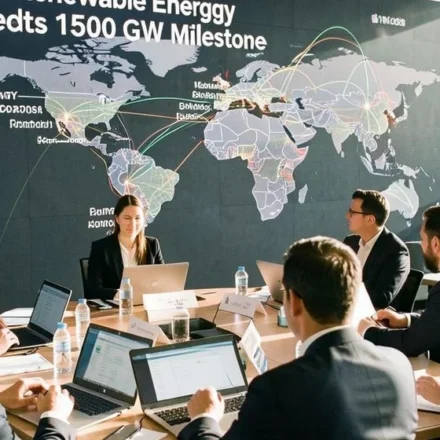
China Renewable Energy Capacity Exceeds 1,500 GW Milestone
🔋 1,500+ GW Total Renewables
☀️ 300 GW Solar Installed in 2025
💨 500+ GW Wind Capacity
💰 $500B+ Clean Energy Investment
A Historic Threshold for the World’s Largest Clean Energy Market
China has officially crossed the 1,500 gigawatt (GW) threshold in installed renewable energy capacity, cementing its position as the global leader in clean power deployment. The milestone, confirmed by the National Energy Administration (NEA) in early 2026, represents a near-doubling of capacity from just three years ago and underscores Beijing’s accelerating push to decarbonize its electricity grid while meeting surging industrial demand.
The achievement is anchored by extraordinary solar expansion. In 2025 alone, China deployed approximately 300 GW of new photovoltaic (PV) capacity — a figure that exceeds the entire installed solar base of any other single country. Cumulative solar capacity now stands at roughly 800 GW, distributed across utility-scale desert mega-projects in the Gobi and Taklamakan regions, distributed rooftop arrays in eastern manufacturing hubs, and agrivoltaic installations across central agricultural provinces.
Wind power has grown in parallel, with total installed capacity surpassing 500 GW. Offshore wind has emerged as a particularly dynamic segment, with eastern coastal provinces — Jiangsu, Shandong, Guangdong, and Fujian — commissioning large-scale projects in the 10–16 MW turbine class. China now operates more offshore wind capacity than any other nation and is rapidly closing the technology gap with European turbine manufacturers.
Capacity by Technology: 2025 End-of-Year Snapshot
| Technology | Installed Capacity (GW) | Share of Total | YoY Growth |
|---|---|---|---|
| Solar PV | ~800 | ~53% | +38% |
| Onshore Wind | ~420 | ~28% | +14% |
| Offshore Wind | ~80 | ~5% | +35% |
| Hydropower (incl. pumped storage) | ~130 | ~9% | +3% |
| Biomass & Waste-to-Energy | ~45 | ~3% | +8% |
| Other (CSP, Geothermal, Tidal) | ~15 | ~1% | +12% |
| Total Renewables | ~1,500+ | 100% | +24% |
Sources: NEA quarterly bulletins, BloombergNEF, China Electricity Council estimates. Figures rounded.
Investment Flows Reach Unprecedented Scale
Capital deployment into China’s clean energy sector exceeded $500 billion in 2025, according to estimates from BloombergNEF and the China Renewable Energy Engineering Institute. This figure encompasses manufacturing capacity expansion, grid infrastructure upgrades, project development, and R&D spending across solar, wind, battery storage, and green hydrogen.
Provincial governments have competed aggressively to attract investment. Inner Mongolia, Xinjiang, Qinghai, and Gansu have become solar manufacturing powerhouses, while Guangdong, Jiangsu, and Zhejiang dominate wind turbine component production. The industrial policy ecosystem — anchored by central government subsidies, tax incentives, and green bond facilitation — has created a self-reinforcing cycle of scale, cost reduction, and technology improvement.
Export Surge: China’s Clean Energy Industrial Base Goes Global
China’s dominance extends well beyond domestic deployment. In 2025, Chinese manufacturers exported solar panels, wind turbine components, lithium-ion batteries, and inverters valued at over $120 billion. Key trends include:
- Solar modules: Chinese producers now supply over 80% of global PV module shipments, with major manufacturers expanding production bases in Southeast Asia and the Middle East to navigate tariff regimes.
- Wind turbines: Goldwind, Envision, Mingyang, and Windey have begun exporting large-scale turbines to markets in Latin America, the Middle East, and Southeast Asia, challenging the duopoly of Vestas and Siemens Gamesa.
- Battery storage: CATL, BYD, and EVE Energy dominate global energy storage system supply, enabling co-deployment with renewable projects worldwide.
- Inverters & BOS: Huawei, Sungrow, and Ginlong hold dominant positions in global inverter markets across residential, commercial, and utility-scale segments.
Grid Integration: The Next Frontier
With 1,500 GW of renewable capacity online, grid integration has become the central challenge. China’s ultra-high-voltage (UHV) transmission network — the world’s largest — now includes over 40 operational lines linking western generation hubs to eastern demand centers. The State Grid Corporation has accelerated deployment of grid-forming energy storage, with over 100 GW of battery storage either operational or under construction nationwide.
Curtailment rates, which had risen in some provinces during 2024, have stabilized thanks to improved dispatch algorithms, expanded inter-provincial power trading, and mandated minimum consumption quotas for renewable electricity. The NEA has set a target of keeping national curtailment below 3% by 2027.
Policy Trajectory: Toward 2030 and Beyond
China’s 14th Five-Year Plan for energy set an initial target of 1,200 GW of solar and wind by 2030 — a target that was met and surpassed more than four years early. The updated trajectory, endorsed at the 2025 National People’s Congress, now targets 3,600 GW of total renewable capacity by 2030, with non-fossil fuel sources comprising over 40% of primary energy consumption.
“The pace of China’s renewable buildout has consistently exceeded even the most optimistic forecasts. What we’re witnessing is not a policy aspiration — it’s an industrial reality operating at a scale and speed without historical precedent.” — Senior Analyst, International Energy Agency
Implications for Global Energy Markets
China’s 1,500 GW milestone carries profound implications for global energy geopolitics. The sheer scale of Chinese manufacturing has driven solar module prices below $0.10/watt and wind turbine costs to record lows, making unsubsidized renewable energy the cheapest source of new electricity generation in virtually every market worldwide. However, this cost dominance has also intensified trade tensions, with the EU, United States, India, and Brazil implementing tariffs, local-content requirements, and anti-dumping measures against Chinese clean energy exports.
For developing economies, China’s industrial output represents both an opportunity and a dependency risk. Affordable Chinese equipment has enabled rapid renewable deployment in Africa, Southeast Asia, and Latin America, but supply chain concentration raises concerns about resilience and technology sovereignty.
CII Analysis
China’s crossing of the 1,500 GW renewable capacity threshold marks a structural inflection point for global energy markets. The deployment velocity — roughly 500 GW added in a single year — is qualitatively different from any prior energy transition in history, and it is driven by an industrial policy apparatus that treats clean energy manufacturing as a strategic national asset on par with semiconductors and defense.
For international stakeholders, three dynamics demand close attention. First, the cost curve advantage is now durable: Chinese solar and wind manufacturing operates at a scale where marginal cost reductions will continue to outpace competitors, creating persistent pricing pressure on non-Chinese producers. Second, grid integration at this scale is generating a secondary investment cycle in storage, UHV transmission, and digital grid management — each a growing export category in its own right. Third, the geopolitical response is hardening: tariff regimes in the US and EU are fragmenting what was once a globally integrated clean energy supply chain, incentivizing Chinese manufacturers to establish production footprints in third-country jurisdictions. Companies and governments should model scenarios where Chinese clean energy equipment supply is either freely available or restricted by trade policy, and plan procurement and industrial strategy accordingly.
© 2026 China Industry Intelligence. All rights reserved. This analysis is provided for informational purposes.