










































Microsoft Sells OpenAI Models to China Through Azure Loophole
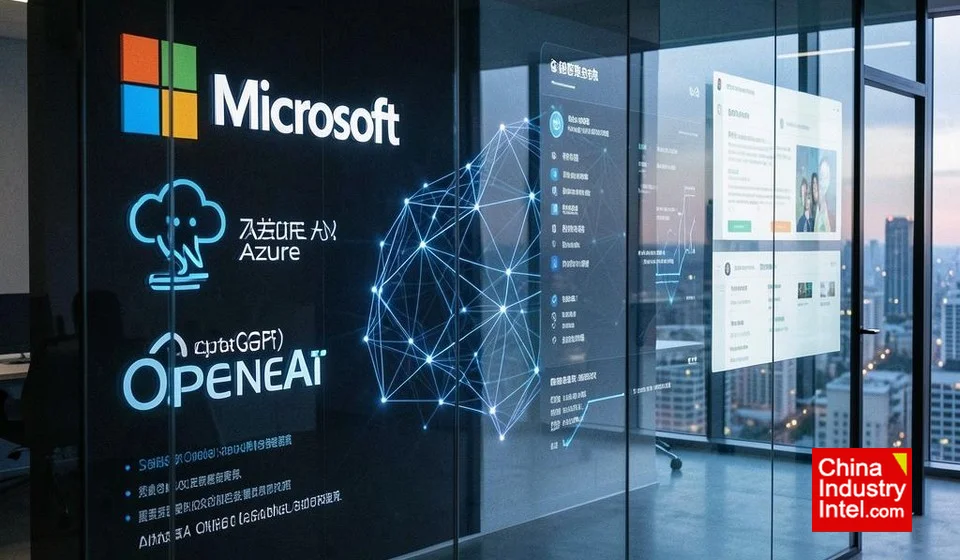
Microsoft has quietly become one of the most successful foreign technology distributors in China, selling access to OpenAI’s models to Chinese enterprises through its Azure cloud platform. The move, reported by Bloomberg on June 17, 2026, gives Microsoft a foothold in a market where most Western AI companies have been shut out by US export controls and Chinese regulatory barriers.
The arrangement works because Microsoft owns a significant stake in OpenAI and controls the distribution rights for the startup’s models through Azure. Chinese companies that want access to GPT-4-class reasoning capabilities can subscribe through Microsoft China’s Azure operations, which comply with local data residency rules. The models run on servers outside China, but the service is sold and supported locally.
How Microsoft pulled off what no other US AI company could
The deal exploits a regulatory gap. US export controls, tightened in October 2023 and again in January 2025, restrict the sale of advanced AI chips to China. They do not restrict the sale of AI model access through cloud services. Microsoft, which operates Azure regions in Hong Kong and has longstanding partnerships with Chinese enterprises, found the lane.
According to Bloomberg’s reporting, Microsoft began offering OpenAI model access through Azure China in late 2025, initially to a small group of enterprise clients in finance and manufacturing. By the second quarter of 2026, the service had expanded to include companies in e-commerce, healthcare, and logistics. Microsoft does not disclose revenue from this specific offering, but analysts estimate the China Azure AI segment could generate $500 million to $800 million annually by 2027.

“This is the most significant foreign AI penetration of the Chinese market since Google pulled its search engine out in 2010,” said Paul Triolo, a partner at Albright Stonebridge Group who advises companies on China technology policy, in a June 18 interview with Bloomberg. “Microsoft has found a way to thread the needle between US export controls and Chinese market access.”
The competitive landscape reshaped overnight
The implications for China’s domestic AI industry are immediate. Companies like Baidu, Alibaba, Tencent, and ByteDance have spent billions developing their own large language models — Ernie Bot, Tongyi Qianwen, Hunyuan, and Doubao, respectively. Those models have improved rapidly, with Stanford HAI’s 2026 AI Index Report noting that the US-China AI performance gap has “effectively closed” in many benchmarks.
But “effectively closed” is not the same as “identical.” For tasks requiring complex reasoning, multi-step planning, and nuanced code generation, GPT-4-class models from OpenAI still hold an edge in independent evaluations. Chinese enterprises that need that edge now have a legal path to get it — without violating export controls or waiting for domestic models to catch up.
The competitive response has been swift. Baidu announced on June 12 that it would cut Ernie Bot API prices by 40 percent for enterprise customers. ByteDance’s Seedance 2.0 model, which the company had been offering as a free incentive during the Lunar New Year promotion period in February, is now available at heavily subsidized rates for commercial use.
| Company | Model | China Market Strategy | Estimated Enterprise Price (per 1M tokens) |
|---|---|---|---|
| Microsoft/OpenAI | GPT-4o via Azure | Cloud distribution through Azure China | $15-30 |
| Baidu | Ernie Bot 4.5 | Direct API + price cuts | $8-15 |
| Alibaba | Tongyi Qianwen 3 | Alibaba Cloud integration | $10-18 |
| ByteDance | Seedance 2.0 | Subsidized enterprise rates | $6-12 |
| Tencent | Hunyuan Turbo | WeChat ecosystem bundling | $8-14 |
Why Beijing is unlikely to block it — for now
The Chinese government’s response has been notably muted. The Ministry of Industry and Information Technology (MIIT) has not issued any public statements about the Microsoft-OpenAI arrangement. Industry analysts interpret the silence as tacit approval, at least for now.
“Beijing wants Chinese companies to have access to the best AI tools,” said Kendra Schaefer, a partner at Trivium China who focuses on technology policy, speaking at the Lujiazui Forum in Shanghai on June 17. “If those tools come from a foreign source but comply with Chinese data laws, the government is pragmatic about it. The priority is industrial competitiveness, not technology nationalism.”
There are limits. Microsoft cannot offer the same service to Chinese military or government entities. The models must run on infrastructure outside mainland China to comply with US export controls. And any data processed through the service must stay within China’s borders under the Personal Information Protection Law (PIPL), which took effect in November 2021.

Supply chain effects: the AI infrastructure race accelerates
The Microsoft arrangement is accelerating demand for AI infrastructure in China — not for training (which happens outside China), but for inference and fine-tuning. Chinese cloud providers are investing heavily in inference-optimized hardware, including chips from Huawei’s Ascend series and domestically designed accelerators from startups like Cambricon and Enflame.
The bottleneck is not compute but data. Chinese enterprises using OpenAI models through Azure must send their data to servers outside China for processing, which creates latency and compliance concerns. Several companies are exploring hybrid architectures: using GPT-4 for complex reasoning tasks while running domestic models for data-sensitive operations.
Upstream, the demand for high-bandwidth networking equipment (to connect Chinese enterprises to offshore Azure regions) is surging. Fiber optic suppliers and networking companies are seeing orders rise 15-20 percent year-over-year, according to supply chain data from MIIT published on June 10.
Market signal: bull, bear, and base cases
Bull case: Microsoft’s success opens the door for other Western AI companies to sell model access in China through compliant cloud arrangements. The Chinese enterprise AI market, estimated at $12 billion in 2026, could double by 2028 as foreign competition drives down prices and improves quality.
Bear case: Beijing eventually closes the regulatory gap, either by restricting foreign AI model access or by requiring that all AI services used by Chinese entities run on domestic infrastructure. This would cut off the Microsoft pipeline and force Chinese enterprises back to domestic models.
Base case: The arrangement continues in a gray zone — tolerated but not officially endorsed. Microsoft maintains its position as the primary foreign AI distributor in China, while domestic companies compete aggressively on price. The market grows, but margins compress.
What to watch: Any MIIT or Cyberspace Administration of China (CAC) guidance on foreign AI model access. Q3 2026 earnings from Microsoft Azure (which will show China segment growth for the first time). Whether Baidu and Alibaba’s price cuts are sufficient to retain enterprise customers.
CII Analysis
Microsoft’s move into China’s AI market through Azure is the most significant foreign technology distribution play since Apple established its App Store operations in the country. The company has found a narrow but viable path between US export restrictions and Chinese market access, and it is exploiting that path aggressively. For Chinese enterprises, the calculus is straightforward: if GPT-4-class models deliver 10-15 percent better performance on complex reasoning tasks, and the price difference between foreign and domestic models is less than 30 percent, the Microsoft option wins. The domestic AI companies have 6-12 months to close the remaining performance gap before this becomes a structural threat to their enterprise market share. Investors should watch Baidu’s and Alibaba’s API pricing moves closely — the next round of cuts will signal whether the domestic market can compete on quality or is retreating to price-only differentiation.